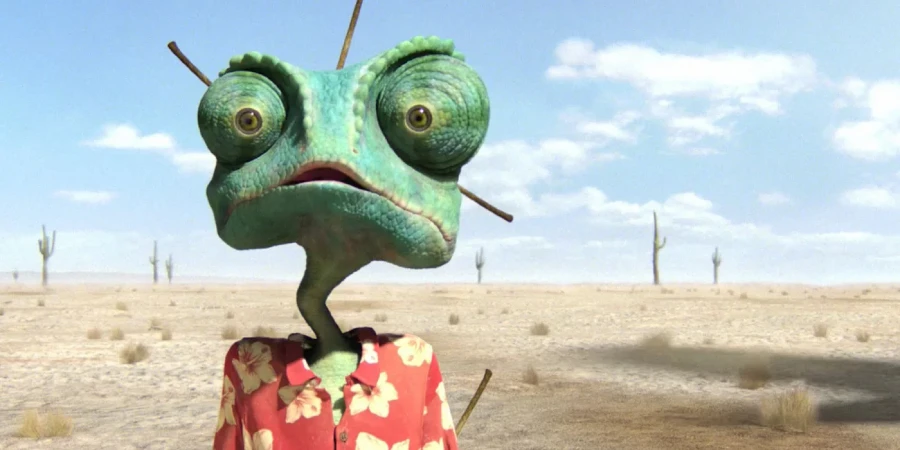

Rango is no ordinary cartoon. It stands as a dusty, sun-bleached monument to weirdness in an era of sanitized family animation. This film embraces its grimy aesthetic and complex themes about identity. Ultimately, it delivers a story that is both a hilarious send-up of the Western genre and a surprisingly profound character study.
Detailed Summary
A Lizard with No Name
We first meet a pet chameleon (Johnny Depp) living a theatrical life in a terrarium. He is an actor without an audience and, more importantly, without a name or identity. A sudden car accident ejects his entire world onto a highway in the middle of the Mojave Desert.
Stranded and alone, he receives cryptic advice from a wise armadillo named Roadkill (Alfred Molina) who seeks the mystical “Spirit of the West.” The armadillo points the chameleon toward the town of Dirt, a place desperately in need of water.
The Town of Dirt
The chameleon stumbles into Dirt, a frontier town populated by parched desert creatures. He enters the local saloon and, through sheer panicked improvisation, crafts a tough-guy persona named “Rango.” He boasts of killing seven notorious outlaws with a single bullet.
His tall tales are quickly put to the test. A vicious hawk attacks the town, and Rango, through a series of lucky accidents, manages to kill the predator. As a result, the townspeople hail him as their savior.
A Hero’s Lie
The town’s elderly tortoise Mayor (Ned Beatty) appoints Rango as the new sheriff. Rango embraces his new role, enjoying the adoration that comes with it. He meets Beans (Isla Fisher), a rancher’s daughter who is fiercely trying to save her father’s land.
His first official duty involves protecting the town’s last water reserve, stored in a large bottle in the bank. However, during the night, thieves steal the entire bottle, leaving Dirt on the brink of collapse. Rango forms a posse to track the water thieves into the desert.
The Water Heist
The posse discovers the town banker, shot and drowned in the desert. They track the water thieves to their canyon hideout and, after a chaotic chase sequence, retrieve the empty water bottle. The thieves, a family of mole-rats and prairie dogs led by Balthazar (Harry Dean Stanton), claim they were simply trying to survive.
Rango notices something amiss. The bottle was empty when they found it, which means someone else has the water. Back in Dirt, he deduces that the Mayor has been buying up all the land and is secretly diverting the town’s water supply through a pipeline for a sinister purpose.
Confronting the Truth
Rango confronts the Mayor, who reveals his master plan: to build a modern city, much like Las Vegas, on the land he has acquired. He summons the legendary outlaw Rattlesnake Jake (Bill Nighy) to deal with the troublesome sheriff.
Jake, a massive rattlesnake with a Gatling gun for a tail, easily humiliates Rango. He exposes Rango as a fraud to the entire town. Shamed and broken, Rango abandons Dirt and walks back out into the desert, leaving his sheriff’s badge behind.

Movie Ending
After being exposed as a fraud, Rango crosses a highway and confronts the “Spirit of the West,” who appears as a stoic, Clint Eastwood-like figure. The Spirit tells Rango that no one can walk out on their own story. This encounter gives Rango the courage to return to Dirt and finish what he started.
Meanwhile, the Mayor has trapped Beans and is preparing to open his new city. Rango challenges Rattlesnake Jake to a duel to buy time. As they face off, the water pipeline bursts, flooding the street. Rango seizes the opportunity and grabs the Mayor’s gun, which holds a single bullet. He aims for a large glass window behind Jake, who mistakes the move as a sign of respect.
The Mayor takes Beans and forces Rango into his sealed, bulletproof bank vault. He plans to leave them there to drown while he deals with Rattlesnake Jake. Inside the vault, Rango realizes he still has the bullet. He gives a final performance, acting as if he’s surrendering the bullet before using it to shatter the vault’s glass floor. Consequently, water from the broken pipeline rushes in, freeing them and flooding the Mayor’s grand opening. Jake, realizing the Mayor’s treachery, drags him into the desert for his own brand of justice. With its water restored, Dirt finally thrives, and Rango becomes its true, legitimate hero.
Are There Post-Credits Scenes?
No, there are no post-credit scenes in Rango. The film concludes after the final scene showing the revitalized town of Dirt.
Type of Movie
Rango is a CG-animated Western comedy-adventure. Beyond its surface genre, however, it functions as a clever satire of Western tropes and a thoughtful exploration of existentialism and identity.
Its tone is noticeably more mature and grittier than typical animated fare. Specifically, the film directly parodies classic Spaghetti Westerns and incorporates thematic elements from film noir, most notably borrowing the water-rights conspiracy plot from Chinatown (1974).
Cast
- Johnny Depp – Rango
- Isla Fisher – Beans
- Abigail Breslin – Priscilla
- Ned Beatty – Tortoise John, the Mayor
- Alfred Molina – Roadkill
- Bill Nighy – Rattlesnake Jake
- Harry Dean Stanton – Balthazar
- Timothy Olyphant – The Spirit of the West
- Ray Winstone – Bad Bill
Film Music and Composer
The film’s dynamic score was composed by the legendary Hans Zimmer. Zimmer crafted a soundscape that is a loving homage to classic Western soundtracks, particularly the work of Ennio Morricone. He used twangy guitars, mariachi horns, and orchestral swells to create a uniquely gritty atmosphere.
Notably, the band Los Lobos contributed to the soundtrack, performing as a quartet of musical owls who narrate the story through song. Their main track, “Rango Theme Song,” provides a recurring, humorous commentary on Rango’s journey.
Filming Locations
As an animated film, Rango was not shot in a physical location. However, the production team, led by director Gore Verbinski, took extensive research trips to the Mojave Desert. They studied the lighting, textures, and unique flora and fauna of the American Southwest.
This research was crucial for the animation team at Industrial Light & Magic (ILM). It allowed them to create a hyper-realistic and tactile desert environment, which is a core component of the film’s distinct visual identity.
Awards and Nominations
Rango was a major critical success upon its release. The film’s most significant achievement was winning the Academy Award for Best Animated Feature at the 84th Academy Awards.
In addition, it received numerous other accolades, including the BAFTA Award for Best Animated Film and multiple Annie Awards, which celebrate excellence in animation.
Behind the Scenes Insights
- Director Gore Verbinski pioneered a technique he called “emotion-capture.” Instead of recording voices in isolated booths, the actors performed the entire film together on a minimalist stage with props and costumes. This process was filmed, giving the animators rich visual references for the characters’ physical performances.
- This was the first full-length animated feature film produced by visual effects powerhouse Industrial Light & Magic (ILM), a company more famous for its work on live-action blockbusters like Star Wars and Jurassic Park.
- Verbinski intentionally sought a “dirty” and imperfect visual style. He wanted the characters to look unconventional and the world to feel sun-scorched and dusty, pushing back against the sleek, clean look of many other contemporary CG animated films.
Inspirations and References
Rango is packed with cinematic and literary influences. Its central plot, involving a corrupt official manipulating water rights in a desert, is a direct homage to the classic film noir Chinatown.
The film’s visual language and character archetypes are heavily inspired by the Spaghetti Westerns of Sergio Leone, with Rango’s journey mirroring that of Clint Eastwood’s “Man with No Name.” Furthermore, Johnny Depp’s performance pays tribute to his previous portrayal of Hunter S. Thompson’s alter ego in Fear and Loathing in Las Vegas.
Alternate Endings and Deleted Scenes
The home media release of Rango includes a few deleted scenes. The most significant of these is an extended ending that shows more of the town’s celebration after water is restored. In this version, the townsfolk have created a large “Welcome to Dirt” sign and are shown enjoying their renewed oasis.
Another scene shows Rango attempting to give a eulogy for the deceased banker, only to be constantly interrupted by the townsfolk. These cuts were likely made to tighten the film’s pacing for the theatrical release.
Book Adaptations and Differences
Rango is not based on a book. It is an original story conceived by director Gore Verbinski, who then developed the screenplay with writer John Logan. Its narrative is a wholly unique creation for the screen.

Memorable Scenes and Quotes
Key Scenes
- The Saloon Entrance: Rango’s improvised, bumbling creation of his tough-guy persona in front of Dirt’s skeptical residents is a masterclass in comedic tension and character introduction.
- The Hawk Attack: A thrilling and chaotic action sequence that accidentally establishes Rango’s heroic reputation. Its dynamic camerawork and sound design make it a standout moment.
- Meeting the Spirit of the West: Rango’s existential conversation with a divine Clint Eastwood figure provides the film’s thematic core, pushing him to accept his role in his own story.
- The Final Standoff: The duel between Rango and Rattlesnake Jake, which turns into a massive flood, brings all the film’s conflicts to a spectacular and satisfying conclusion.
Iconic Quotes
- “Who am I? I could be anyone.” – Rango
- “No man can walk out on his own story.” – The Spirit of the West
- “It only takes one bullet.” – Rango
- “From where I come from, we call this a ‘profoundly disturbing paradox’.” – Rango
- “Hello, brother. Thirsty?” – Rattlesnake Jake
Easter Eggs and Hidden Details
- During the opening highway sequence, Rango splatters against the windshield of a red convertible. Inside are caricatures of Raoul Duke and Dr. Gonzo, the protagonists of Fear and Loathing in Las Vegas, a film also starring Johnny Depp.
- The “Spirit of the West” drives a golf cart holding five golden statuettes that are clear replicas of the Academy Award (Oscar). Actor Clint Eastwood, the basis for the character, has won four Oscars.
- When Beans freezes, Rango passes by a rock with a drawing on it that resembles the alien from the 1982 film E.T. the Extra-Terrestrial.
- The owl mariachi band is briefly seen playing a rendition of Richard Wagner’s “Ride of the Valkyries” during the bat-riding chase, a clear reference to the iconic helicopter scene in Apocalypse Now.
Trivia
- Rango is a chameleon, a creature famous for its ability to blend in. Ironically, Rango’s central conflict is his inability to blend in and his desperate quest to stand out.
- The character of Rattlesnake Jake was designed without legs to force the animators to create a more authentic, serpentine performance.
- Actor Timothy Olyphant, who voices The Spirit of the West, is famous for playing gunslingers in Westerns like the TV shows Deadwood and Justified, making his casting particularly fitting.
Why Watch?
Watch for a visually stunning animated film that dares to be different. Rango offers a witty, surprisingly profound story about finding your identity, all wrapped in a brilliant homage to the Western genre. It is a rare film that truly entertains both kids and adults.
Director’s Other Movies
- Mouse Hunt (1997)
- The Mexican (2001)
- The Ring (2002)
- Pirates of the Caribbean: The Curse of the Black Pearl (2003)
- Pirates of the Caribbean: Dead Man’s Chest (2006)
- Pirates of the Caribbean: At World’s End (2007)
- A Cure for Wellness (2016)