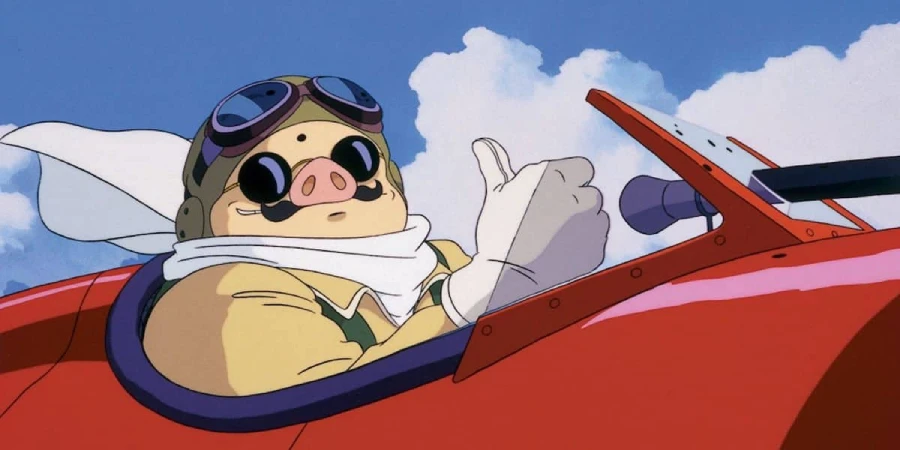

Hayao Miyazaki’s Porco Rosso is one of Studio Ghibli’s most unusual and quietly profound films. On the surface, it’s a charming aerial adventure about a pig who flies a seaplane and hunts sky pirates over the Adriatic. Underneath, it’s a meditation on war trauma, lost identity, romance, pride, and the fading of an era.
Set between the two World Wars in the Mediterranean, this film blends aviation obsession, European nostalgia, and Miyazaki’s pacifist worldview into something deeply personal.
Detailed Summary
The Adriatic Sky and the “Crimson Pig”
We meet Porco Rosso, a bounty-hunting pilot who looks like an anthropomorphic pig. He lives alone on a small island, flies a red seaplane, and makes a living chasing air pirates who harass cruise ships and tourists.
His real name is Marco Pagot, once a celebrated Italian ace pilot in World War I. Now he refuses to return to Italy, which has fallen under fascism, and lives as a self-exiled cynic. He claims, “I’d rather be a pig than a fascist.” That line defines his entire existence.
The Air Pirates and the American Rival
A group of air pirates, humiliated repeatedly by Porco, hire an American hotshot pilot named Donald Curtis to defeat him. Curtis shoots Porco’s plane down in an ambush, damaging it severely.
Porco travels to Milan to have his plane repaired by his old friend Piccolo. There he meets Fio, Piccolo’s teenage granddaughter, an engineering prodigy who insists on redesigning the aircraft herself. Their partnership becomes one of the emotional cores of the film.
Fio, Youth, and the Fading Generation
Fio represents a new world: hopeful, talented, energetic. Porco represents a generation scarred by war, drifting without purpose. Through her, we see Porco slowly softening. She admires him without judgment, and he, despite himself, becomes protective and affectionate.
Gina and the Past That Won’t Leave
Porco frequently visits a seaside hotel run by Gina, a glamorous singer and widow who has lost three pilot husbands to war. It’s clear she and Marco share a deep past connection. Gina waits for him to come back to her, but Porco, weighed down by guilt and self-loathing, refuses to let himself be loved.
The Dream Sequence: Why Porco is a Pig
In one of the most haunting scenes Miyazaki ever created, Porco tells Fio about a vision he had during the war. He saw the spirits of dead pilots rising into the sky in an endless procession of planes forming a white river in the clouds.
Marco watched his comrades ascend while he alone fell back to earth. He survived. They didn’t. That survivor’s guilt is the emotional reason behind his transformation. He didn’t “turn into” a pig physically by magic. He sees himself as one. It’s a curse of shame, grief, and moral disillusionment.
The Final Duel with Curtis
Curtis challenges Porco to a final duel for pride, for Gina, and for honor. Instead of an aerial battle, it turns into a brutal, absurd fistfight in the mud after both planes are wrecked. The air pirates, Fio, and others watch like it’s a sporting event.
This fight is symbolic. Two relics of a fading era, punching each other over outdated ideals of masculinity and glory.


Movie Ending
After the ridiculous fistfight, Curtis is defeated. Porco collapses, exhausted. The air pirates, who once feared him, now treat him with respect and affection. Fio cheers for him. The mood becomes strangely warm and communal.
Then the Italian air force arrives. Fascist authorities are coming to arrest Porco.
He quietly escapes.
We do not see how.
The film then jumps forward in time through Fio’s narration. She explains what happened afterward:
- Curtis becomes a Hollywood actor.
- Fio grows up and continues her aviation career.
- The Piccolo company prospers.
- The hotel still operates.
- Gina’s garden is now full of planes from visiting pilots.
Then Fio says something crucial:
“Gina finally stopped waiting.”
This line is loaded with meaning. In Gina’s private garden, we see a familiar red seaplane parked there.
Porco came back to her.
Whether he is still a pig or human is never shown. Miyazaki deliberately avoids answering it. The point is not the spell. The point is that Marco finally allowed himself to live again.
Are There Post-Credits Scenes?
No. There are no post-credits scenes. The story fully concludes within the film and Fio’s final narration.
Type of Movie
Porco Rosso is a historical fantasy adventure drama blended with romance and anti-war themes, wrapped in an aviation story with gentle humor and melancholy undertones.
Cast (Japanese Voices)
- Shūichirō Moriyama — Porco Rosso / Marco Pagot
- Tokiko Kato — Gina
- Akemi Okamura — Fio Piccolo
- Akio Ōtsuka — Donald Curtis
Film Music and Composer
The beautiful score was composed by Joe Hisaishi, Miyazaki’s longtime collaborator. The music mixes European elegance, nostalgia, and light adventure tones that perfectly match the Adriatic setting.


Filming Locations and Setting Importance
While animated, the film’s world is heavily inspired by real locations around the Adriatic Sea, especially:
- Croatia’s coastline
- Italian seaside towns
- Mediterranean architecture and geography
Miyazaki based much of the design on his own travels in the region. The setting is crucial because it represents a Europe between wars, a peaceful surface hiding political tension and historical trauma.
Awards and Nominations
- Winner — Mainichi Film Award for Best Animation Film
- Winner — Animage Anime Grand Prix
- Nominated — Japanese Academy Awards
Behind the Scenes Insights
- Miyazaki is a lifelong aviation enthusiast; this film is one of his most personal aviation tributes.
- Originally planned as a short in-flight movie for Japan Airlines.
- The fascist Italy themes were strengthened as Yugoslav wars were happening during production.
- Miyazaki considers this one of his most “adult” films emotionally.
Inspirations and References
- Miyazaki’s own manga Hikōtei Jidai (The Age of the Flying Boat)
- Real WWI aviation history
- European interwar politics
- Classic Hollywood adventure films
Alternate Endings and Deleted Scenes
No major alternate ending exists, but early drafts had a more explicit explanation of Porco’s transformation. Miyazaki intentionally removed it to keep the metaphor intact.
Book Adaptations and Differences
The film is loosely based on Miyazaki’s manga. The manga is lighter and more comedic, while the film deepens the emotional and political themes significantly.

Memorable Scenes and Quotes
Key Scenes
- The dreamlike river of dead pilots in the sky
- Fio defending Porco’s honor in front of the pirates
- The absurd mud fistfight
- Gina singing at sunset while waiting for Marco
Iconic Quotes
- “I’d rather be a pig than a fascist.”
- “A pig that doesn’t fly is just an ordinary pig.”
- “You’re not a pig. You’re just a man who doesn’t want to be one.”
Easter Eggs and Hidden Details
- Marco Pagot’s name references Italian animators Nino and Toni Pagot.
- Curtis is a parody of early Hollywood action stars.
- The red plane design is inspired by real Italian seaplanes from WWI.
- Gina’s three husbands symbolize Europe’s repeated loss to war.
Trivia
- Miyazaki said Porco is his favorite male protagonist.
- The film contains no traditional villain; even the pirates are lovable.
- The pig design was chosen because Miyazaki felt ashamed drawing a “cool hero.”
Why Watch?
Because Porco Rosso is not really about a pig. It’s about how war breaks people, how pride prevents healing, and how love patiently waits for someone to forgive themselves.
Director’s Other Works (Hayao Miyazaki)
- Nausicaä of the Valley of the Wind (1984)
- Castle in the Sky (1986)
- My Neighbor Totoro (1988)
- Princess Mononoke (1997)
- Spirited Away (2001)
- Howl’s Moving Castle (2004)
- The Wind Rises (2013)
- The Boy and the Heron (2023)