
David Fincher’s Panic Room is a tightly constructed psychological thriller that turns a single house into a pressure cooker of fear, paranoia, and survival. Released in 2002, the film is often remembered for its technical brilliance, claustrophobic tension, and a powerhouse performance by Jodie Foster.
Detailed Summary
A New House, A New Beginning
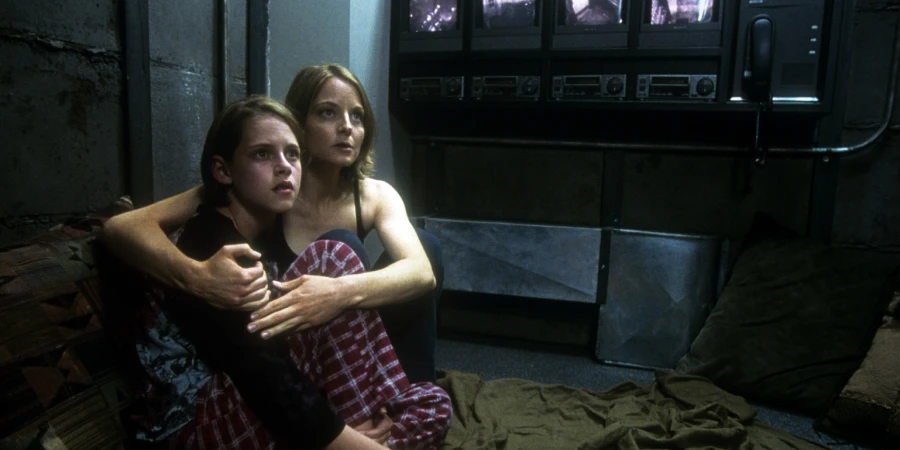
Recently divorced Meg Altman moves into a large Manhattan brownstone with her daughter Sarah, who suffers from diabetes. The house’s most notable feature is a hidden, fortified panic room, built by the previous owner as a last-resort safe haven. At first, it feels like an unnecessary curiosity—until it becomes central to survival.
The Break-In
On Meg and Sarah’s first night, three burglars break into the house:
- Junior, the entitled grandson of the house’s former owner
- Burnham, a calm and intelligent locksmith
- Raoul, a violent and unpredictable enforcer
Their target is not jewelry or electronics, but something far more specific hidden inside the panic room itself.
Trapped on Both Sides of the Door
Meg and Sarah lock themselves inside the panic room just in time. This creates the film’s core tension: the protagonists are safe, but they are also trapped. The burglars cannot leave without what’s inside the room, and Meg cannot escape without endangering her daughter.
As the night progresses, power outages, gas manipulation, and psychological warfare escalate the situation. Sarah’s worsening medical condition raises the stakes even further.
Shifting Loyalties
As pressure mounts, cracks form among the burglars. Burnham begins questioning the violence, while Junior’s arrogance and Raoul’s brutality push events toward chaos. The film subtly explores moral ambiguity, especially through Burnham’s character, who is neither hero nor villain.

Movie Ending
The climax unfolds in a brutal and emotionally charged sequence. Raoul turns on the others, killing Junior in a sudden act of violence. Meg is forced to leave the panic room to retrieve Sarah’s insulin, resulting in a vicious physical confrontation between Meg and Raoul.
Burnham ultimately makes a decisive choice. After Raoul is mortally wounded during the struggle, Burnham saves Sarah’s life by giving her the insulin, fully aware that doing so will lead to his own arrest. He locks himself inside the panic room with the stolen bonds and waits for the police.
The film ends with Meg and Sarah months later, healed but changed, searching for a new apartment. They pass on another home that also has a panic room, signaling that they are no longer defined by fear. Safety, the film suggests, comes not from reinforced walls but from resilience.
Are There Post-Credits Scenes?
No. Panic Room does not include any post-credits or mid-credits scenes. The story concludes fully within the main runtime.
Type of Movie
Panic Room is a psychological thriller with strong elements of home-invasion horror, relying on tension, confined spaces, and escalating stakes rather than spectacle.
Cast
- Jodie Foster as Meg Altman
- Kristen Stewart as Sarah Altman
- Forest Whitaker as Burnham
- Jared Leto as Junior
- Dwight Yoakam as Raoul
Film Music and Composer
The score was composed by Howard Shore, whose music emphasizes unease and dread rather than melodic themes. The soundtrack subtly reinforces the feeling of constant surveillance and impending danger.


Filming Locations
Although set in Manhattan, the movie was largely filmed on soundstages in Los Angeles.
The house itself was entirely constructed as a massive, modular set, allowing Fincher’s camera to move through walls, floors, and keyholes. This technical choice reinforces the film’s themes of intrusion and vulnerability while giving it a uniquely fluid visual style.
Awards and Nominations
- Nominated for Best Actress (Jodie Foster) – Saturn Awards
- Nominated for Best Thriller Film – Empire Awards
- Widely praised for technical innovation, though it received limited major award recognition
Behind the Scenes Insights
- Nicole Kidman was originally cast as Meg but dropped out due to an injury; Jodie Foster replaced her mid-production.
- David Fincher used early digital compositing techniques to create impossible camera movements.
- Kristen Stewart was only 11 years old during filming, marking one of her earliest major roles.
- Over 90% of the film takes place inside a single location, a deliberate creative constraint.
Inspirations and References
- Influenced by classic home-invasion thrillers and Hitchcock-style suspense.
- The concept plays on late-1990s fears of urban crime and personal security.
- Fincher cited an interest in exploring how architecture affects human behavior.
Alternate Endings and Deleted Scenes
No alternate ending was officially released. Some deleted scenes focused on extended burglar backstories and additional moments between Meg and Sarah, but these were removed to maintain pacing and tension.
Book Adaptations and Differences
Panic Room is an original screenplay written by David Koepp and is not based on a novel or true story.



Memorable Scenes and Quotes
Key Scenes
- The first frantic rush into the panic room
- The gas being pumped into the sealed chamber
- Meg’s brutal fight with Raoul in the darkened house
Iconic Quotes
- “You’re supposed to be able to trust your home.”
- “This is not your house.”
Easter Eggs and Hidden Details
- Fincher’s signature coffee cup appears briefly.
- Surveillance camera shots subtly resemble security footage aesthetics.
- The house number is never clearly shown, reinforcing anonymity.
- Reflections and glass are frequently used to imply unseen threats.
Trivia
- The film was shot in chronological order, unusual for thrillers.
- Fincher insisted on realistic sound design, minimizing music during key tension scenes.
- The panic room door prop weighed over 3 tons.
- Forest Whitaker improvised several moments of Burnham’s hesitation.
Why Watch?
If you appreciate intelligent thrillers that rely on tension rather than explosions, Panic Room is a masterclass. It’s especially rewarding for viewers who enjoy psychological mind games, strong performances, and meticulous direction.
Director’s Other Works (Movies)
- Se7en (1995)
- The Game (1997)
- Fight Club (1999)
- Zodiac (2007)
- The Social Network (2010)
- Gone Girl (2014)