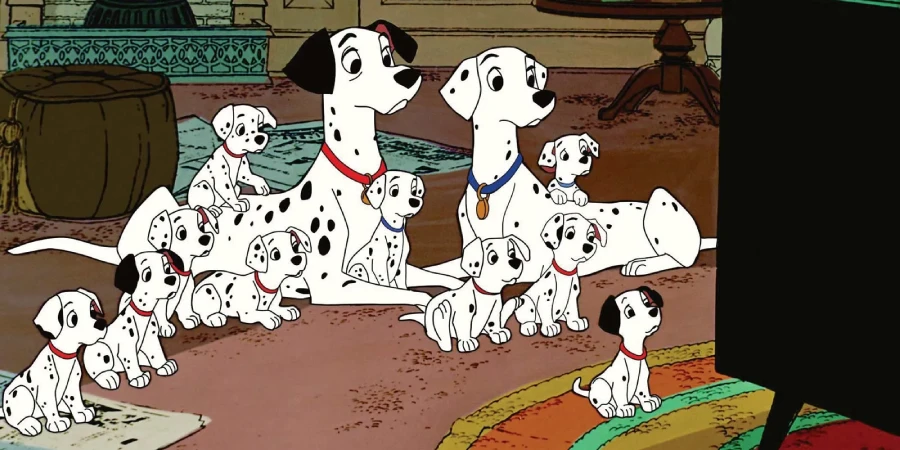

Few animated films have villains as fabulously wicked as Cruella de Vil and puppies as irresistibly charming as this lot. One Hundred and One Dalmatians is one of Disney’s most stylish, energetic, and surprisingly suspenseful animated features. Released in 1961, it marked a major turning point in animation history thanks to its distinctive visual style and modern urban setting.
Detailed Summary
A Chance Encounter in London
The story begins in London, where songwriter Roger Radcliffe lives with his Dalmatian, Pongo. Bored with bachelor life, Pongo decides it’s time for Roger to find a mate. From his window, Pongo spots a fashionable woman, Anita, walking with her Dalmatian, Perdita. In one of Disney’s most charming meet-cutes, Pongo engineers a chaotic park encounter that results in Roger and Anita falling in love.
Soon, both humans and dogs are happily married. Domestic bliss seems complete—until Anita’s old schoolmate, the extravagantly dramatic Cruella de Vil, enters the picture.
Cruella’s Obsession
Cruella is immediately fixated on Perdita’s upcoming litter of puppies. She announces her intention to buy them—making it disturbingly clear she wants to turn them into fur coats. Roger firmly refuses.
When the puppies are born—fifteen in total—Cruella wastes no time. She hires two bumbling henchmen, Jasper and Horace, to kidnap them. One snowy night, they succeed.
The Twilight Bark and the Discovery
In a brilliant narrative device, the dogs of London activate the “Twilight Bark,” a communication chain that spreads the message across the countryside. Eventually, Pongo and Perdita learn that their puppies are being held at an abandoned estate called Hell Hall.
Determined and desperate, the parents embark on a dangerous journey through snow-covered fields and icy rivers to rescue them.
Hell Hall and the Shocking Surprise
At Hell Hall, Pongo and Perdita find not just their fifteen puppies—but ninety-nine Dalmatian puppies in total. Cruella has been gathering Dalmatians from across the region for her fashion scheme.
The realization raises the stakes enormously. This is no longer just a rescue mission. It’s a full-scale liberation effort.
The Great Escape
With help from other farm animals, the puppies overpower Jasper and Horace in a delightfully chaotic sequence. The dogs escape into the snow, but danger isn’t over yet. Cruella, driving like a maniac in her iconic car, chases them down icy roads in one of the most intense car chases in classic animation.
The tension builds to a climax as Cruella loses control and crashes spectacularly—her rage quite literally driving her into ruin.
Movie Ending
After the daring escape, Pongo and Perdita realize there is no safe way to return ninety-nine spotted puppies to London unnoticed. In a clever move, they disguise themselves by rolling in soot, appearing like black Labradors.
The dogs sneak into a moving van headed to London. Inside, as snow falls gently outside, the soot begins to melt away, revealing their spots once again—creating a moment of quiet triumph.
Back home, Roger and Anita are overjoyed when their original fifteen puppies return. But the shock of seeing ninety-nine additional puppies quickly turns into awe. Instead of sending them away, Roger has an epiphany. Inspired, he writes a hit song mocking Cruella (“Cruella de Vil”), which becomes a financial success.
With the new income, Roger and Anita decide to keep all the puppies. They move to the countryside, where there’s room for everyone.
The final image is heartwarming: one hundred and one Dalmatians united as a family, free from danger. Cruella, meanwhile, is left humiliated, defeated, and fur-less. The ending is not just happy—it’s triumphant, delivering justice, warmth, and a sense of poetic balance.
Are There Post-Credits Scenes?
No. One Hundred and One Dalmatians (1961) does not include any post-credits or mid-credits scenes. The story concludes fully before the credits roll, as was standard for animated films of that era.
Type of Movie
One Hundred and One Dalmatians is an animated family adventure-comedy with strong elements of suspense. While playful and humorous, it also carries darker undertones through its villain and kidnapping plot, giving it surprising dramatic weight.
Cast
The principal voice cast includes:
- Rod Taylor as Pongo
- Cate Bauer as Perdita
- Betty Lou Gerson as Cruella de Vil
- Ben Wright as Roger Radcliffe
- Martha Wentworth as Nanny and Queenie
Betty Lou Gerson’s performance as Cruella is especially iconic—her voice drips with theatrical malice and exaggerated flair.
Film Music and Composer
The film’s music was composed by George Bruns. The standout song, “Cruella de Vil,” written by Mel Leven, became one of Disney’s most memorable villain themes. Its jazzy, mischievous tone perfectly captures Cruella’s flamboyant wickedness.
Filming and Animation Locations
The film was produced by Walt Disney Productions in Burbank, California.
Technologically, the film is significant for its use of Xerox animation, supervised by Ub Iwerks. This process allowed animators to transfer drawings directly onto cels, preserving sketch lines and reducing production costs. The result? A rougher, more modern look that perfectly suited the London setting and marked a major shift in Disney animation history.
Awards and Nominations
Although not a major awards contender upon release, the film later received recognition for its lasting cultural impact. It has been included in several “greatest animated films” lists and remains one of Disney’s most commercially successful re-releases.
Behind the Scenes Insights
- Walt Disney initially worried that animating so many spotted dogs would be too complicated.
- Animators reportedly had to draw millions of spots—carefully ensuring they didn’t “swim” between frames.
- The Xerox process saved the studio from potential financial trouble following the expensive production of Sleeping Beauty.
- Cruella’s design was inspired partly by fashion trends of the 1960s and exaggerated high-society glamour.
Inspirations and References
The film is based on the 1956 novel The Hundred and One Dalmatians by Dodie Smith. Smith reportedly owned nine Dalmatians herself and conceived the story after one of her friends jokingly admired her puppies’ fur for coats.
Book Adaptation and Differences
While largely faithful, there are notable differences:
- In the novel, Cruella has a husband (Mr. de Vil), who is absent from the film.
- The book contains more political and satirical elements.
- The film simplifies certain plot threads to streamline pacing and focus more on the puppies and action sequences.
The adaptation leans more heavily into comedy and stylized villainy, making Cruella more flamboyant and theatrical.
Alternate Endings and Deleted Scenes
No confirmed alternate ending exists. However, early drafts reportedly included darker material regarding Cruella’s fashion empire and expanded scenes inside Hell Hall that were ultimately trimmed to maintain pacing and tone suitable for children.
Memorable Scenes and Quotes
Key Scenes
- The romantic park chaos that brings Roger and Anita together
- The hauntingly quiet discovery that the puppies have been kidnapped
- The snowy countryside journey of Pongo and Perdita
- The high-speed car chase ending in Cruella’s explosive crash
Iconic Quotes
- “Cruella de Vil, Cruella de Vil, if she doesn’t scare you, no evil thing will.”
- “I live for furs! I worship furs!”
Cruella’s lines remain some of the most deliciously over-the-top villain dialogue in animation history.
Easter Eggs and Hidden Details
- The dogs watch a television show featuring Thunderbolt, a meta nod to serialized adventure programs of the time.
- Several character designs subtly resemble 1960s British fashion illustrations.
- Some animators reused movements from earlier Disney films to manage production scale.
- The film includes subtle caricature references to real-life fashion elites.
Trivia
- It was Disney’s first animated feature set in a contemporary urban environment.
- The film saved the studio financially after Sleeping Beauty underperformed.
- Cruella consistently ranks among Disney’s greatest villains.
- The film’s success led to multiple re-releases and live-action adaptations decades later.
Why Watch?
Because it balances charm and menace beautifully. The film offers tight pacing, stylish animation, a legendary villain, and genuine emotional stakes. It’s not just cute puppies—it’s a suspenseful rescue thriller wrapped in family-friendly storytelling.
And let’s be honest: Cruella steals every scene she’s in.
Director’s Other Works
Directed by Clyde Geronimi, Hamilton Luske, and Wolfgang Reitherman, who also worked on:
- Cinderella (1950)
- Alice in Wonderland (1951)
- Peter Pan (1953)
- Lady and the Tramp (1955)
- The Jungle Book (1967)
Recommended Films for Fans
If you loved this, you might enjoy:
- Lady and the Tramp (1955)
- The Aristocats (1970)
- Oliver & Company (1988)
- The Rescuers (1977)
- The Jungle Book (1967)