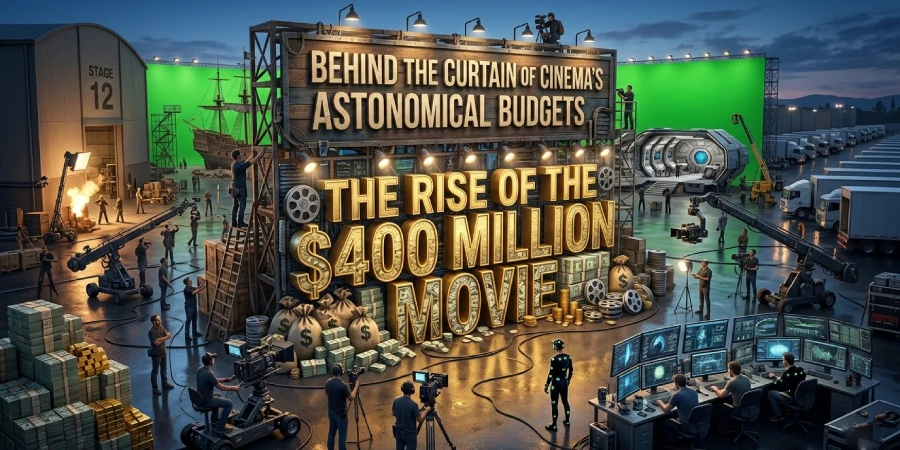

Hollywood has always been synonymous with excess, but today’s blockbusters are shattering budget records like never before. Films costing $300 million, $400 million, or even more have become surprisingly common. But when you hear that a single movie cost more than the GDP of a small nation, you might wonder: where exactly does all that money go? Is it just movie stars demanding outrageous paychecks, or is there something deeper happening behind those astronomical production costs? In this post, we’ll pull back the curtain on the most expensive movies ever made and trace every dollar from the studio’s vault to the silver screen.
The Reigning Champions of Cinema Budgets
Let’s start with the heavy hitters. The title of most expensive movie shifts depending on whether you adjust for inflation, but here are the modern record-breakers that left studios sweating over their balance sheets.
Pirates of the Caribbean: On Stranger Tides (2011) officially holds the crown with a reported production budget of $379 million. That’s before marketing costs, which can easily add another $150-200 million. Avengers: Age of Ultron (2015) came close at $365 million, while Avengers: Endgame (2019) clocked in around $356 million. James Cameron’s Avatar: The Way of Water (2022) reportedly cost between $350-400 million, making it one of the priciest films in history.
These aren’t just expensive movies—they’re financial gambles that could sink entire studios if they flop. So what justifies these mind-boggling budgets?



Breaking Down the Biggest Expenses
Visual Effects: The Budget Devourer
Visual effects have become the single largest expense for most expensive movies today. A film like Avatar: The Way of Water reportedly spent over 40% of its budget on cutting-edge CGI, motion capture technology, and underwater filming innovations. Creating believable digital characters, elaborate action sequences, and entirely computer-generated worlds requires armies of VFX artists working for years.
Modern blockbusters often employ multiple VFX houses simultaneously, each specializing in different aspects—one for creatures, another for environments, another for destruction sequences. A single frame of complex VFX can cost thousands of dollars, and with 24 frames per second, those costs explode faster than a CGI spaceship.
A-List Salaries and Backend Deals
While star salaries aren’t always the primary cost driver, they’re still substantial. Robert Downey Jr. famously earned $50-75 million for Avengers: Endgame when including backend profit participation. Tom Cruise’s deals for the Mission: Impossible franchise include significant backend points that can push his total compensation above $100 million per film.
These backend deals—where stars receive percentages of box office gross or net profits—can dramatically inflate the true cost of expensive movies when they become hits. Studios gamble that a marquee name will guarantee ticket sales, making these investments worthwhile despite the risk.
Location Shooting and Production Design
Practical filmmaking still costs a fortune. Pirates of the Caribbean: On Stranger Tides filmed across multiple continents, requiring massive crew transportation, location permits, and local production support. Building elaborate physical sets—even when enhanced with CGI—requires skilled craftspeople, materials, and time.
The Lord of the Rings trilogy famously built entire villages in New Zealand. Star Wars sequels constructed full-scale spacecraft interiors and alien landscapes. These practical elements create tangible authenticity that pure CGI can’t match, but they don’t come cheap.
The Hidden Costs Nobody Talks About
Here’s where budgets really balloon: reshoots, extended production schedules, and post-production delays. Justice League (2017) underwent massive reshoots that reportedly added $25 million to its already hefty budget. Solo: A Star Wars Story fired its original directors mid-production and reshot approximately 70% of the film, causing costs to skyrocket past $275 million.
Insurance, legal fees, marketing tie-ins, and administrative overhead can add 15-20% to production budgets. When productions run over schedule, daily costs for crew, equipment rentals, and facilities can reach hundreds of thousands of dollars. A film budgeted at $250 million can easily become a $300 million movie through delays alone.
Technology’s Rising Price Tag
Innovation costs money. James Cameron spent years developing new 3D camera systems and underwater filming technology for his Avatar films. These research and development costs get absorbed into production budgets, making expensive films effectively beta tests for future filmmaking technology.
Motion capture technology, virtual production stages (like Disney’s StageCraft used in The Mandalorian and Marvel films), and advanced rendering software all require significant upfront investment. While these tools eventually become more affordable, the studios pioneering them pay premium prices.
Marketing: The Budget After the Budget
Production costs are only half the story. Marketing and distribution for the most expensive movies often equal or exceed production budgets. A $300 million film might spend another $200 million on worldwide marketing, including TV spots, digital campaigns, premiere events, and promotional partnerships.
This means a film with a $300 million production budget actually costs the studio $500 million before earning a single dollar. Studios typically need to gross 2.5-3 times the production budget just to break even when accounting for theater splits and distribution costs.
Why Studios Keep Spending More
Despite the risks, studios continue greenlighting expensive movies for simple reasons: when they work, they work spectacularly. Avengers: Endgame earned $2.8 billion globally. Avatar: The Way of Water surpassed $2.3 billion. These aren’t just profitable films—they’re franchise foundations that generate revenue through sequels, merchandise, theme parks, and streaming value for decades.
The global box office has expanded dramatically, particularly in China and other international markets. Films that once would have been financial disasters now have worldwide audiences large enough to justify enormous budgets. Streaming wars have also inflated budgets as platforms compete for prestige content.
The Future of Film Budgets: Higher Still?
Industry insiders predict budgets will continue climbing. Inflation affects filmmaking costs just like everything else, and audience expectations for spectacle keep rising. Virtual production technology might eventually reduce some expenses, but for now, it’s adding costs as studios invest in new infrastructure.
Some analysts believe the bubble must eventually burst—that studios can’t sustain $400-500 million gambles indefinitely. But as long as billion-dollar box office returns remain possible, expect to see budgets that make today’s most expensive movies look modest.



What This Means for Cinema
The rise of expensive films has reshaped Hollywood’s entire ecosystem. Mid-budget films ($30-80 million) have nearly disappeared from theatrical release, migrating to streaming platforms. Studios increasingly focus on guaranteed franchise properties rather than original stories, reducing the diversity of theatrical offerings.
This concentration of resources into fewer, bigger films means more is riding on each release. One major flop can damage a studio’s entire year, while competitors capitalize on their missteps. It’s a high-stakes game that’s fundamentally changed what kinds of stories get told on the biggest screens.
The Bottom Line on Blockbuster Budgets
So where does all that money go? Everywhere. Into cutting-edge technology and thousands of artists’ salaries. Into A-list talent and global location shoots. Into marketing campaigns that blanket the planet and reshoots that perfect every frame. The most expensive movies ever made are essentially small economies unto themselves, employing thousands and pushing the boundaries of what’s technically possible in cinema.
Whether these astronomical budgets represent artistic ambition or financial recklessness depends on who you ask—and whether the film succeeds. But one thing’s certain: as long as audiences keep showing up for spectacular big-screen experiences, studios will keep betting bigger. The next time you’re watching a $300 million blockbuster, remember you’re seeing every dollar on screen—and quite a few behind it too.