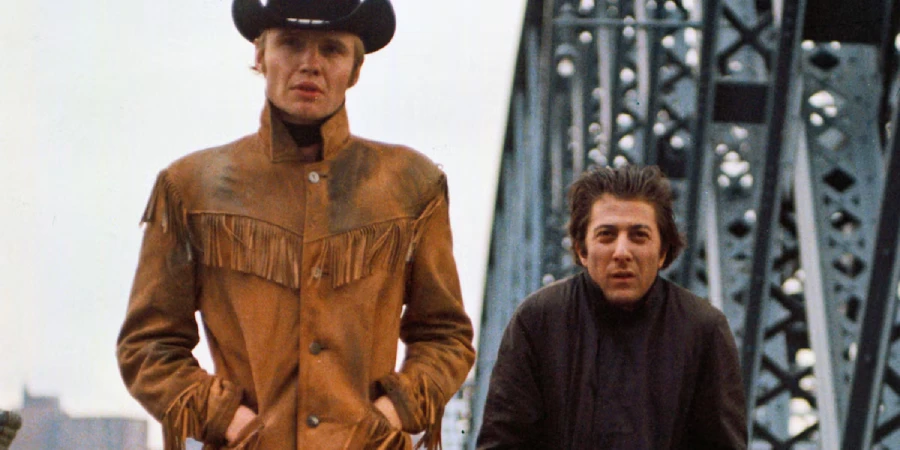

Midnight Cowboy is not a Western. It is an anti-Western, a brutal dissection of the American Dream set against the grime of late-1960s New York. The film strips away romantic myths, leaving only the raw, painful story of two outcasts clinging to each other for survival. Ultimately, it is a devastating portrait of loneliness and misplaced hope.
Detailed Summary
Joe Buck Arrives in New York
Naive and full of misguided confidence, Joe Buck leaves his small-town Texas life behind. He kits himself out in brand-new cowboy gear, believing his good looks and charm will make him a successful hustler for wealthy New York women. His optimism, however, quickly collides with the city’s harsh indifference.
His first attempt at seducing a sophisticated older woman, Cass, ends in humiliation. Instead of getting paid, he ends up giving her money for a taxi. This encounter establishes Joe’s fundamental misunderstanding of the world he has entered.
Encountering Ratso Rizzo
Limping through the city streets, the sickly con man Enrico “Ratso” Rizzo spots Joe as an easy mark. He introduces himself as a potential manager who can connect Joe with the right clients. Consequently, Ratso cons Joe out of his last twenty dollars, sending him to a bizarre meeting with a religious fanatic.
Broke and desperate, Joe eventually tracks Ratso down. Instead of seeking revenge, a weary Joe accepts Ratso’s offer to share his squalid room in a condemned tenement building. This marks the beginning of their strange and dysfunctional partnership.
A Partnership of Hustlers
Joe and Ratso form an unlikely team. Ratso, with his street smarts, acts as Joe’s self-appointed manager, though his connections are non-existent. Their days are filled with petty thefts and desperate schemes to find food and money.
Despite the grim circumstances, a genuine bond begins to form. They argue and insult each other, but they also provide a fragile sense of companionship neither has ever known. They are two broken souls huddling together against the cold indifference of the city.
The Warhol-esque Party
Through a chance encounter, the pair score an invitation to a psychedelic, counter-culture party seemingly inspired by Andy Warhol’s Factory scene. Lost in the haze of drugs and avant-garde art, Joe connects with a socialite named Shirley. She eventually hires him for his services.
The encounter is awkward and transactional, but it finally earns Joe some real money. This small success gives both him and Ratso a fleeting glimmer of hope that their plan might actually work.
Desperate Times
As winter sets in, Ratso’s health deteriorates rapidly, his persistent cough worsening. Joe’s hustling opportunities dry up, forcing him into increasingly desperate measures. He resorts to selling his blood for cash and attempts to hustle men, which leads to a traumatic and violent encounter in a hotel room.
Joe steals the man’s wallet and flees, shaken by the experience. The incident underscores his inability to navigate the brutal realities of street life and deepens his commitment to caring for the ailing Ratso.
The Dream of Florida
Ratso fixates on an idealized vision of moving to Florida. He believes the warm weather will cure his illness and allow them to live an easy life. This dream becomes their sole motivation.
To fund the trip, Joe reverts to what he knows best: targeting an older, wealthy man. The encounter turns violent when the client panics, and Joe brutally beats him, stealing the money needed for two bus tickets to Miami. He races back to Ratso, finally ready to make their escape.
Movie Ending
Joe Buck and a gravely ill Ratso Rizzo finally board a bus bound for Miami. During the journey, Joe sheds his cowboy persona, buying new clothes for both of them. He tenderly cares for Ratso, who is now feverish and barely conscious. Joe speaks with genuine optimism about their future, promising to get a real job to support them.
As they approach Miami, Joe talks excitedly about their arrival. He gently places a hand on Ratso’s shoulder, only to realize his friend has died quietly in his sleep. The bus driver, noticing Joe’s distress, tells him and the other passengers to stay seated until they reach the terminal.
Joe puts his arm around his deceased friend, shielding him from the curious stares of others. In the final shot, Joe’s reflection is seen in the bus window, the vast, sunny landscape of Florida behind him. The cowboy is gone, replaced by a man utterly alone, his one true connection severed just as their dream was within reach.
Are There Post-Credits Scenes?
There are no post-credits scenes in Midnight Cowboy.
Type of Movie
Midnight Cowboy is a groundbreaking buddy drama and a gritty character study. Its tone is overwhelmingly bleak and realistic, punctuated by moments of dark humor and profound sadness. The film subverts traditional Hollywood narratives, offering an unvarnished look at poverty, loneliness, and the dark underbelly of the American Dream.
Cast
- Jon Voight – Joe Buck
- Dustin Hoffman – Enrico “Ratso” Rizzo
- Sylvia Miles – Cass
- John McGiver – Mr. O’Daniel
- Brenda Vaccaro – Shirley
- Barnard Hughes – Towny
- Jennifer Salt – Annie
Film Music and Composer
The film’s iconic score was composed by John Barry, who was already famous for his work on the James Bond films. Barry’s main theme, played beautifully on harmonica by Toots Thielemans, captures the melancholy and loneliness at the heart of the story.
Moreover, the film is indelibly linked to the song “Everybody’s Talkin'”, written by Fred Neil and performed by Harry Nilsson. Director John Schlesinger used it as a temp track but found it so perfect for Joe Buck’s character that he kept it, creating one of cinema’s most memorable music moments.
Filming Locations
Midnight Cowboy was filmed on location, which was crucial to its raw, documentary-like feel. Much of the movie was shot in New York City, particularly the then-seedy areas of Times Square and the East Village. This authenticity places the characters in a real, hostile environment, making their struggle feel immediate and palpable.
Additional scenes were filmed in Big Spring, Texas, for Joe Buck’s backstory and on the bus route to Miami, Florida, for the film’s final sequence.
Awards and Nominations
Midnight Cowboy made history at the 42nd Academy Awards. It became the first and only X-rated film to ever win the Oscar for Best Picture. The film also won for Best Director (John Schlesinger) and Best Adapted Screenplay (Waldo Salt).
Both Jon Voight and Dustin Hoffman received Best Actor nominations, and Sylvia Miles was nominated for Best Supporting Actress. The film’s critical success, despite its controversial rating, signaled a major shift in Hollywood cinema.
Behind the Scenes Insights
- The film’s most famous line, “I’m walkin’ here!”, was improvised by Dustin Hoffman. A taxi driver ignored the film crew’s barricades and nearly hit him and Voight, prompting Hoffman to stay in character and yell at the driver.
- To perfect Ratso’s limp, Dustin Hoffman reportedly put pebbles in his shoe.
- The film was originally given an “R” rating by the MPAA. However, a frustrated United Artists released it with a self-imposed “X” rating to protest the ratings board and trumpet the film’s adult nature.
- Director John Schlesinger used many non-actors and real street people for background roles to enhance the film’s gritty realism.
Inspirations and References
The film’s primary inspiration is its source material, the 1965 novel of the same name by James Leo Herlihy. Schlesinger and screenwriter Waldo Salt drew heavily from the book’s narrative and characterizations, though they streamlined certain subplots and character backstories for the screen.
Alternate Endings and Deleted Scenes
There are no known dramatically different alternate endings for Midnight Cowboy. The tragic conclusion on the bus was always the intended finale. Some minor trims were made to avoid an even more restrictive rating, but the core narrative and ending remained intact from Waldo Salt’s screenplay. The director’s cut is essentially the theatrical version seen today.
Book Adaptations and Differences
Midnight Cowboy is a faithful adaptation of James Leo Herlihy’s 1965 novel, but there are notable differences. The book, for instance, delves more deeply into Joe Buck’s traumatic past, including clearer details about his complicated relationship with his grandmother and his implied repressed homosexuality.
In contrast, the film handles these elements more ambiguously through disjointed, stylized flashbacks. Ratso’s backstory is also more detailed in the novel, explaining that his limp is from a childhood bout with polio and that his father was an illiterate Italian immigrant who worked in a subway tunnel. The film presents Ratso as more of an enigma, defined by his present condition and his dreams of escape.
Memorable Scenes and Quotes
Key Scenes
- Joe’s Arrival in New York: Dressed in his finest cowboy gear, Joe strides through Times Square to the tune of “Everybody’s Talkin'”, a perfect visualization of his naive optimism.
- “I’m Walkin’ Here!”: The legendary unscripted scene where Ratso Rizzo slaps the hood of a taxi that nearly runs them over, perfectly capturing the abrasive spirit of a true New Yorker.
- The Party: Joe and Ratso’s fish-out-of-water experience at a bizarre counter-culture party, highlighting the gulf between their world and the fashionable elite.
- The Final Bus Ride: A heartbreaking sequence where Joe cares for a dying Ratso, shedding his cowboy persona and embracing his role as a caregiver, only to lose his friend at the very end.
Iconic Quotes
- “I’m walkin’ here! I’m walkin’ here!” – Ratso Rizzo
- “I’m a hustler. Ain’t no other way to make a living, ‘cept by hustlin’.” – Joe Buck
- “Frankly, you’re beginning to smell, and for a stud in New York, that’s a handicap.” – Ratso Rizzo
- “I’m goin’ to Florida, where the sun shines.” – Ratso Rizzo
Easter Eggs and Hidden Details
- During the party scene, several real-life members of Andy Warhol’s entourage appear, including Viva, Ultra Violet, and International Velvet, adding authenticity to the avant-garde setting.
- The cemetery Joe and Ratso visit is in Queens, with the Manhattan skyline visible in the background, visually connecting their bleak present with their inaccessible dreams.
- The recurring image of a falling television set in Joe’s flashbacks symbolizes the breakdown of communication and the collapse of the idealized American family life he never had.
- Joe’s transistor radio is his only link to his old life. He clutches it throughout the film, but notably leaves it behind when he and Ratso board the bus for Florida, signifying he is ready to start anew.
Trivia
- Bob Dylan originally wrote “Lay Lady Lay” for the film’s soundtrack, but he didn’t complete it in time, so “Everybody’s Talkin” was used instead.
- The film was re-rated from X to R in 1971 without a single frame being cut, a testament to how quickly cultural standards were changing.
- Sylvia Miles’ role as Cass, which earned her an Oscar nomination, has less than six minutes of screen time.
- Dustin Hoffman initially felt he was wrong for the part of Ratso and tried to suggest other actors. He met with director John Schlesinger in a Times Square arcade dressed as a homeless person to prove he could be convincing.
Why Watch?
This film is essential viewing. It remains a raw, powerful masterpiece of American cinema, anchored by two of the greatest performances ever put on screen. Its unflinching look at friendship and survival on the margins of society is as heartbreaking and relevant today as it was in 1969.
Director’s Other Movies
- Darling (1965)
- Sunday Bloody Sunday (1971)
- The Day of the Locust (1975)
- Marathon Man (1976)
Recommended Films for Fans
- The Graduate (1967)
- Easy Rider (1969)
- Five Easy Pieces (1970)
- Klute (1971)
- Scarecrow (1973)
- Taxi Driver (1976)