
Look Who’s Back (original title: Er ist wieder da) is a sharp, unsettling, and darkly comic German film that dares to ask one of the most uncomfortable “what if?” questions in modern cinema:
What if Adolf Hitler suddenly returned to present-day Germany — and nobody took him seriously?
Blending satire, mockumentary, social commentary, and absurd humor, the film gradually transforms from comedy into something far more disturbing.
Detailed Summary
Adolf Hitler Wakes Up in Modern Berlin
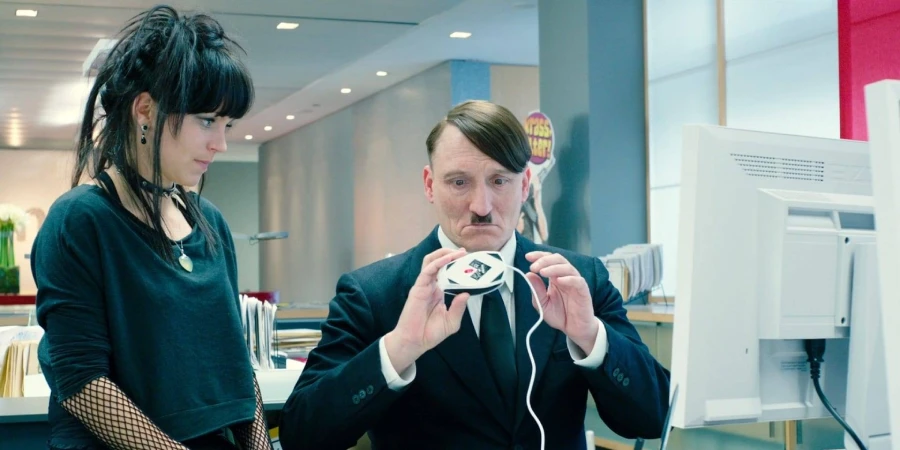
The film opens with Adolf Hitler awakening in 2014 Berlin, right where his bunker once stood. The world around him is unrecognizable: smartphones, immigrants, modern fashion, and a democratic Germany.
Hitler believes he has simply overslept and assumes the Third Reich has fallen temporarily. Everyone else assumes he is an extremely dedicated comedian.
This misunderstanding becomes the engine of the entire story.
Society Mistakes Reality for Satire
Hitler wanders through Berlin in full uniform, speaking exactly as the real Hitler did. Passersby laugh, take selfies, and praise his “performance.”
No one believes he is real.
This is one of the film’s most important ideas:
modern society filters everything through irony and entertainment.
Rise Through the Media World
Hitler meets Fabian Sawatzki, an unemployed TV producer who sees viral potential in the strange man. He begins filming Hitler interacting with real people across Germany.
These scenes are largely unscripted and shot documentary-style. Real citizens respond to Hitler’s rhetoric with laughter, agreement, or disturbing approval.
The footage becomes a sensation.
Hitler is invited onto television talk shows, comedy programs, and political satire segments. His extreme views are dismissed as jokes, allowing him to speak freely in ways that would normally be unacceptable.
Hitler as a Media Product
As Hitler’s popularity grows, he becomes a brand.
He gains:
- A YouTube following
- Merchandise
- Television contracts
- Public sympathy
When he delivers hateful monologues, audiences laugh. When he criticizes democracy, people applaud his “honesty.”
The media doesn’t question him because ratings keep rising.
This section of the film quietly shifts tone from comedy to warning.
The Illusion of Control
Sawatzki believes he is exploiting Hitler for entertainment. The television executives believe the same.
But Hitler sees something else: opportunity.
He realizes that modern media is far more powerful than propaganda ever was. He adapts effortlessly, learning to weaponize controversy, outrage, and viral fame.
And he does not need violence. He only needs attention.
Movie Ending
The final act abandons humor almost completely.
Fabian begins to realize the danger of what he has helped create. He attempts to expose Hitler as genuine and stop the project. However, the media company refuses. Hitler is too profitable.
Fabian eventually confronts Hitler directly and tries to kill him. He shoots Hitler in the head. The audience gasps — until Hitler stands back up. The gunshot did not kill him. Hitler calmly explains something terrifying:
He cannot be destroyed by violence because he is not the problem.
He represents ideas that already exist in society.
Then comes the film’s most chilling moment.
As Hitler rides through Berlin in a convertible, real archival footage of modern extremist demonstrations plays alongside the fictional scenes. Hitler addresses the audience directly in voiceover, explaining that as long as people feel angry, afraid, or unheard, someone like him will always return.
The final line implies that he never truly left.
The film ends not with laughter, but with discomfort.
Are There Post-Credits Scenes?
No. There are no post-credits scenes. The film ends definitively, leaving the audience alone with its message.
Type of Movie
Look Who’s Back is a satirical political comedy that gradually transforms into a social drama and psychological warning. It uses humor as bait before revealing a deeply serious critique of modern media culture and extremism.
Cast
- Oliver Masucci as Adolf Hitler
- Fabian Busch as Fabian Sawatzki
- Christoph Maria Herbst as Adolf Grünbaum
- Katja Riemann as Bellini von Borstel
- Franziska Wulf as Krömeyer
Oliver Masucci’s performance is widely regarded as the core strength of the film.
Film Music and Composer
The music was composed by Enis Rotthoff. Rather than dominating scenes, the score subtly supports the emotional shift from comedy to unease, especially toward the final act.
Filming Locations
The film was shot across real locations in Berlin and throughout Germany, including:
- Brandenburg Gate area
- Alexanderplatz
- Residential suburbs
- Rural towns
These locations are essential to the film’s realism. By placing Hitler in everyday modern Germany rather than stylized sets, the movie blurs fiction and reality — making its message far more disturbing.
Awards and Nominations
- German Film Award – Winner: Best Actor (Oliver Masucci)
- German Film Award – Nominations: Best Film, Best Editing, Best Screenplay
- Bavarian Film Award – Best Actor
The film was also Germany’s submission for the Academy Awards, though it was not nominated.
Behind the Scenes Insights
- Many street scenes were filmed with hidden cameras, capturing real reactions from unsuspecting citizens.
- Some participants expressed agreement with Hitler’s statements, shocking the crew.
- Oliver Masucci remained in character throughout filming to preserve realism.
- Several reactions were so extreme that footage could not be used.
- Director David Wnendt stated that the film became more frightening during production than originally planned.
Inspirations and References
- Based on the novel “Look Who’s Back” by Timur Vermes (2012)
- Influenced by mockumentary formats
- References to Charlie Chaplin’s The Great Dictator (1940)
- Strong commentary on modern populism and media sensationalism
Alternate Endings and Deleted Scenes
No official alternate ending has been released.
However, interviews reveal that:
- Early drafts ended more comedically
- The darker ending was chosen intentionally to leave viewers unsettled
- Several extreme public interviews were removed for ethical reasons
Book Adaptation and Differences
The film closely follows the novel’s premise but introduces key changes:
- The book is entirely told from Hitler’s perspective
- The film adds the filmmaker character (Fabian)
- The movie places stronger emphasis on modern media culture
- The ending of the film is darker and more direct than the novel
Memorable Scenes and Quotes
Key Scenes
- Hitler waking up in modern Berlin
- Public interviews with real citizens
- Hitler’s first viral television appearance
- The failed assassination attempt
- The final montage combining fiction and real footage
Iconic Quotes
- “I was never gone.”
- “You can’t kill an idea.”
- “People don’t fear dictatorship. They fear boredom.”
Easter Eggs and Hidden Details
- Several background newspapers contain real political headlines
- Hitler’s YouTube popularity mirrors real viral growth patterns
- The dog he adopts symbolically humanizes him — intentionally uncomfortable
- Camera angles increasingly resemble real political broadcasts
- Final footage blends real demonstrations with fictional scenes
Trivia
- The film cost under €5 million but became a major international success
- It sparked intense political debate in Germany
- Some cinemas held post-screening discussions due to audience reactions
- The film is studied in European media and political science courses
- Oliver Masucci later stated the role was psychologically exhausting
Why Watch?
You should watch Look Who’s Back because it is:
- Funny at first — terrifying by the end
- A rare satire that refuses to protect the audience
- A powerful warning about media, populism, and complacency
- Uncomfortably relevant in the age of viral politics
- One of the top movies to watch among Hitler movies!
It doesn’t tell you what to think.
It forces you to question why people laugh.
Director’s Other Works
- Combat Girls (2011)
- Wetlands (2013)
- Sun and Concrete (2023)
David Wnendt is known for confronting social taboos directly.
Recommended Films for Fans
- The Death of Stalin (2017)
- Jojo Rabbit (2019)
- Dr. Strangelove (1964)
- Network (1976)
- A Face in the Crowd (1957)
- Vice (2018)