
Less Than Zero is more than a movie; it is a neon-drenched autopsy of 80s youth culture. The film rips away the glamorous facade of Beverly Hills, exposing a heart of darkness fueled by cocaine and moral decay. Ultimately, it serves as a devastating portrait of corrupted innocence. Its story is a chilling reminder of the price of excess.
Detailed Summary
Clay’s Homecoming
College freshman Clay Easton returns to Los Angeles from the East Coast for Christmas break. He is greeted by his ex-girlfriend, Blair, who seems nervous and desperate for his return. Blair’s vague pleas hint that something is seriously wrong with their mutual best friend, Julian Wells.
Clay finds a Los Angeles that feels both familiar and alien. Consequently, the lavish parties and decadent lifestyle of his wealthy peers now seem hollow and disturbing. He quickly discovers that the carefree world he left behind has soured into something dangerous.
The Corrupted Triangle
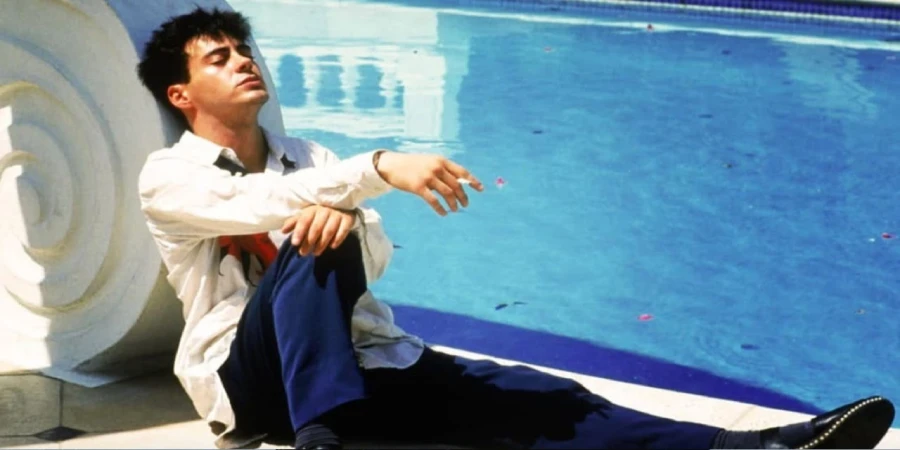
Clay’s reunion with Julian is a shock. His once-charming and vibrant friend is now a gaunt, paranoid cocaine addict. Furthermore, Clay learns that Julian was kicked out of his family home after stealing to fund his habit. He also learns Blair and Julian had a brief affair after Clay left for college.
This revelation creates a tense dynamic between the three old friends. Blair is consumed by guilt, while Clay grapples with betrayal and a growing sense of responsibility. Julian, meanwhile, sinks deeper into his addiction, pushing away any genuine attempts to help him.
Julian’s Debt to Rip
The true source of Julian’s desperation becomes terrifyingly clear. He owes $50,000 to his predatory drug dealer, Rip, a former classmate turned menacing pimp. Rip calmly explains to Clay that Julian’s debt is non-negotiable.
Rip’s calm demeanor makes him even more frightening. He treats Julian not as a person but as a commodity he owns. As Julian’s situation worsens, Rip’s methods for collecting the debt become more extreme and degrading.
A Failed Intervention
Determined to save his friend, Clay pays off a portion of Julian’s debt and tries to get him into rehab. He and Blair attempt to drive him out to the desert to detox. Julian’s addiction, however, proves too powerful.
He escapes their custody during a stop, immediately seeking out Rip to get another fix. This failure solidifies the grim reality for Clay. Normal solutions will not work here. Julian is completely in Rip’s control.
Descent into Hell
With no money left, Julian becomes Rip’s property entirely. Rip forces him into prostitution to pay off the remainder of his debt. Clay finds Julian in a vacant, drug-filled flophouse, being offered to a group of men.
Horrified, Clay confronts Rip and beats him up, grabbing a barely conscious Julian and escaping with Blair. This is the point of no return. They know they must get Julian out of Los Angeles for good.
Movie Ending
After rescuing Julian from Rip, Clay and Blair drive east, hoping to escape the city’s corrupting influence. They put a severely weakened Julian in the back seat. During the drive through the desert, as dawn breaks, Julian has a moment of clarity.
He quietly thanks Clay before succumbing to a fatal overdose. Clay and Blair realize he has stopped moving and pull over, discovering their friend is dead. The film ends with Clay standing alone at Julian’s funeral in a desolate graveyard. He has lost his friend and the last vestiges of his own innocence.
Are There Post-Credits Scenes?
No, there are no scenes after the credits begin to roll. The film concludes with the final shot at the funeral.
Type of Movie
Less Than Zero is a stark drama and a cautionary tale. It is often associated with the “Brat Pack” films of the era, but its tone is significantly darker and more tragic. The film explores themes of addiction, alienation, and the moral emptiness of extreme wealth, creating a bleak and unsettling atmosphere.
Cast
- Andrew McCarthy – Clay Easton
- Jami Gertz – Blair
- Robert Downey Jr. – Julian Wells
- James Spader – Rip
Film Music and Composer
The film’s iconic soundtrack was produced by the legendary Rick Rubin. It perfectly captures the movie’s edgy, stylish vibe with a mix of rock, pop, and hip-hop. Notable tracks include The Bangles’ cover of Simon & Garfunkel’s “Hazy Shade of Winter” and LL Cool J’s “Going Back to Cali.”
The moody and atmospheric score was composed by Thomas Newman. His work provides a haunting counterpoint to the high-energy soundtrack, emphasizing the underlying sadness and despair of the story.

Filming Locations
Less Than Zero was filmed primarily in Los Angeles and Palm Springs, California. These locations are essential to the story’s themes. The opulent mansions of Beverly Hills and the exclusive nightclubs highlight the characters’ immense wealth and privilege.
In contrast, the stark, empty landscapes of the desert symbolize both an escape and a desolate end. The locations effectively portray a world of extreme superficial beauty hiding a deep, internal ugliness.
Awards and Nominations
The film did not receive any major film industry awards or nominations. Its soundtrack, however, was a commercial success and remains a classic compilation of 80s music.
Behind the Scenes Insights
- Robert Downey Jr.’s powerful performance as Julian was tragically mirrored by his own real-life struggles with drug addiction, which intensified in the years following the film’s release.
- Author Bret Easton Ellis famously disliked the film, stating it bore little resemblance to his novel. He sarcastically called it “The Julian Movie” because it centered so heavily on a character he considered minor in the book.
- The studio, 20th Century Fox, was reportedly nervous about the novel’s dark subject matter. They consequently pushed for a more conventional, redemptive narrative, resulting in a significantly altered plot.
- James Spader and Andrew McCarthy had worked together previously on another 80s classic, Pretty in Pink (1986), where their roles were inversions of their characters in this film.
Inspirations and References
The film is based on the 1985 debut novel of the same name by Bret Easton Ellis. While the movie adapts the core characters and setting, it drastically changes the plot and tone to create a more linear, character-driven drama about addiction and rescue.
Alternate Endings and Deleted Scenes
An early version of the script reportedly featured a happier ending where Julian survives and goes to rehab. Test audiences, however, responded negatively to this less impactful conclusion. The filmmakers ultimately chose the tragic ending where Julian dies, believing it was more honest to the story’s dark themes, though still a far cry from the book’s nihilism.
Book Adaptations and Differences
The film is a very loose adaptation of Bret Easton Ellis’s novel. The book is an episodic, non-linear narrative told from Clay’s detached, nihilistic perspective. In contrast, the movie creates a more traditional, sympathetic plot centered on Clay trying to save Julian.
Key differences are numerous. In the book, Clay is an amoral and passive observer, whereas the film portrays him as a proactive hero. The novel includes graphic scenes of violence, torture, and child abuse that were completely removed from the movie. Julian’s role is also greatly expanded for the film; in the book, he is just one of many disturbing figures in Clay’s life, and his fate is left ambiguous.

Memorable Scenes and Quotes
Key Scenes
- The Party: Clay walks through a decadent house party shortly after arriving in L.A., with the camera capturing the vacant, drugged-out expressions of the young partygoers, setting the film’s tone.
- Julian’s Plea: A desperate and drug-addled Julian confesses the extent of his debt to Clay in a car, breaking down and revealing his terror of Rip.
- The Rescue: Clay finds Julian being pimped out by Rip and, in a burst of rage, attacks Rip and carries Julian’s nearly lifeless body out to the car.
- Julian’s Death: The quiet, heartbreaking moment in the car when Clay and Blair realize Julian has died on their way out of the desert.
Iconic Quotes
- “This is not recess. This is my life.” – Julian
- “Do you want to see something? I want to show you something. This is what you do for a living? This is how you make your money?” – Clay (to Rip)
- “Just… disappear here.” – Julian (referring to the billboard)
- “I just don’t want to die.” – Julian
Easter Eggs and Hidden Details
- The recurring phrase “Disappear Here” is a central motif. It appears as graffiti, on a billboard, and is spoken by Julian, symbolizing the desire for oblivion that pervades the characters’ lives.
- When Clay first arrives, he walks past a movie theater marquee advertising a film called The Way Back, foreshadowing his journey to save Julian and his eventual return to his old life.
- Julian’s father, played by actor Nicholas Pryor, appears in family photos but his face is never clearly shown, emphasizing Julian’s complete alienation from his family.
Trivia
- Judd Nelson was the original choice to play Julian, but he was unavailable. The role ultimately went to Robert Downey Jr., whose performance became one of the most acclaimed of his early career.
- The film’s vibrant, high-contrast cinematography was done by Edward Lachman, who intentionally used a specific film stock to give the L.A. nights a distinctive, oversaturated look.
- Brad Pitt has a brief, uncredited role as an extra. He appears as a “Preppie Guy at Fight / Partygoer” in one of the party scenes.
Why Watch?
This film is a must-see for its raw, unforgettable performance by Robert Downey Jr. and its unflinching look at 80s excess. It is a powerful, stylish, and ultimately heartbreaking cautionary tale that stays with you long after the credits roll.
Director’s Other Movies
- Another Country (1984)
- A Different Loyalty (2004)
Recommended Films for Fans
- Bright Lights, Big City (1988)
- The Basketball Diaries (1995)
- Trainspotting (1996)
- Requiem for a Dream (2000)