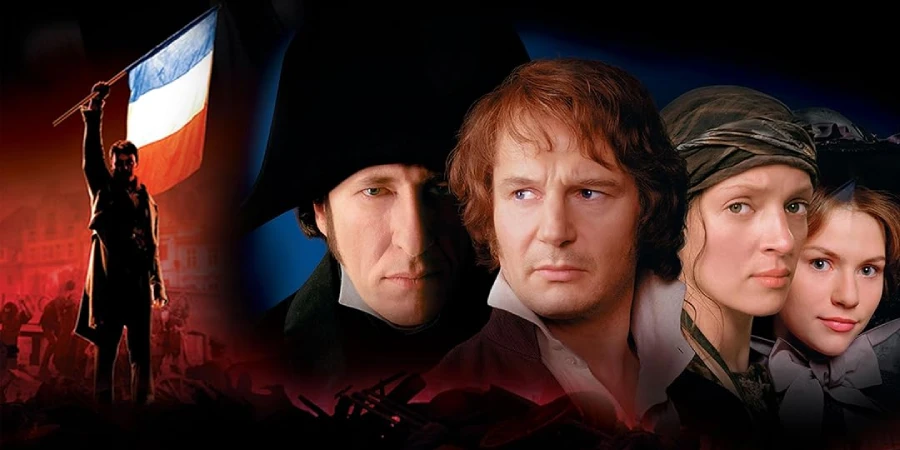

The 1998 film Les Misérables is a dramatic retelling of Victor Hugo’s iconic 1862 novel. Directed by Bille August, this adaptation is not a musical but a character-driven period drama that focuses on the emotional journey of Jean Valjean, the cycle of injustice, and the relentless pursuit of redemption.
Detailed Summary
A Man Marked by the Past: Jean Valjean’s Release
Jean Valjean (Liam Neeson), imprisoned for stealing bread, is released on parole after 19 brutal years under the harsh watch of Inspector Javert (Geoffrey Rush). Once free, he struggles to start a new life as society brands him a criminal. After a bishop offers him kindness, Valjean decides to break his parole and rebuild his identity, a choice that turns him into a fugitive in Javert’s eyes.
This section of the film emphasizes the contrast between mercy and law, already marking Valjean and Javert as philosophical opposites.
A New Identity, A New Life, A New Responsibility
Years later, Valjean is a respected mayor and factory owner under the name Monsieur Madeleine. A tragic turn occurs when the desperate factory worker Fantine (Uma Thurman) is dismissed under false accusations. After sinking into poverty, she becomes ill. Before dying, she begs Valjean to care for her daughter Cosette, revealing a secret that changes his life once more.
Valjean’s promise marks the emotional core of the film, showing his growth into a guardian and symbol of moral strength.
Raising Cosette and the Growing Threat of Javert
Valjean rescues Cosette from the abusive Thénardiers and raises her as his daughter. However, Javert resurfaces, growing even more obsessed with enforcing the law. His belief in law as absolute justice becomes a dangerous fixation. As Cosette grows up, she meets young revolutionary Marius (Hans Matheson), sparking a romance that brings Valjean into the political turmoil of Paris.
Revolution, Sacrifice, and Confrontation
During the student uprising, Valjean risks his life to save Marius. Javert, captured by revolutionaries, is handed over to Valjean, who unexpectedly frees him. This act of compassion shatters Javert’s rigid worldview: how can a criminal be capable of moral goodness?
This internal collapse drives Javert to the edge, setting the stage for the film’s emotional climax.
Movie Ending
After the failed uprising, Marius survives thanks to Valjean’s sacrifice. Valjean reveals to Marius that he is an ex-convict and decides to leave to protect Cosette’s future. However, Marius tells Cosette the truth, and they both seek Valjean out.
Meanwhile, Javert, unable to reconcile Valjean’s goodness with the idea of absolute justice, takes his own life. He chooses death rather than living in a world where right and wrong are not governed solely by law.
In the final scene, Cosette and Marius find Valjean in peace, moments before he dies. Valjean, surrounded by love and having fulfilled his promise to Fantine, passes away quietly. The ending emphasizes redemption, human compassion, and the idea that mercy can change destinies. It is somber but deeply hopeful, showing that Valjean’s legacy lives on through Cosette.
Are There Post-Credits Scenes?
No. Les Misérables (1998) does not include any post-credits or mid-credits scenes. The story concludes firmly with Valjean’s death, and the credits roll without added content.
Type of Movie
This is a historical drama with deep themes of morality, justice, redemption, and societal struggle. It is not a musical adaptation like many other versions of Les Misérables.
Cast
- Liam Neeson as Jean Valjean
- Geoffrey Rush as Inspector Javert
- Uma Thurman as Fantine
- Claire Danes as Cosette
- Hans Matheson as Marius
- Jon Voight as Bishop Myriel
- Helena Bonham Carter and Timothy Spall as the Thénardiers
Film Music and Composer
Composed by Basil Poledouris, the film score uses orchestral emotion to highlight Valjean’s inner struggle, the revolution’s tension, and the tragic beauty of the story. The music avoids theatrical flair, focusing instead on subtle emotional storytelling.


Filming Locations and Importance
- Prague, Czech Republic – used to represent 19th-century Paris due to its preserved historical architecture.
- Poland and England – provided smaller village and countryside backdrops.
These locations allowed the film to maintain historical authenticity without heavy digital enhancement, grounding the drama in a realistic environment.
Awards and Nominations
- Nominated for Best Costume Design at the Academy Awards.
- Received several nominations for acting performances (various critics’ associations).
- Recognized for historical accuracy and production design in multiple European festivals.
Although it did not dominate awards season, it earned strong recognition for performance and atmosphere.
Behind the Scenes Insights
- Liam Neeson read parts of Hugo’s novel repeatedly to understand Valjean’s moral transformation.
- Geoffrey Rush insisted on portraying Javert without villainous exaggeration, viewing him as a “tragic believer in order”.
- Uma Thurman’s physical decline scenes were partially unscripted reactions, using minimal makeup to appear genuinely exhausted.
- The bishop’s silver candlesticks were recreated from detailed historical references because they symbolize Valjean’s redemption throughout the story.
Inspirations and References
This film is directly inspired by Victor Hugo’s novel Les Misérables (1862). The adaptation chooses to emphasize personal morality over political revolution, shifting focus from the novel’s broad critique of society to an intimate character study of Valjean and Javert.
Alternate Endings and Deleted Scenes
Some scenes depicting the uprising were shortened to focus more on Valjean’s character arc than the broader political movement. A deleted funeral sequence was removed to avoid overly extending the emotional ending.
Book Adaptations and Differences
- The film reduces political subplots and focuses more heavily on Valjean and Javert.
- Cosette and Marius’s romance is simplified.
- Thénardiers remain villainous but with less comic tone than the novel or musical adaptations.
- The bishop’s influence on Valjean is shorter but remains a key emotional moment.
The movie emphasizes personal redemption above social revolution, differing from Hugo’s wider societal critique.



Memorable Scenes and Quotes
Key Scenes
- The bishop forgiving Valjean and giving him the silver candlesticks.
- Fantine’s dismissal and tragic descent.
- Javert’s release by Valjean during the revolution.
- Javert’s final decision on the bridge.
- Valjean dying peacefully as Cosette holds him.
Iconic Quotes
- “I’ve bought your soul. I give it to God.” – Bishop Myriel
- “Once a thief, always a thief.” – Javert
- “You are wrong. You no longer belong to evil.” – Valjean’s realization from the bishop’s mercy
- “I am the law, and the law is not mocked.” – Javert
Easter Eggs and Hidden Details
- The bishop’s candlesticks remain visible in Valjean’s home throughout the film.
- Javert’s uniform buttons subtly change as he rises in rank, symbolizing increasing obsession with the law.
- Cosette’s dresses shift from winter grays to soft whites as signs of her protection and purity under Valjean.
Trivia
- Liam Neeson and Claire Danes worked together again two years later in The Princess and the Warrior discussions, though the role didn’t materialize.
- A real Parisian cobblestone maker was hired to replicate historically accurate stones for certain streets.
- Victor Hugo’s writings were placed on set for actors to reference between takes.
Why Watch?
This film is ideal for viewers who want a serious, emotionally grounded adaptation of Les Misérables without musical elements. It focuses on character psychology, moral transformation, and the tragedy of rigid justice, powered by strong acting and atmospheric realism.
Director’s Other Movies
- Pelle the Conqueror (1987)
- The Best Intentions (1992)
- A Song for Martin (2001)
- The House of the Spirits (1993)
Recommended Films for Fans
- The Shawshank Redemption (1994)
- Gangs of New York (2002)
- The Mission (1986)
- Les Misérables (2012)
- A Tale of Two Cities (1980)