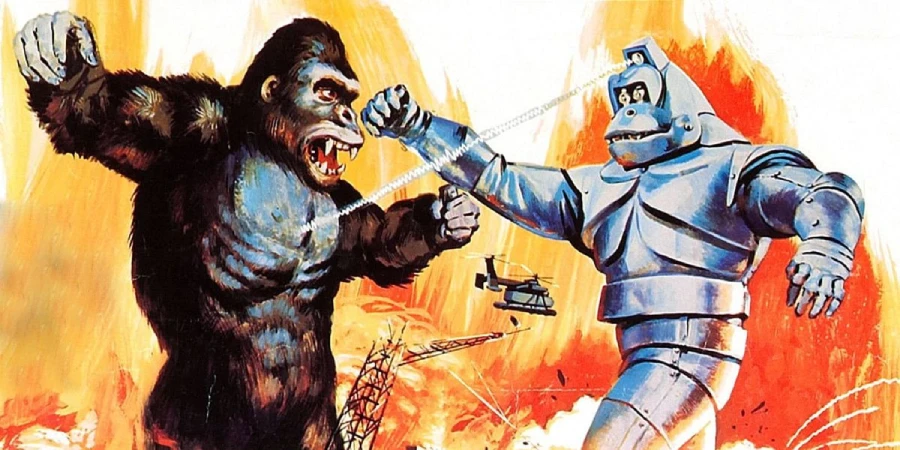

King Kong Escapes (1967) is one of the wildest and most entertaining entries in the long history of cinematic giant apes. Directed by Ishirō Honda, and produced by Toho, the film is a colorful, campy, and surprisingly ambitious crossover between classic monster cinema and 1960s spy-adventure aesthetics.
This is not the tragic, poetic Kong of 1933. This is pop-art, Saturday-morning-serial, mech-battle Kong — and it’s glorious.
Detailed Summary
The Discovery of Kong on Mondo Island
The film opens with an expedition led by Lieutenant Commander Carl Nelson (Rhodes Reason), who travels to the remote Mondo Island in search of a mysterious energy substance called Element X. Instead of just scientific intrigue, they discover that King Kong is very much alive, ruling the island and defending it from a giant sea serpent.
Unlike darker Kong portrayals, this version leans into spectacle and adventure. Kong is less tragic beast and more misunderstood powerhouse.
Dr. Who and Mechani-Kong
Meanwhile, we meet the fabulously over-the-top villain Dr. Who (played by Hideyo Amamoto). Yes, that’s his actual name — and no, it has nothing to do with the British TV series.
Dr. Who has constructed a robotic duplicate called Mechani-Kong, designed to mine Element X from the North Pole. However, the extreme radiation interferes with the robot’s circuitry. His solution? Capture the real Kong and force him to do the job.
This is where the movie fully embraces its pulp energy. A robot doppelgänger of Kong, an Arctic base, mind-control technology — it’s all here.
Kong Captured
Dr. Who kidnaps Susan Miller (Linda Miller), hoping to lure Kong into captivity, as Kong has developed a protective bond with her. Kong is captured and transported to the Arctic, where he is hypnotized to mine Element X.
However, Kong’s emotional attachment to Susan proves stronger than the mind control. He breaks free, destroys the villain’s base, and escapes.
This is a key turning point: Kong is no longer a passive victim — he actively rebels.

Movie Ending
The final act moves to Tokyo, and things escalate beautifully.
After Kong escapes Dr. Who’s Arctic facility, Mechani-Kong is deployed again to stop him. The two giant apes clash in one of the most memorable kaiju battles of the 1960s. The fight begins near Tokyo Tower, which becomes a major battleground.
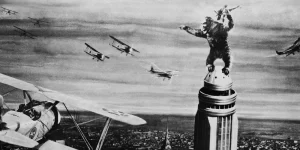
Mechani-Kong climbs Tokyo Tower in an eerie visual echo of the Empire State Building scene from the 1933 King Kong. But this time, the dynamic is different. Instead of planes shooting Kong down, we get a mechanical monster showdown.
The fight is surprisingly intense for its era. Sparks fly. Buildings crumble. Mechani-Kong uses spinning hands and mechanical weaponry. Kong fights with brute strength and instinct. Eventually, Kong tears Mechani-Kong apart, defeating his robotic counterpart.
Dr. Who attempts to flee but is killed during the chaos, crushed by falling debris after Mechani-Kong is destroyed. It’s a blunt but fitting end for such an operatic villain.
In the aftermath, Kong climbs Tokyo Tower once more. Military forces hesitate — they prepare to attack, but Susan intervenes, pleading that Kong be allowed to return home. Rather than replaying the tragic 1933 ending, the film makes a bold tonal choice.
Kong climbs down and returns peacefully to the sea, swimming back toward Mondo Island. He is not killed, not captured. He survives.
This ending reinforces the film’s lighter, more adventurous tone. It closes not with tragedy, but with escape and survival, making the title literal.
Are There Post-Credits Scenes?
No. King Kong Escapes does not include any post-credits or mid-credits scenes. Once the film ends, it ends.
Type of Movie
King Kong Escapes is a colorful blend of kaiju monster film, sci-fi adventure, and 1960s spy-inspired pulp spectacle. It leans more toward campy action than horror, embracing comic-book energy rather than tragedy.
Cast
- Rhodes Reason as Commander Carl Nelson
- Linda Miller as Susan Miller
- Mie Hama as Madame Piranha
- Hideyo Amamoto as Dr. Who
- Haruo Nakajima as King Kong (suit actor)
Haruo Nakajima is particularly notable — he was also the original performer inside the Godzilla suit.
Film Music and Composer
The score was composed by Akira Ifukube, best known for creating the iconic Godzilla theme. His music here is bold, brassy, and heroic, giving Kong a sense of grandeur and momentum.

Filming Locations
The film was shot primarily at Toho Studios in Tokyo using elaborate miniatures and suitmation techniques. Tokyo itself becomes an important narrative location, especially during the climactic Tokyo Tower battle. The Arctic base sequences were studio-built sets designed to emphasize cold isolation and villainous secrecy.
Tokyo Tower functions symbolically — it visually references the Empire State Building while grounding the story firmly in Japan’s cinematic monster tradition.
Awards and Nominations
The film did not receive major international awards but has since gained cult recognition among kaiju fans. Its importance lies more in its legacy within Toho’s monster catalog than in awards recognition.
Behind the Scenes Insights
- The film was inspired by an animated series called The King Kong Show, which explains its lighter tone.
- This was a rare official collaboration between Toho and American rights holders of King Kong.
- Mechani-Kong’s design influenced later Toho mechanical monsters like Mechagodzilla.
- Linda Miller performed many of her own scenes without extensive stunt doubling.
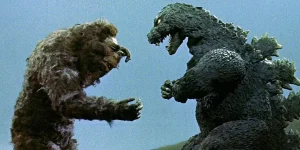
- The Kong suit used here was different from the one in King Kong vs. Godzilla, redesigned to appear more expressive.
Inspirations and References
The film draws from:
- The original King Kong
- The animated The King Kong Show
- The broader Toho kaiju universe
- Cold War-era sci-fi villain tropes
Mechani-Kong is essentially a proto-Mechagodzilla concept — technology attempting to replicate and control nature.
Alternate Endings and Deleted Scenes
There is no widely documented alternate ending. However, some international cuts trimmed dialogue scenes for pacing. No significantly different finale has been confirmed.
Book Adaptations and Differences
The film was not directly adapted from a novel but from The King Kong Show animated series concept. Compared to the cartoon, the film adopts a more traditional monster-movie structure and increases the scale of destruction and drama.


Memorable Scenes and Quotes
Key Scenes
- Kong battling the giant sea serpent on Mondo Island
- Mechani-Kong mining Element X in the Arctic
- Kong breaking free from mind control
- The climactic Kong vs. Mechani-Kong battle at Tokyo Tower
Iconic Quotes
- Dr. Who: “The world will bow to me!”
- Susan: “He’s not a monster. He saved me.”
Easter Eggs and Hidden Details
- Tokyo Tower mirrors the Empire State Building imagery.
- Mechani-Kong foreshadows Mechagodzilla.
- Madame Piranha’s name is a deliberate pulp-style exaggeration.
- The Arctic base design resembles classic Bond villain lairs.
Trivia
- This was one of the last major 1960s Toho monster spectacles before the genre shifted tone in the 1970s.
- Haruo Nakajima considered the Kong suit less comfortable than the Godzilla suit.
- The English-language version was widely distributed in the United States.
Why Watch?
Because it’s giant ape vs. robot double in 1967 Tokyo.
It’s bold, weird, colorful, and historically important. If you appreciate practical effects, miniature destruction, and retro sci-fi charm, this is essential viewing.
Director’s Other Works (Ishirō Honda)
- Godzilla (1954)
- Mothra vs. Godzilla (1964)
- The War of the Gargantuas (1966)
- Rodan (1956)
Honda helped define the kaiju genre itself.
Recommended Films for Fans
- King Kong vs. Godzilla (1962)
- Godzilla vs. Mechagodzilla (1974)
- The Mighty Peking Man (1977)
- Kong: Skull Island (2017)