
A father’s frantic love letter to his dying son is written with a gun and a hostage crisis. John Q. Archibald is not a monster; in reality, he is a man pushed to the absolute edge by a flawed system. Consequently, the film weaponizes a parent’s desperation, creating a gripping and controversial thriller about societal failings.
Detailed Summary
The story of John Q is a powerful examination of one man’s breaking point. Therefore, the plot unfolds in a series of increasingly desperate moments that test the limits of love and ethics.
The Collapse
John Quincy Archibald is a Chicago factory worker struggling to make ends meet for his wife, Denise, and their young son, Michael. During a little league baseball game, Michael suddenly collapses while running to first base. After rushing him to Hope Memorial Hospital, John and Denise receive devastating news. Michael has an enlarged heart and will die without an urgent heart transplant.
The Financial Wall
The family’s joy at finding a solution is short-lived. Hospital administrator Rebecca Payne informs them that their health insurance policy does not cover the surgery. Specifically, the company recently changed John’s status from full-time to part-time, downgrading his coverage. The procedure costs $250,000, and they require a $75,000 down payment simply to place Michael on the transplant list. Payne, therefore, suggests they prepare for their son’s death.
Desperate Measures
John and Denise spend the next few weeks trying frantically to raise the money. They sell their belongings and seek help from their church, but they still fall far short. Meanwhile, Michael’s condition worsens, and the hospital prepares to discharge him. Payne delivers the final blow, stating they will send Michael home to die. This act of cold bureaucracy, as a result, becomes John’s final push into desperation.
The Hostage Situation
With no options left, John walks into the Hope Memorial Hospital emergency room with a handgun he claims is empty. He takes a group of patients and staff hostage, including the callous cardiologist, Dr. Raymond Turner. John’s one demand is simple: put his son’s name on the transplant recipient list. He barricades the doors and a tense standoff begins.
The Standoff
Outside, veteran hostage negotiator Frank Grimes and bullish Police Chief Gus Monroe manage the crisis. The media, led by an ambitious reporter, soon arrives and turns the event into a public spectacle. Inside, John is surprisingly calm and empathetic, even treating one of the hostages with Dr. Turner’s help. The hostages, after hearing his story, begin to sympathize with his plight. This public support grows as John’s story is broadcast on television.
The Ultimatum
As hours pass, Chief Monroe grows impatient and orders a sniper to take a shot. The sniper misses John but wounds him in the shoulder. Infuriated, John fires a warning shot and presents his final ultimatum. He reveals his intention to commit suicide so his own heart can be transplanted into his son. He pressures Dr. Turner to perform the surgery, giving the hospital one hour to prepare.


Movie Ending
The climax of John Q is a masterclass in tension and emotional misdirection. John prepares for his own death, saying a tearful goodbye to Michael over a video call. However, just as he places the gun to his head, his wife Denise receives miraculous news. A matching donor heart has become available from a recently deceased car crash victim. She frantically relays this information to the police.
Grimes gets the news to John just moments before he can pull the trigger. Consequently, John allows the medical team to bring Michael into the operating room for the transplant. After ensuring the surgery is underway, John releases the hostages. He then walks out of the ER, surrendering to the police.
The film concludes with John’s trial. His lawyer argues that his actions, while illegal, were necessary and ultimately saved his son’s life. News reports show that the hostage crisis has sparked a national debate on healthcare reform. Although he is acquitted of attempted murder and armed criminal action, the court finds John guilty of kidnapping and false imprisonment. He accepts his prison sentence, knowing his son is alive and well.
Are There Post-Credits Scenes?
No, John Q does not have any post-credits or mid-credits scenes. Once the final credits begin to roll, the film is officially over.
Type of Movie
John Q is primarily a crime thriller and a social drama. The film uses the tense structure of a hostage movie to deliver a sharp critique of the American healthcare system. Its tone is largely serious and emotionally charged, although it features moments of dark humor and unexpected warmth between John and his hostages. Ultimately, it functions as a powerful, albeit melodramatic, morality play.
Cast
- Denzel Washington – John Quincy Archibald
- Kimberly Elise – Denise Archibald
- Daniel E. Smith – Michael “Mike” Archibald
- Robert Duvall – Lt. Frank Grimes
- James Woods – Dr. Raymond Turner
- Anne Heche – Rebecca Payne
- Ray Liotta – Chief Gus Monroe
- Eddie Griffin – Lester Matthews
- Shawn Hatosy – Mitch Quigley
- Laura Harring – Gina Palumbo
Film Music and Composer
The score for John Q was composed by Aaron Zigman. This film marked his debut as a feature film composer, a journey he began after a successful career arranging for pop artists like Christina Aguilera and the Backstreet Boys. The music is emotionally resonant, effectively underscoring the story’s dramatic weight. Notably, the score avoids typical thriller clichés, instead focusing on a more sweeping, orchestral sound to highlight the human drama. The licensed soundtrack also includes the powerful song “I Believe I Can Fly” by R. Kelly.


Filming Locations
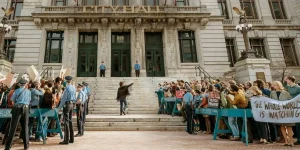
Despite being set in Chicago, a significant portion of John Q was filmed in Toronto, Ontario, Canada. Various Toronto landmarks and streets were dressed to resemble the Windy City. For instance, the dramatic hospital exterior shots used a facility in Canada. However, some key exterior scenes and aerial shots were indeed filmed on location in Chicago to establish the setting authentically. The decision to film primarily in Canada was likely for budgetary reasons, a common practice in the film industry.
Awards and Nominations
While not a major awards contender, John Q received recognition for its powerful performances and themes. Most notably, Denzel Washington won the “Outstanding Actor in a Motion Picture” award at the NAACP Image Awards. The film itself was also nominated for “Outstanding Motion Picture” at the same event. In addition, Kimberly Elise and Daniel E. Smith received nominations for their supporting roles.
Behind the Scenes Insights
- Director Nick Cassavetes’s own daughter, Sasha, has a congenital heart defect. As a result, his personal experiences with the healthcare system profoundly influenced his direction and the film’s passionate tone.
- Denzel Washington did extensive research for the role. He interviewed people who had been in similar financial and medical predicaments to understand the desperation his character felt.
- The script, written by James Kearns, had been in development hell for almost a decade before Cassavetes and Washington signed on. At one point, legendary director Sydney Lumet was attached to direct.
- Actor James Woods, who plays Dr. Turner, improvised many of his character’s sarcastic and cynical lines, adding a layer of authenticity to the burnt-out cardiologist.
Inspirations and References
The plot of John Q bears a striking resemblance to a real-life event that occurred in Toronto in 1998. A man named Henry Masuka stormed a doctor’s office and took a hostage after his son was denied life-saving treatment. Furthermore, the film draws inspiration from the 1975 classic Dog Day Afternoon, which also features a sympathetic protagonist who takes hostages out of desperation, becoming a media sensation and a public hero in the process. Both films explore how the media can shape public perception of a crisis.
Alternate Endings and Deleted Scenes
The original script by James Kearns reportedly had a much darker ending. In that version, John Q. successfully commits suicide, and his heart is indeed transplanted into his son. However, director Nick Cassavetes and the studio opted for a more hopeful, albeit less shocking, conclusion. They believed the current ending, where a donor heart becomes available fortuitously, better served the story’s emotional core without glorifying suicide. Several deleted scenes also focused more on the side stories of the hostages, but these were cut to maintain focus on John’s journey.
Book Adaptations and Differences
John Q is not based on a book. It is an original screenplay written by James Kearns. Therefore, there are no literary sources to compare it to. The story was conceived entirely as a feature film, designed to provoke discussion about its timely social issues.


Memorable Scenes and Quotes
The film is packed with tense standoffs and emotional confrontations that have cemented its place in popular culture.
Key Scenes
- The Diagnosis: The cold, sterile moment when Dr. Turner and Rebecca Payne inform John that his son’s life has a price tag. This scene perfectly establishes the film’s central conflict.
- The Takeover: John’s fumbling but determined takeover of the ER. His initial uncertainty quickly hardens into resolve, marking his irreversible transition from worried father to desperate criminal.
- The Goodbye: John’s video call with Michael, where he pretends he is going on a long trip. It is a gut-wrenching scene filled with subtext, representing the ultimate parental sacrifice.
Iconic Quotes
- “I’m not going to bury my son! My son is going to bury me!” – John’s defiant cry to Rebecca Payne, encapsulating his entire motivation.
- “It’s the system! That’s the problem! And you’re a part of it!” – John explaining his actions to Dr. Turner.
- “This is not a negotiation. It’s a revolution.” – A hostage, Julie, on the phone, showing how the captives have switched their allegiance to John.
Easter Eggs and Hidden Details
- In the opening scene, a sticker on a woman’s car reads “We support HMOs,” followed by a gunshot sound as the car is hit. This detail foreshadows the film’s direct conflict with the healthcare industry.
- When news channels are covering the story, one of the talking heads is a “Dr. Klein.” This is a likely nod to renowned healthcare ethicist Dr. Rudolf Klein.
- The name of the hospital, “Hope Memorial,” serves as a deeply ironic setting for the story, where hope is systematically denied to those who cannot afford it.
Trivia
- The gun Denzel Washington’s character uses is a Taurus PT92. In a pivotal moment, he reveals it is unloaded, though he later finds a single bullet, raising the stakes.
- Rapper Eve and actor Kevin Connolly have small cameo roles in the film. Connolly plays one of John’s coworkers seen at the beginning of the movie.
- The film’s theatrical trailer famously used a dramatic voiceover stating, “What if your son needed a new heart? And the only one that matched was yours?” This tagline, however, misrepresents the film’s actual ending.
Why Watch?
Watch this film for a powerhouse performance from Denzel Washington. It is a gripping thriller that forces you to question what you would do for family. Moreover, its critique of healthcare remains incredibly relevant and thought-provoking today.
Director’s Other Movies
- The Notebook (2004)
- Alpha Dog (2006)
- My Sister’s Keeper (2009)
- The Other Woman (2014)
Recommended Films for Fans
- Dog Day Afternoon (1975)
- Falling Down (1993)
- The Negotiator (1998)
- Inside Man (2006)
- Dallas Buyers Club (2013)