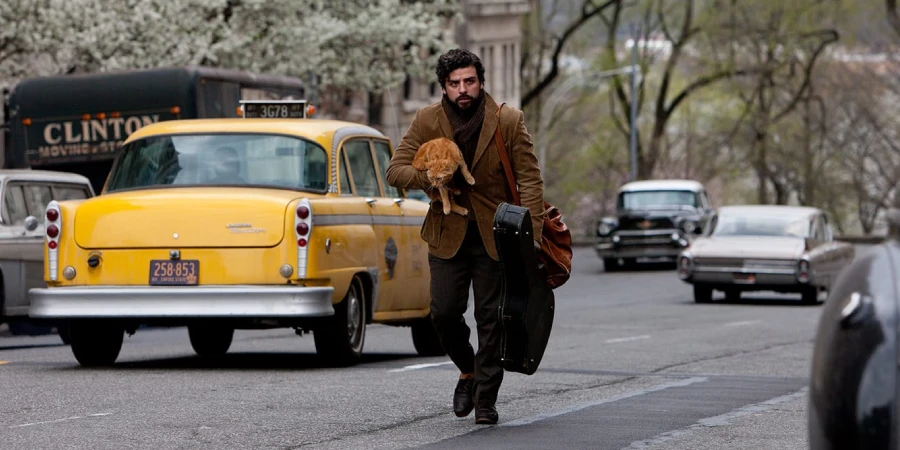

Inside Llewyn Davis is one of the Coen Brothers’ most introspective and quietly devastating films. Set in the early 1960s New York folk scene, it follows a struggling musician caught in an endless loop of failure, pride, and bad timing. This is not a movie about success; it’s about existing on the margins of it.
Detailed Summary
A Week in the Life of a Losing Folk Singer
The film follows Llewyn Davis, a folk singer trying to survive in Greenwich Village after the suicide of his musical partner, Mike. With no stable home, no money, and no clear future, Llewyn drifts from couch to couch, carrying his guitar and his growing bitterness.
From the opening scene, where he performs at the Gaslight Café and is beaten up in an alley afterward, we understand the rhythm of the film: perform, hope, fail, repeat.
The Cat: A Metaphor That Won’t Leave Him Alone
Early on, Llewyn accidentally loses the cat of the couple hosting him. The cat accompanies him through much of the movie, disappearing and reappearing like Llewyn’s own sense of direction. The cat is widely interpreted as a symbol of Llewyn’s guilt, responsibility, and inability to commit.
Chicago Trip: Hope That Goes Nowhere
Desperate for a break, Llewyn hitchhikes to Chicago to audition for a powerful music manager. The journey is cold, uncomfortable, and emotionally draining. When he finally performs, the verdict is brutal: he’s talented, but not marketable. No deal. No encouragement. Just honesty.
This moment crystallizes the film’s thesis: talent alone is not enough, and timing matters more than effort.
Back to New York, Back to Nothing
Returning to New York, Llewyn finds that Jean (his former lover) wants nothing to do with him, his sister is tired of helping him, and even the folk community is moving on without him. He briefly considers rejoining the merchant marine, effectively giving up music, but even that option slips away.
The film slowly closes in on the idea that Llewyn is trapped by his own personality as much as by circumstance.

Movie Ending
Llewyn returns to the Gaslight Café and performs the same song we heard at the beginning of the movie. Afterward, he steps outside and is once again beaten up by the same man. The implication is clear: we have come full circle. Nothing has changed. This entire film has been one cycle in Llewyn’s life.
As Llewyn walks away, the camera lingers inside the club, where a young Bob Dylan (never named, but unmistakable) begins to perform. This moment is crucial. While Llewyn is stuck repeating his failures, history is quietly moving past him. The folk revolution is about to explode, but Llewyn won’t be part of it.
The ending answers the film’s central question with brutal honesty: What happens to the talented people who don’t make it? They don’t get redemption arcs. They just keep going, or they fade away.
Are There Post-Credits Scenes?
No. Inside Llewyn Davis does not include any post-credits or mid-credits scenes. The story ends exactly where it needs to, reinforcing its cyclical nature.
Type of Movie
Inside Llewyn Davis is a character-driven drama with strong elements of dark comedy. It blends musical performance with existential realism, focusing more on internal struggle than external plot.
Cast
- Oscar Isaac as Llewyn Davis
- Carey Mulligan as Jean Berkey
- Justin Timberlake as Jim Berkey
- John Goodman as Roland Turner
- Garrett Hedlund as Johnny Five
- F. Murray Abraham as Bud Grossman
Film Music and Composer
The film’s music was curated and produced by T Bone Burnett, with performances recorded live on set. Oscar Isaac performs all of Llewyn’s songs himself, giving the music a raw, unpolished authenticity that mirrors the character’s life.

Filming Locations
The film was shot primarily in New York City and Chicago, with additional work done in rural areas to capture the bleak winter landscapes. Greenwich Village is essential to the story, representing both artistic hope and creative suffocation. The cold, muted color palette reinforces the emotional isolation of the protagonist.
Awards and Nominations
- Grand Prix, Cannes Film Festival (Winner)
- Academy Awards (2014):
- Nominated for Best Cinematography
- Nominated for Best Sound Mixing
- Golden Globe Awards:
- Nominated for Best Actor – Oscar Isaac
Behind the Scenes Insights
- Oscar Isaac learned guitar and folk singing techniques specifically for the role.
- The Coen Brothers insisted on live performances rather than lip-syncing.
- Many minor characters are composites of real-life folk musicians from the era.
- The Coens intentionally avoided romanticizing the folk scene.
Inspirations and References
The film is loosely inspired by Dave Van Ronk’s memoir The Mayor of MacDougal Street. Llewyn is not a direct adaptation, but the book’s tone, environment, and philosophy heavily influenced the screenplay.
Alternate Endings and Deleted Scenes
No alternate ending has been officially released. However, several musical performances were trimmed for pacing. The Coens have stated that the cyclical ending was always the plan and never seriously reconsidered.
Book Adaptations and Differences
While inspired by Dave Van Ronk’s memoir, the film diverges significantly. Van Ronk eventually found recognition and stability, while Llewyn does not. The movie deliberately removes the idea of eventual success to explore failure as a final state.

Memorable Scenes and Quotes
Key Scenes
- Llewyn’s opening performance at the Gaslight Café
- The recording of “Please Mr. Kennedy”
- The Chicago audition scene
- The final reveal of Bob Dylan on stage
Iconic Quotes
- “I don’t see a lot of money here.” – Bud Grossman
- “If it was never new, and it never gets old, then it’s a folk song.”
- “I just don’t see you going anywhere.”
Easter Eggs and Hidden Details
- The street signs and posters reflect real 1961 folk events.
- The repeated alley beating mirrors the film’s circular narrative.
- Llewyn’s songs subtly change in tempo, reflecting his emotional state.
Trivia
- Oscar Isaac’s breakout performance led directly to major roles in later years.
- The cat was played by multiple animals due to scheduling and behavior issues.
- The Coens wrote the script while listening to early folk recordings.
Why Watch?
Watch this film if you’re interested in the stories that don’t end in triumph. It’s a meditation on missed chances, ego, and the uncomfortable truth that not everyone who deserves success gets it. Quiet, sad, funny, and deeply human.
Director’s Other Works
- Blood Simple (1984)
- Raising Arizona (1987)
- Miller’s Crossing (1990)
- Fargo (1996)
- The Big Lebowski (1998)
- No Country for Old Men (2007)
- A Serious Man (2009)