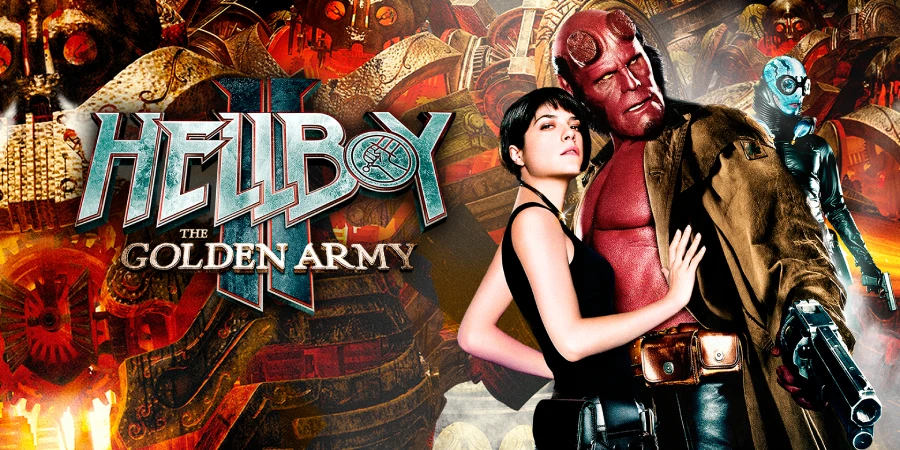
Hellboy II: The Golden Army (2008), directed by Guillermo del Toro, expands the Hellboy universe with rich folklore, stunning creature designs, and a darker emotional core.
Detailed Summary
The Ancient Truce and the Creation of the Golden Army
The film opens with a bedtime story from Professor Broom to young Hellboy, explaining an ancient war between humans and magical creatures. King Balor, seeking to end the bloodshed, commissioned an unstoppable mechanical force known as the Golden Army. Horrified by its destructive power, he eventually agreed to a truce: magical creatures would stay to forests and wild lands, and humans to cities. But his son, Prince Nuada, rejected this deal and went into exile.
This mythic prologue lays the foundation for the conflict to come and hints at Nuada’s tragic, complex motivations.
Prince Nuada’s Return
Nuada resurfaces to reclaim the three pieces of the magical crown required to control the Golden Army. He kills various magical beings in the Troll Market and executes his own father to acquire one of the crown fragments. His twin sister, Princess Nuala, escapes with the last piece, setting her on a collision course with Hellboy and the BPRD.
Hellboy and Liz’s Relationship Issues
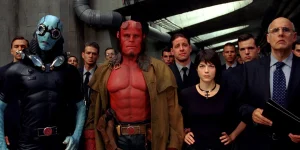
Hellboy (Ron Perlman) and Liz (Selma Blair) struggle with Liz’s unexpected pregnancy—a secret she keeps from Hellboy—amidst the turbulence of their relationship. While Hellboy craves public acceptance, Liz wishes he were more grounded and careful, creating the emotional core of the film.
The Troll Market and Johann Krauss
The search for clues leads the BPRD to the Troll Market, one of the film’s most visually impressive sequences. Here they meet Johann Krauss, a vaporous ectoplasmic being contained in a robotic suit, who becomes the new team leader. His strict, by-the-book methods constantly clash with Hellboy’s impulsive behavior.
The Angel of Death
After an attack leaves Hellboy mortally wounded, the group visits the Angel of Death—a haunting creature even by del Toro standards. The angel warns Liz that Hellboy will someday doom humanity if he lives. She chooses to save him anyway, a moment that reveals her unwavering loyalty but also plants seeds of future tragedy.
Movie Ending
The climax unfolds inside an ancient underground city where Nuada activates the Golden Army, which instantly obeys him. Hellboy challenges Nuada to single combat under the ancient laws that the army must obey.
The duel is beautifully choreographed and comes down to a final exchange where Nuada realizes he cannot defeat Hellboy. But it’s Nuala—connected to her twin by a magical life bond—who ultimately stops him. She impales herself to prevent Nuada from continuing his violent crusade, dying in Abe’s arms. Nuada collapses dead moments later.
The Golden Army shuts down, now under Hellboy’s control. Hellboy destroys the crown’s last piece, choosing peace instead of power, and ensuring the Golden Army will never rise again.
In the fallout, Hellboy, Liz, Abe, and Johann all quit the BPRD, frustrated with bureaucracy and eager to take control of their own destinies. Liz finally reveals she’s pregnant—with twins, leaving Hellboy stunned and setting up future story possibilities that were never realized due to the lack of a sequel.
Are There Post-Credits Scenes?
There are no post-credits scenes in Hellboy II: The Golden Army. Once the credits roll, the story truly ends, with no extra teases or bonus sequences.
Type of Movie
The film is a dark fantasy action-adventure with comic-book roots. It blends supernatural folklore with superhero storytelling, adding a layer of emotional complexity rarely seen in genre films at the time.
Cast
- Ron Perlman as Hellboy
- Selma Blair as Liz Sherman
- Doug Jones as Abe Sapien (and also the Angel of Death & the Chamberlain)
- Luke Goss as Prince Nuada
- Anna Walton as Princess Nuala
- Seth MacFarlane as the voice of Johann Krauss
- John Hurt as Professor Broom (flashback)
Film Music and Composer
The score is composed by Danny Elfman, who leans into gothic, whimsical, and melancholic tones. His work adds emotional weight to key scenes—especially the mythic prologue and Hellboy’s confrontation with destiny.

Filming Locations and Their Importance
The movie was primarily filmed in Hungary, Ireland, and London.
- Budapest & Hungarian studios: Served as major set locations for the Troll Market and underground city scenes. The architectural textures of Budapest helped maintain a timeless, mystical aesthetic.
- Northern Ireland: Used for exteriors tied to ancient landscapes, reinforcing the movie’s folklore-heavy tone.
- London: Provided modern urban environments, contrasting the magical underworld and emphasizing the conflict between humans and mythical beings.
The locations were chosen to echo the film’s central theme: the uneasy coexistence of human cities and old supernatural worlds.
Awards and Nominations
- Won Best Makeup at the Saturn Awards
- Nominated for several Saturn Awards including Best Fantasy Film and Best Director
- Received nominations for visual effects and production design from various guilds
Although not a major awards powerhouse, the film was widely praised for its creature design and visual imagination.
Behind the Scenes Insights
- Guillermo del Toro designed many creatures himself, creating hundreds of concept sketches.
- Ron Perlman endured hours of makeup each day yet remained upbeat according to cast members.
- Luke Goss trained extensively in martial arts to perform almost all his own stunts.
- Doug Jones performed multiple roles, pushing his physical acting abilities to the limit, especially as the Angel of Death.
- The Troll Market sequence required over 150 creature designs—one of del Toro’s most ambitious scenes.
- Seth MacFarlane’s voice for Johann Krauss was so unexpected that cast members reportedly had difficulty staying serious during takes.
Inspirations and References
- Based loosely on the Dark Horse Hellboy comic arcs created by Mike Mignola.
- Heavy inspiration from Celtic mythology, European folklore, and steampunk designs.
- Del Toro’s personal fascination with ancient truce legends influenced the story’s central conflict.
- Many creature designs echo medieval bestiaries and Renaissance interpretations of mythical beings.
Alternate Endings and Deleted Scenes
While no major alternate ending exists, several deleted scenes include:
- Extended Troll Market interactions showing more creature species.
- A longer emotional farewell between Abe and Nuala.
- A comedic subplot about Hellboy’s desire for public recognition that was trimmed for pacing reasons.
Book Adaptations and Differences
The film draws on multiple Hellboy comics rather than adapting a single storyline.
Key differences:
- Prince Nuada and Nuala are original characters created for the film.
- The Golden Army storyline is loosely inspired by steampunk elements in Mignola’s art but does not directly adapt any single comic arc.
- Tone-wise, the film is more romantic and tragic than most Hellboy comics.
Memorable Scenes and Quotes
Key Scenes
- The mechanical giants of the Golden Army awakening in unison.
- Hellboy and Abe getting drunk while listening to love songs—a surprisingly heartfelt comedy moment.
- Hellboy confronting the Elemental in a visually breathtaking street battle.
- The haunting encounter with the Angel of Death.
- Abe choosing love over duty as he attempts to protect Princess Nuala.
Iconic Quotes
- Hellboy: “I’m not a very good shot… but the Samaritan is.”
- Prince Nuada: “Let this remind you why you once feared the dark.”
- Abe Sapien: “I always like to think there’s a chance.”
- Hellboy: “We’ll do it together. Always.”
Easter Eggs and Hidden Details
- The tooth fairies are inspired by del Toro’s original concept art from early Pan’s Labyrinth development.
- Hellboy’s locker contains numerous props referencing past BPRD missions.
- Del Toro inserted background cameos of creatures inspired by classic European folklore (kobolds, leshys, banshees).
- The Angel of Death’s design is mirrored in other del Toro films, hinting at his personal mythology.
Trivia
- Del Toro wanted to make Hellboy III immediately afterward, but studio conflicts prevented it.
- Ron Perlman wore heavier prosthetics than in the first film due to enhanced detailing.
- The Golden Army soldiers were partly practical miniatures combined with CG effects.
- Selma Blair kept Liz’s lighter as a keepsake after filming wrapped.
- The Troll Market took three months to build and was one of the largest sets del Toro ever created.
Why Watch?
Because it’s Guillermo del Toro at full artistic power, delivering a mix of emotional storytelling, dazzling fantasy, and thoughtful themes about coexistence and destiny. The film is both visually poetic and wildly entertaining, making it one of the most distinctive comic-book movies ever made.
Director’s Other Movies
- Cronos (1993)
- The Devil’s Backbone (2001)
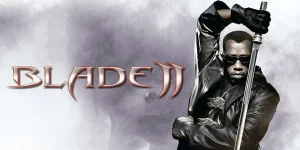
- Blade II (2002)
- Pan’s Labyrinth (2006)
- Pacific Rim (2013)
- Crimson Peak (2015)
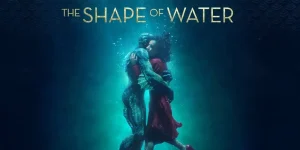
- The Shape of Water (2017)