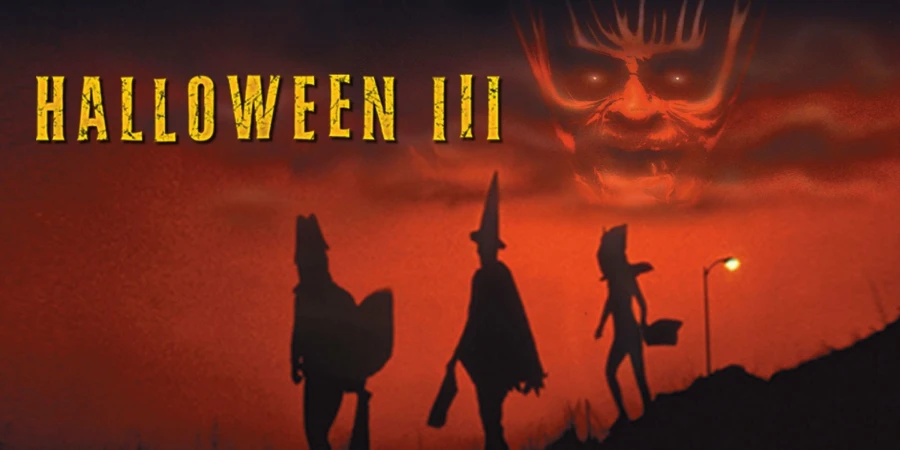

Halloween III: Season of the Witch is the most controversial entry in the Halloween franchise, mainly because Michael Myers is completely absent. Instead, the film attempts to transform Halloween into an anthology series, focusing on a standalone story rooted in ancient pagan horror, technology, and corporate evil. Over the years, what was once rejected by fans has become a cult classic.
Detailed Summary
A Disturbing Beginning: Masks, Fear, and Death
The film opens with a frantic man being chased by mysterious figures in suits. He clutches a Silver Shamrock mask and repeatedly mutters, “They’re going to kill us all.” He collapses in a hospital and is murdered in his bed by one of the pursuers, who then sets himself on fire. This shocking opening immediately establishes that this will not be a traditional slasher film.
Dr. Dan Challis Enters the Nightmare
Dr. Dan Challis, a cynical and emotionally detached physician, becomes involved after the victim’s daughter, Ellie Grimbridge, asks for help uncovering the truth behind her father’s death. Together, they trace the mask to Silver Shamrock Novelties, a company that dominates the Halloween mask market.
Santa Mira: The Town That Feels Wrong
Their investigation leads them to Santa Mira, California, a seemingly idyllic town controlled almost entirely by Silver Shamrock. The town feels artificial and unsettling. Surveillance cameras are everywhere, children behave strangely, and residents appear oddly loyal to the company.
The factory owner, Conal Cochran, welcomes visitors with eerie charm. He speaks obsessively about Halloween’s ancient roots and hints that the holiday once held a far darker purpose.
The Horrifying Truth About the Masks
Dan discovers that Silver Shamrock masks contain microchips embedded with fragments of Stonehenge, fused with advanced technology and dark magic. When activated during a specific TV broadcast, the masks will kill the wearer—mostly children—in grotesque ways involving insects, snakes, and total bodily destruction.
Ellie is captured and replaced with an android duplicate, revealing that Cochran has mastered artificial human replicas used to enforce his will.
Escape and Countdown to Doom
Dan barely escapes the factory and races against time to stop the broadcast scheduled for Halloween night. As millions of children prepare to watch the Silver Shamrock jingle on television, the scope of the threat becomes global.
Movie Ending
Dan manages to sabotage the Silver Shamrock factory by triggering Cochran’s own ritual machinery, killing Cochran and destroying much of the operation. However, this victory is only partial.
The television broadcast has already begun.
In the final sequence, Dan desperately contacts television stations, begging them to stop airing the Silver Shamrock commercial. He succeeds with two channels, but the third major network refuses to pull the ad, assuming it’s a prank or ratings stunt.
The film ends with Dan screaming into the phone:
“Stop it! Stop it! Turn it off!”
The screen cuts to black before we learn whether the final broadcast is stopped. The implication is horrifying: millions of children may have just been killed, and the audience is left to sit with that uncertainty. There is no heroic triumph, no reassurance—only dread.
This ending is often cited as one of the darkest finales in 1980s horror cinema.
Are There Post-Credits Scenes?
No. Halloween III does not include any post-credits or mid-credits scenes. The film ends abruptly, reinforcing its nihilistic tone.
Type of Movie
Halloween III is a science-fiction-infused horror film with strong elements of folk horror and dystopian thriller, blending ancient mythology with modern technological paranoia.
Cast
- Tom Atkins as Dr. Dan Challis
- Stacey Nelkin as Ellie Grimbridge
- Dan O’Herlihy as Conal Cochran
- Michael Currie as Rafferty
- Ralph Strait as Buddy Kupfer Sr.
Film Music and Composer
The score was composed by John Carpenter and Alan Howarth. Unlike the iconic Halloween theme, the music here is heavily synth-driven and hypnotic, enhancing the film’s sense of technological menace. The Silver Shamrock jingle is intentionally catchy and psychologically invasive.
Filming Locations
The film was shot primarily in California, with the town of Santa Mira constructed to feel artificial and controlled. This setting reinforces the film’s themes of corporate dominance and loss of individuality. The factory interiors emphasize cold industrial power rather than gothic horror.
Awards and Nominations
The film did not receive major awards at the time of release. Its critical reappraisal came decades later, where it gained recognition in cult horror circles and retrospective genre lists.
Behind the Scenes Insights
- John Carpenter wanted Halloween to become an anthology series, not a Michael Myers saga.
- The studio pushed Carpenter to include a Myers reference; he compromised by showing Halloween (1978) playing on a TV within the film.
- The android effects were inspired by Westworld (1973).
- Tom Atkins became a cult horror icon due to this and later genre roles.
Inspirations and References
The film draws inspiration from Celtic mythology, specifically Samhain rituals, combined with Cold War–era fears of mass media manipulation. It also echoes Invasion of the Body Snatchers and The Wicker Man (1973).
Alternate Endings and Deleted Scenes
Early concepts included a more explicit depiction of the broadcast’s aftermath, but Carpenter chose ambiguity. Some deleted scenes expanded Cochran’s mythology, but were removed to maintain pacing.
Book Adaptations and Differences
There is a novelization of the film that expands internal monologues and explains Cochran’s beliefs more clearly. The book provides slightly more closure but retains the grim ending.
Memorable Scenes and Quotes
Key Scenes
- The hospital murder and self-immolation
- The first mask activation test
- Ellie’s android reveal
- The final phone call to the TV station
Iconic Quotes
- “Happy, happy Halloween, Halloween, Halloween…”
- “Do I look like I know how a TV station works?”
- “It’s time. Time to give something back.”
Easter Eggs and Hidden Details
- Halloween (1978) plays on a TV, implying it exists as a movie within this universe.
- Cochran’s speech references real Celtic sacrificial traditions.
- The factory workers are mostly androids, hinted at long before the reveal.
Trivia
- The film was initially marketed as a Michael Myers sequel, leading to audience backlash.
- Roger Ebert later praised the film’s ambition despite its failure.
- The mask designs became real merchandise years later due to cult popularity.
Why Watch?
If you’re tired of predictable slashers, Halloween III offers something rare: a horror film willing to end without hope. Its themes of corporate control, media influence, and ritualized violence feel more relevant today than ever.
Director’s Other Works
- The Exorcist (1973) – producer
- Fright Night Part 2 (1988)
- IT (1990)
- The Langoliers (1995)