Godzilla Minus One is a powerful reinvention of the legendary monster franchise, returning Godzilla to his darkest roots. Directed by Takashi Yamazaki, the film combines large-scale destruction with deeply human drama, focusing not on superheroes or advanced technology, but on ordinary people trying to survive unimaginable trauma.
Detailed Summary
Post-War Japan and a Broken Protagonist
The story begins in 1945 Japan, immediately after World War II. The country is already devastated, morale is shattered, and resources are nearly nonexistent.
The protagonist, Kōichi Shikishima, is a former kamikaze pilot who deliberately avoided his suicide mission by claiming mechanical failure. This decision haunts him deeply. He carries intense survivor’s guilt and is branded a coward by his own conscience.
During an emergency landing on Odo Island, Kōichi witnesses the first appearance of Godzilla, then smaller but already terrifying. The creature attacks the base, killing nearly everyone. Kōichi survives again, strengthening his belief that he does not deserve to live.
Trying to Live After the War
Back in Tokyo, Kōichi finds his home destroyed and his parents dead. He meets Noriko, a young woman caring for an orphaned baby named Akiko. The three form an improvised family, not through romance or heroism, but out of shared loneliness.
Japan’s government is overwhelmed. The U.S. military refuses involvement due to rising Cold War tensions. Ordinary civilians are left to rebuild on their own.
Kōichi takes a dangerous job clearing naval mines from the sea, working alongside other veterans who also survived when they were supposed to die.
Godzilla’s Evolution and the Nuclear Metaphor
Godzilla resurfaces after exposure to American nuclear testing in the Pacific. This transforms him into the massive, nearly invincible monster seen in the film.
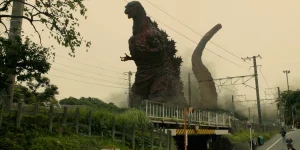
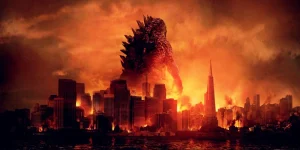
Unlike many modern versions, this Godzilla is not misunderstood or neutral. He is pure destruction. His atomic breath levels entire districts of Tokyo, portrayed with horrifying realism.
The devastation mirrors Japan’s experience with nuclear weapons. The film makes it clear that Godzilla is not just a monster but a walking embodiment of atomic trauma.
The Civilian Counterattack Plan
With no military support, a group of scientists, engineers, and veterans devise an unconventional plan using:
- Decommissioned warships
- Pressure-based buoyancy physics
- Explosive decompression
The plan is dangerous and relies heavily on human sacrifice, something the characters actively reject. Their goal is to defeat Godzilla without repeating the wartime mentality that treated lives as expendable.
Kōichi is chosen for the most dangerous role, confronting his fear that his life has no value.
Movie Ending
The final act delivers one of the most emotionally complex endings in the Godzilla franchise.
Godzilla approaches Tokyo once more, regenerating rapidly and destroying everything in his path. The civilian fleet launches its operation at sea. Using coordinated flooding mechanisms, they manage to pull Godzilla into extreme ocean depths, attempting to crush him through pressure.
The plan partially works but fails to kill him.
Godzilla resurfaces, wounded but alive.
At this point, Kōichi initiates the final contingency plan. He pilots a small aircraft directly toward Godzilla, intending to sacrifice himself by detonating explosives in the monster’s mouth.
Throughout the film, Kōichi has believed that dying is the only way he can atone for surviving the war.
At the last moment, however, his plane ejects automatically. Godzilla is critically damaged by the explosion and collapses into the ocean, seemingly destroyed.
Kōichi survives.
He returns to shore believing Noriko died earlier during Godzilla’s attack on Tokyo, where she was caught in the blast.
In the closing moments, Kōichi visits Noriko in the hospital. She is alive, badly injured but recovering. The family is reunited.
However, the final shot reveals something disturbing: black, vein-like marks spreading beneath Noriko’s skin, suggesting exposure to Godzilla’s radiation.
The implication is chilling.
Godzilla may be gone for now, but the damage he caused lives on within the survivors themselves.
The ending reinforces the film’s central theme:
war does not end when the fighting stops.
Are There Post-Credits Scenes?
No. There are no post-credits or mid-credits scenes in Godzilla Minus One. The story ends definitively with its final shot, leaving only thematic ambiguity rather than sequel bait.
Type of Movie
Godzilla Minus One is a kaiju disaster drama that blends historical war fiction with science fiction horror. Unlike many modern monster films, it places emotional realism and human trauma at the center of the narrative.
Cast
- Ryunosuke Kamiki as Kōichi Shikishima
- Minami Hamabe as Noriko Ōishi
- Yuki Yamada as Shirō Mizushima
- Munetaka Aoki as Sōsaku Tachibana
- Hidetaka Yoshioka as Kenji Noda
Film Music and Composer
The score is composed by Naoki Satō, who blends:
- Traditional orchestral tragedy
- Military-style percussion
- Updated arrangements of Akira Ifukube’s classic Godzilla themes
The music emphasizes sorrow more than spectacle, reinforcing the human cost of destruction.
Filming Locations
The film was shot primarily in Japan, with extensive use of digital environments.
Key locations include:
- Tokyo coastal districts recreated through CGI
- Odo Island sets built on sound stages
- Real historical references to post-war urban destruction
These locations matter because the film intentionally grounds fantasy in historical realism, making Godzilla’s attacks feel disturbingly authentic.
Awards and Nominations
- Academy Award for Best Visual Effects (2024) – Winner
- Japan Academy Film Prize – Multiple nominations
- Blue Ribbon Awards – Best Film nomination
This marked the first Godzilla film ever to win an Oscar.
Behind the Scenes Insights
- The film was made with a fraction of Hollywood monster-movie budgets.
- Takashi Yamazaki personally supervised visual effects.
- Over 600 VFX shots were completed by a very small team.
- Godzilla’s movement was designed to feel “heavy,” inspired by natural disasters rather than animals.
- The director cited emotional realism as more important than scale.
Inspirations and References
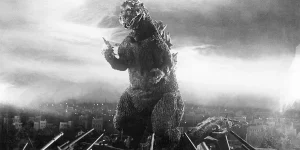
- The original Godzilla (1954)
- Post-war Japanese literature
- Testimonies from atomic bomb survivors
- Classic Showa-era Godzilla themes
- Japanese war films such as The Human Condition
Alternate Endings and Deleted Scenes
No alternate ending has been released publicly.
Some deleted scenes reportedly focused on extended domestic moments between Kōichi and Noriko, removed to preserve pacing and avoid softening the film’s bleak tone.
Book Adaptations and Differences
The film is not based on a novel or manga.
However, it intentionally mirrors the thematic structure of the 1954 film more closely than any modern adaptation, emphasizing fear, guilt, and accountability rather than heroism.

Memorable Scenes and Quotes
Key Scenes
- Godzilla’s first full atomic breath sequence in Ginza
- The silent aftermath of Tokyo’s destruction
- The mine-clearing ship crew confronting their mortality
- Kōichi’s final flight toward Godzilla
- The hospital reunion scene
Iconic Quotes
- “We survived. That must mean something.”
- “This country does not need more dead heroes.”
- “Living is not a sin.”
Easter Eggs and Hidden Details
- Godzilla’s roar is reconstructed from the 1954 original recordings.
- The regeneration effect mirrors earlier Toho designs frame by frame.
- Several ship names reference real WWII vessels.
- Background radios broadcast historically accurate post-war news reports.
- Godzilla’s theme is deliberately delayed until his full reveal.
Trivia
- Godzilla Minus One refers to Japan going from zero after the war to “minus” after Godzilla’s attack.
- The film outperformed many Hollywood blockbusters internationally.
- It became one of the highest-rated Godzilla films ever made.
- Director Takashi Yamazaki had never directed a kaiju film before.
Why Watch?
You should watch Godzilla Minus One if you want:
- A monster movie that treats destruction seriously
- Strong character-driven storytelling
- A return to Godzilla as a symbol of fear, not spectacle
- One of the most emotionally mature entries in the franchise
This is not just a monster film.
It is a story about survival, guilt, responsibility, and choosing to live.
Director’s Other Works (Movies)
- Always: Sunset on Third Street (2005)
- Always 2 (2007)
- The Eternal Zero (2013)
- Dragon Quest: Your Story (2019)
- Lupin III: The First (2019)