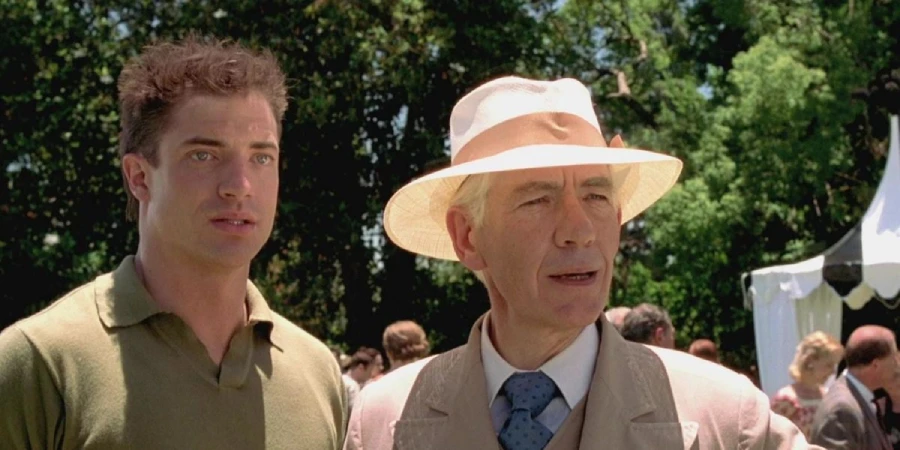

Bill Condon’s Gods and Monsters is a quiet, intimate, and emotionally devastating film built on memory, loneliness, and the fading of a once-great mind. Inspired by the final days of legendary director James Whale, the man behind Frankenstein (1931), the movie is less a biopic and more a psychological chamber piece about aging, regret, and human connection in unexpected places.
Detailed Summary
The Fading Mind of James Whale
We meet James Whale (Ian McKellen) in 1950s Los Angeles, long retired from filmmaking and living in semi-isolation. Whale is intelligent, sharp, and witty, but his mind is deteriorating after a series of strokes. He is haunted by memories of World War I, his career in Hollywood, and his loneliness as a gay man in an era that forces him into quiet obscurity.
His housekeeper Hanna (Lynn Redgrave) watches over him with strict moral concern, suspicious of Whale’s behavior and worried about his decline.
The Arrival of Clayton Boone
Whale becomes fascinated with Clayton Boone (Brendan Fraser), a handsome, simple, and kind-hearted gardener working nearby. Whale hires Boone under the pretense of wanting him to pose for sketches.
What begins as an awkward employer-employee relationship evolves into something much deeper. Whale is drawn to Boone’s physicality and innocence, while Boone is both confused and intrigued by Whale’s intelligence, stories, and emotional fragility.
War Memories and Psychological Trauma
Through fragmented flashbacks, we see Whale’s traumatic experiences in the trenches of World War I. These memories blur into his present, influencing his mental state and artistic imagination. The horrors he witnessed echo strongly in the monsters he later brought to life in cinema.
The film suggests that Frankenstein’s monster was deeply rooted in Whale’s war trauma and feelings of being an outsider.
Emotional Manipulation and Moral Tension
Whale begins to emotionally manipulate Boone, sharing stories, testing boundaries, and subtly probing Boone’s reactions to homosexuality, art, and mortality. Boone struggles between discomfort and empathy.
This dynamic becomes the emotional core of the film. Boone realizes Whale is profoundly lonely and mentally declining, but also senses Whale’s attempts to use him as both muse and emotional crutch.
The Line Between Compassion and Exploitation
Whale’s behavior becomes increasingly provocative. He asks Boone uncomfortable questions, imagines scenarios, and expresses a desire to be understood before he dies. Boone begins to see Whale less as a strange old man and more as a tragic figure nearing the end of his life.
The tension rises as Whale’s intentions grow darker and more self-destructive.

Movie Ending
In the final, deeply unsettling act, Whale asks Boone to help him commit suicide. He stages a situation where he pretends to be weak and vulnerable, asking Boone to drown him in his swimming pool. Boone is horrified and refuses, realizing that Whale is trying to manipulate him into becoming the instrument of his death.
A struggle ensues in the pool. Boone pulls Whale out, shaken and angry, confronting him about his manipulation. Whale, now exposed and emotionally raw, understands that Boone’s compassion is genuine but that he has crossed a line.
Later, Whale calmly and deliberately commits suicide alone in his pool. The film does not dramatize this moment with spectacle. Instead, it presents it with quiet inevitability. Boone learns of Whale’s death and is deeply affected. The experience leaves him permanently changed, having witnessed the tragic end of a brilliant but tormented man.
The ending emphasizes loneliness, dignity, and the desperate need to be seen before death.
Are There Post-Credits Scenes?
There are no post-credits scenes. The film ends with a reflective, definitive closure.
Type of Movie
Gods and Monsters is a psychological drama and biographical character study that explores aging, memory, sexuality, trauma, and human connection through an intimate, dialogue-driven narrative.
Cast
- Ian McKellen as James Whale
- Brendan Fraser as Clayton Boone
- Lynn Redgrave as Hanna
- Lolita Davidovich as Betty Boone
- David Dukes as David Lewis
Film Music and Composer
The score was composed by Carter Burwell, whose subtle and melancholic music enhances the film’s reflective tone without overwhelming it.
Filming Locations and Their Importance
The film was shot primarily in Los Angeles, California, using period-appropriate homes and neighborhoods to authentically recreate 1950s Hollywood. Whale’s house, pool, and garden are central to the film’s intimacy, serving as almost theatrical spaces where the emotional drama unfolds. These confined locations reinforce the sense of isolation and mental confinement Whale experiences.
Awards and Nominations
- Academy Award Winner: Best Adapted Screenplay (Bill Condon)
- Academy Award Nominee: Best Actor (Ian McKellen)
- Academy Award Nominee: Best Supporting Actress (Lynn Redgrave)
- Numerous nominations and wins at critics’ associations and independent film awards
Behind the Scenes Insights
- Ian McKellen has called this role one of the most personal and meaningful performances of his career.
- Brendan Fraser deliberately toned down his usual energetic screen presence to portray Boone’s simplicity.
- Bill Condon was deeply influenced by Whale’s own films while directing, especially Frankenstein and Bride of Frankenstein.
- Many of Whale’s sketches seen in the film were recreated based on historical references.
Inspirations and References
The film is based on the novel Father of Frankenstein by Christopher Bram. It draws heavily from real events in James Whale’s life, though dramatized for narrative effect. Whale’s own films, especially Frankenstein (1931) and Bride of Frankenstein (1935), act as thematic mirrors throughout the story.
Alternate Endings and Deleted Scenes
No known alternate ending exists, but some deleted scenes reportedly expanded Boone’s family life to contrast more sharply with Whale’s isolation. These were removed to keep the narrative tightly focused on the central relationship.
Book Adaptations and Differences
The film closely follows Christopher Bram’s novel but softens some of the darker psychological elements. The book portrays Whale as more manipulative and Boone as more conflicted, whereas the film adds more tenderness and empathy to their relationship.

Memorable Scenes and Quotes
Key Scenes
- Whale sketching Boone while discussing his war memories
- The tense swimming pool sequence
- Boone confronting Whale after the attempted manipulation
- Whale watching old clips from Frankenstein in quiet reflection
Iconic Quotes
- “You think I created the monster, but I was the monster.”
- “We all die alone, Mr. Boone.”
- “Memory is the only immortality we have.”
Easter Eggs and Hidden Details
- Several visual compositions mirror shots from Bride of Frankenstein.
- Whale’s drawings in the film echo real artwork from his life.
- The pool serves as a symbolic reference to rebirth and death, mirroring Frankenstein’s creation imagery.
Trivia
- The film was made on a relatively small budget but received major critical acclaim.
- Ian McKellen earned his first Oscar nomination for this role.
- James Whale’s real-life suicide in a swimming pool is historically documented.
Why Watch?
Because it is a rare film that explores aging, regret, sexuality, and dignity with remarkable sensitivity. It is a performance-driven story where Ian McKellen delivers one of the finest portrayals of a fading genius ever put on screen.
Director’s Other Works (Movies)
- Kinsey (2004)
- Dreamgirls (2006)
- The Twilight Saga: Breaking Dawn – Part 1 (2011)
- The Twilight Saga: Breaking Dawn – Part 2 (2012)
- Beauty and the Beast (2017)
- Candyman (2021)