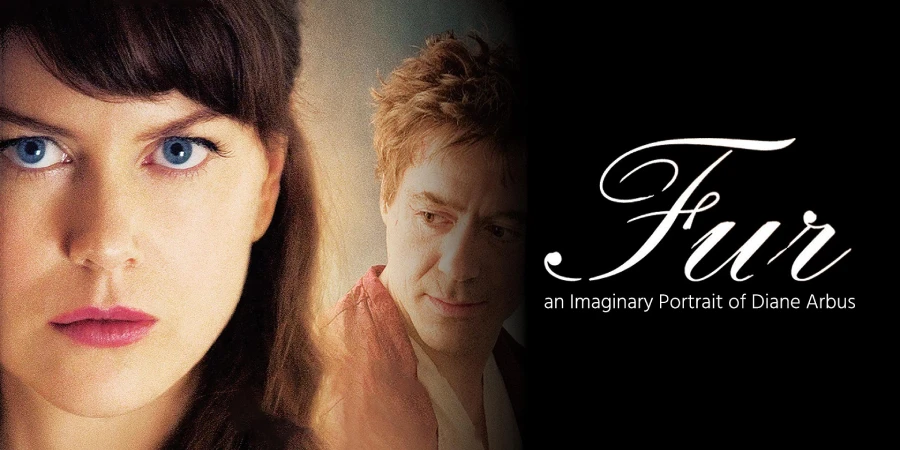

Fur: An Imaginary Portrait of Diane Arbus is not a conventional biopic. It is a dark, beautiful fairy tale about the artist who saw beauty in the unconventional. This film is less concerned with historical facts; instead, it crafts a fable about how a stifled 1950s housewife found her voice. Consequently, it invites you into a world of profound strangeness and intimacy.
Detailed Summary
The Gilded Cage
The story begins in New York City, 1958. Diane Arbus (Nicole Kidman) lives a life of upper-class conformity. She assists her husband, Allan (Ty Burrell), in his commercial photography studio, which is run out of their lavish apartment and funded by her wealthy family.
Diane feels creatively and personally unfulfilled. She plays the role of a perfect wife and mother, but her quiet observations reveal a deep yearning for something more authentic and visceral. Her world is pristine, orderly, and suffocating.
A Mysterious New Neighbor
A new tenant moves into the apartment upstairs. This man, who always wears a mask and hat, immediately piques Diane’s curiosity. Mysterious plumbing issues originating from his apartment give Diane a reason to investigate, though her interactions are initially met with silence and closed doors.
Crossing the Threshold
Diane’s fascination soon becomes an obsession. She finally gets an invitation to his apartment after a pipe bursts and floods her bathroom. She enters his world, a dimly lit space that feels like a hidden carnival sideshow, filled with strange objects and a sense of secrecy.
Here, she meets Lionel Sweeney (Robert Downey Jr.). He removes his mask to reveal a face and body completely covered in hair due to a condition called hypertrichosis. Instead of recoil, Diane feels an overwhelming sense of wonder.
The Unveiling
Diane and Lionel begin a secret, intense relationship. She spends her days in his apartment, learning about his life and his unique circle of friends. He, in turn, encourages her to see the world through her own eyes, not her husband’s or her parents’.
A pivotal moment occurs when Lionel asks Diane to shave him completely. It is an act of extreme vulnerability and trust. As she shaves his face, she is metaphorically stripping away his mask and, in doing so, shedding her own societal inhibitions. This act solidifies their deep, platonic-but-intimate bond.
A World of Outsiders
Lionel introduces Diane to his friends, a collection of society’s “freaks” and outcasts. These include a woman without arms and a giant. At first hesitant, Diane quickly realizes she feels more at home with them than she ever did at her parents’ dinner parties.
Meanwhile, her absence causes a rift with Allan. He cannot understand her sudden change and her growing distance from their picture-perfect life. Diane eventually leaves her husband and children to fully embrace her new path.
The Final Goodbye
Lionel reveals a tragic secret. His hypertrichosis is not just external; the hair grows inside his lungs, slowly suffocating him. He explains that his time is short. To grant him a final wish, Diane takes him to the ocean.
At the beach, they share a final, tender moment. Lionel then calmly walks into the waves and allows himself to drown. This act is not one of despair but of choice, a final assertion of control over his own life and body.
Movie Ending
The ending of Fur is both tragic and liberating. After Lionel’s death, Diane is spiritually and artistically reborn. He leaves her his most prized possession: her father’s old camera, which he had secretly acquired and fixed for her. This symbolizes her inheritance of a new way of seeing.
In the film’s closing sequence, Diane travels to a nudist colony, a place Lionel had told her about. She is no longer just an assistant. Confidently, she approaches the residents, sets up her camera, and takes her first independent photograph. The final shot is her looking through the lens, having finally become the artist she was meant to be. Her subject is a person in their raw, unadorned state—precisely the kind of subject that would define her real-life career.
Are There Post-Credits Scenes?
No, there are no post-credits scenes in Fur: An Imaginary Portrait of Diane Arbus. Once the credits begin to roll, the story is complete.
Type of Movie
Fur is best classified as a biographical fantasy drama. It uses the real-life figure of Diane Arbus as a starting point but creates a fictional narrative to explore her artistic transformation. The term “Imaginary Portrait” in the title is key; the film prioritizes emotional truth over historical accuracy.
The tone is dreamlike and often melancholic, blending elements of a dark fairy tale with a serious character study. It feels more like an allegory about art and identity than a straightforward biography, creating a unique and sometimes surreal viewing experience.
Cast
- Nicole Kidman – Diane Arbus
- Robert Downey Jr. – Lionel Sweeney
- Ty Burrell – Allan Arbus
- Harris Yulin – David Nemerov
- Jane Alexander – Gertrude Nemerov
Film Music and Composer
The evocative score for Fur was composed by Carter Burwell, a frequent collaborator with the Coen Brothers and director Todd Haynes. Burwell is known for his atmospheric and emotionally nuanced compositions.
His music for this film is understated and haunting. It perfectly complements the story’s fairy tale quality, weaving between moments of quiet wonder and deep melancholy. The score avoids grand, sweeping themes, opting instead for delicate piano and string arrangements that underscore Diane’s internal journey.

Filming Locations
Fur was primarily shot in and around New York City, with soundstages at Steiner Studios in Brooklyn used for the detailed apartment interiors. The use of real New York locations helps ground the fantastical story in a tangible 1950s reality.
Notably, the architecture of the Arbus apartment—clean, bright, and sterile—is in stark contrast to Lionel’s apartment, which is dark, cluttered, and organic. This visual dichotomy between the two settings is a powerful metaphor for Diane’s internal conflict and eventual transformation.
Awards and Nominations
While the film did not receive major awards like the Oscars or Golden Globes, it earned some recognition for its technical achievements. Specifically, it was nominated for Excellence in Production Design for a Period Film by the Art Directors Guild and for Best Costume Design in a Period Film by the Costume Designers Guild Awards.
Behind the Scenes Insights
- Director Steven Shainberg previously directed Secretary (2002), another film about an unconventional relationship that pushes boundaries. He brought the same writer, Erin Cressida Wilson, on board for Fur.
- Robert Downey Jr. spent hours in the makeup chair for the role of Lionel. The full-body suit of hair was painstakingly applied, making for a physically demanding performance.
- Nicole Kidman actively pursued the role of Diane Arbus. She was fascinated by the photographer’s life and the script’s unique approach to telling her story.
Inspirations and References
The movie is explicitly inspired by Patricia Bosworth’s book Diane Arbus: A Biography. However, it takes extensive creative liberties, using the biography as a jumping-off point for a fictional exploration of the artist’s psyche.
The primary inspiration, however, is Diane Arbus’s own photography. The film is a cinematic attempt to imagine the kind of transformative experience that could lead a person to create such arresting and empathetic portraits of society’s outsiders. Lionel Sweeney serves as a living embodiment of the subjects Arbus would later seek out.
Alternate Endings and Deleted Scenes
There are no known alternate endings or significant deleted scenes for Fur that have been made public. Director Steven Shainberg presented a singular, focused vision for the film. The narrative is self-contained, and the ending provides a definitive, albeit poetic, conclusion to Diane’s fictionalized origin story.
Book Adaptations and Differences
Fur is not a direct adaptation of Patricia Bosworth’s biography but is instead “inspired by” it. This is a critical distinction. The most significant difference is the character of Lionel Sweeney; he is a complete fabrication and did not exist in Diane Arbus’s real life.
In contrast, the book is a traditional, meticulously researched biography detailing Arbus’s life, career, relationships, and struggles with depression. The film invents the character of Lionel to function as a catalyst and a symbol. He represents the “other” that Arbus was famously drawn to, condensing her years-long artistic evolution into a single, transformative relationship.
Memorable Scenes and Quotes
Key Scenes
- The Shaving Scene: An intimate and bizarrely tender sequence where Diane shaves Lionel’s entire face and body. It is the film’s thematic centerpiece, representing total trust, the removal of masks, and Diane’s own liberation from conformity.
- The Final Photograph: Diane, standing confidently in a nudist colony with her camera, is fully realized as an artist. Her gaze through the lens signifies her new identity, making it a powerful and hopeful final image.
Iconic Quotes
- Lionel Sweeney: “The flaw is the thing we love.”
- Diane Arbus: “Most people go through life dreading they’ll have a traumatic experience. I wish I would. It would be a relief from the boredom.”
- Lionel Sweeney: “How can you take a picture of a secret?”
Easter Eggs and Hidden Details
- Identical Twins Homage: At a party in Lionel’s apartment, two girls in identical outfits briefly appear. This is a clear visual nod to one of Arbus’s most famous photographs, Identical Twins, Roselle, New Jersey (1967).
- The Camera: The camera Lionel gives Diane is a Rolleiflex, the same type of camera the real Diane Arbus famously used for much of her signature work.
- Fur Catalog: The magazine that Lionel shows Diane, featuring her parents’ fur photography, is titled “Nemerov Furs.” Nemerov was Diane Arbus’s maiden name.
Trivia
- Ty Burrell, who plays the serious and conventional Allan Arbus, would become famous just a few years later for playing the zany Phil Dunphy on the sitcom Modern Family.
- The film’s title, Fur, is a triple entendre. It refers to the fur coats from Diane’s family business, Lionel’s hypertrichosis, and the sensuous, animalistic nature that Diane discovers within herself.
- Despite Robert Downey Jr.’s character being central, he is effectively masked or hidden for a significant portion of his screen time, relying heavily on his voice and physical presence.
Why Watch?
This film is a must-see for its daring imagination and stunning central performances. It rejects the tired biopic formula for something far more poetic. Watch Fur to witness a beautiful, strange fable about finding your true self in the most unexpected places.
Director’s Other Movies
- Hit Me (1996)
- Secretary (2002)
- Rupture (2016)
Recommended Films for Fans
- The Elephant Man (1980)
- Frida (2002)
- The Shape of Water (2017)
- The Diving Bell and the Butterfly (2007)
- Secretary (2002)