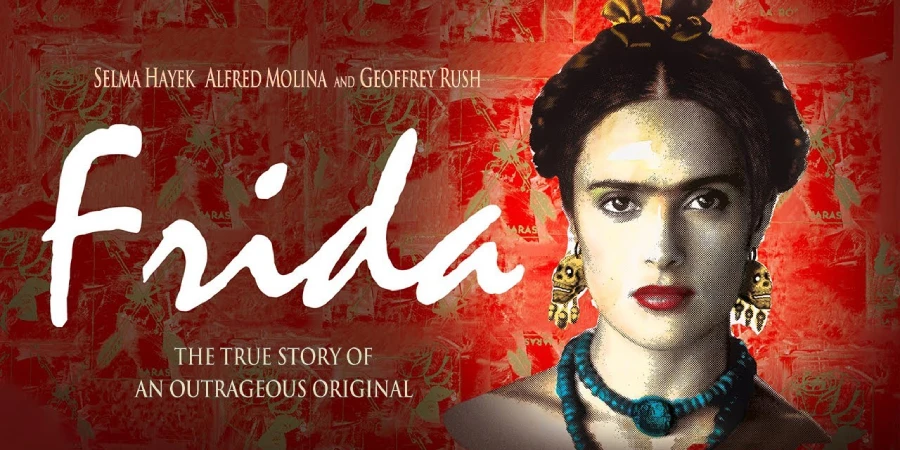

Julie Taymor’s Frida is not merely a biopic. It is a living mural, splashed with the same vibrant colors and brutal honesty as Frida Kahlo’s own paintings. Consequently, the film transforms pain into poetry, blurring the line between the artist’s life and her surreal, magnificent art. This is the story of a woman who refused to be defined by her suffering.
Detailed Summary
The Accident
The film begins with a young, spirited Frida Kahlo (Salma Hayek) in 1920s Mexico City. A horrific trolley accident brutally changes her life. A steel handrail impales her, shattering her spine, collarbone, ribs, and pelvis.
Confined to her bed in a full-body cast, she begins to paint. Her father gives her a special easel, and a mirror is placed over her bed. As a result, her first subject becomes herself.
Meeting Diego Rivera
Once she recovers enough to walk again, Frida boldly seeks out the famous muralist Diego Rivera (Alfred Molina). She finds him painting a mural and demands his honest opinion of her work. Impressed by her talent and audacity, Diego becomes her mentor.
Their connection grows from professional respect to a passionate romance. Despite her family’s objections and his reputation, they soon marry. Her mother famously compares the union to an elephant marrying a dove.
Marriage and Mexico City
Their life together is a whirlwind of art, politics, and parties. Frida and Diego are fervent communists, embedding their ideals in their life and work. However, their marriage is anything but conventional.
Frida accepts Diego’s constant philandering to a point. She, in turn, finds her own artistic and personal freedom. She embraces her unique style, traditional Mexican clothing, and her now-iconic unibrow.
America and Misfortune
The couple moves to New York City, where Diego has a commission for a mural at Rockefeller Center. Frida feels out of place among the American elite, whom she finds vapid. Her time there is marked by personal tragedy, including a devastating miscarriage, which she channels into the haunting painting Henry Ford Hospital.
Later, in Detroit, Diego’s mural is deemed communist propaganda by his patron, Nelson Rockefeller, who orders it destroyed. This event forces them to return to Mexico, disillusioned with the United States.
Affairs and Heartbreak
Back in Mexico, their relationship faces its greatest test. Frida discovers Diego is having an affair with her own sister, Cristina. This betrayal shatters Frida, leading to a separation.
During this time, Frida has her own affairs, including one with American photographer Tina Modotti (Ashley Judd). Furthermore, she and Diego offer asylum to exiled Russian revolutionary Leon Trotsky (Geoffrey Rush). A brief, intense affair develops between Frida and Trotsky, adding another layer of complexity to her life.
A Solo Artist
Frida’s art begins to receive international recognition. She travels to Paris for her first solo exhibition, though she finds the European surrealists pretentious. Despite her disdain for the scene, the experience solidifies her reputation as a major artist in her own right.
Declining Health and Final Triumph
Throughout the years, Frida’s health deteriorates due to the injuries from her accident. She endures dozens of surgeries. She becomes increasingly dependent on alcohol and painkillers to manage her constant agony.
Ultimately, gangrene sets in, and her right leg is amputated at the knee. Even in this state, her spirit remains unbroken. For her first solo exhibition in Mexico, she is too ill to leave her bed. Instead, she orders her four-poster bed to be moved to the gallery, arriving like a queen to celebrate with friends and admirers.


Movie Ending
Frida lies in her bed, surrounded by the warmth of her own exhibition. She drinks, sings, and rejoices with her loved ones, a triumphant figure defying her physical limitations. Sometime later, she is back at her home, Casa Azul, in that same bed, with Diego by her side. She says, “I hope the exit is joyful… and I hope never to return.”
Diego gently places her ashes in a pre-Columbian urn. In a stunning, surreal final sequence, Frida’s bed is shown in the middle of a room, and it suddenly bursts into flames. As the fire consumes it, the image morphs into one of her paintings, symbolizing her complete transformation into her art. She has become eternal, her fiery spirit immortalized.
Are There Post-Credits Scenes?
No, there are no post-credits or mid-credits scenes in Frida.
Type of Movie
Frida is a biographical drama that transcends the genre’s typical confines. It incorporates elements of magical realism, visually translating the surrealism of Kahlo’s paintings into live-action sequences. The tone is passionate, vibrant, and often tragic, mirroring the artist’s own tumultuous life.
Cast
- Salma Hayek – Frida Kahlo
- Alfred Molina – Diego Rivera
- Geoffrey Rush – Leon Trotsky
- Mía Maestro – Cristina Kahlo
- Ashley Judd – Tina Modotti
- Antonio Banderas – David Alfaro Siqueiros
- Edward Norton – Nelson Rockefeller
- Valeria Golino – Lupe Marín
Film Music and Composer
The score was composed by Elliot Goldenthal, who won an Academy Award for Best Original Score for his work. The music is a brilliant fusion of traditional Mexican folk and guitar music with a lush, orchestral score. It expertly captures the film’s passion and pain.
Notable tracks include the Oscar-nominated original song “Burn It Blue,” performed by Caetano Veloso and Lila Downs. The soundtrack is an essential element, fully immersing the audience in Frida’s world.

Filming Locations
The film was shot primarily on location in Mexico, which lends an incredible authenticity to the story. Key locations included Mexico City and San Miguel de Allende. Most importantly, the production was granted access to film inside Frida Kahlo’s actual home and studio, Casa Azul (“The Blue House”) in Coyoacán.
Filming in these real-life settings, where Frida lived, loved, and created, adds a powerful layer of historical resonance. Viewers see the real courtyards and rooms that defined her existence.
Awards and Nominations
Frida was a critical success and received numerous accolades. It was nominated for six Academy Awards and won two: Best Makeup (for transforming Hayek into Kahlo) and Best Original Score. Salma Hayek’s powerful performance earned her a nomination for Best Actress.
Behind the Scenes Insights
- This film was a passion project for Salma Hayek, who also served as a producer. It took her nearly a decade to get the film made.
- Hayek and Alfred Molina became great friends during filming. Their on-screen chemistry is a direct result of their genuine off-screen rapport.
- Edward Norton, who was dating Salma Hayek at the time, did an uncredited rewrite of the screenplay.
- Director Julie Taymor brought her extensive background in theater and opera to the film, creating the visually stunning “live painting” sequences.
Inspirations and References
The film is directly inspired by Frida Kahlo’s life and art. The primary source material was Hayden Herrera’s acclaimed 1983 book, Frida: A Biography of Frida Kahlo. Additionally, the film draws heavily from Kahlo’s letters and diaries.
Many of Kahlo’s most famous paintings, such as The Two Fridas, The Broken Column, and My Grandparents, My Parents, and I, are recreated in the film as vivid, live-action tableaus, blending her life with her artistic vision.
Alternate Endings and Deleted Scenes
There are no official alternate endings or widely available deleted scenes for Frida. The theatrical cut is considered director Julie Taymor’s definitive version of the story.
Book Adaptations and Differences
The film is based on Hayden Herrera’s biography, Frida: A Biography of Frida Kahlo. While the film is largely faithful to the book’s account of Kahlo’s life, it naturally condenses and dramatizes events for cinematic effect. For instance, the film places a heavy emphasis on the Frida-Diego love story as the central narrative thread.
In contrast, the book provides a more exhaustive, academic exploration of Kahlo’s life, politics, and artistic development, with less of the romantic dramatization required for a feature film.



Memorable Scenes and Quotes
Key Scenes
- The Trolley Accident: A horrifying yet beautifully surreal sequence where Frida is impaled by the trolley, and a passenger’s gold leaf powder covers her bloodied body, turning a moment of horror into a work of art.
- Frida Meets Diego: Frida marches onto Diego’s scaffolding, shouts up at him, and sends her paintings up in a dumbwaiter for his critique. This scene perfectly establishes her fearless personality.
- The Two Fridas: A live-action recreation of her famous painting, showing two versions of herself seated side-by-side, their hearts connected by an artery, which one Frida cuts with surgical scissors.
- The Final Exhibition: Frida arrives at her own gallery opening in her bed, carried by her friends, turning her sickbed into a throne of triumph.
Iconic Quotes
- “I suffered two grave accidents in my life… One was the trolley, and the other was Diego. Diego was by far the worst.” – Frida Kahlo
- “I paint myself because I am so often alone, because I am the subject I know best.” – Frida Kahlo
- “I hope the exit is joyful, and I hope never to return.” – Frida Kahlo
Easter Eggs and Hidden Details
- The film is filled with live-action recreations of Frida’s paintings. Pay close attention to scenes like the miscarriage in Detroit (Henry Ford Hospital) or Frida standing between a version of herself in traditional Mexican wear and one in a white European dress (The Two Fridas).
- Many of Frida’s real-life pets are represented, including her beloved spider monkeys and parrots, which often appeared as surrogates in her paintings.
- Frida’s clothing, meticulously recreated by costume designer Julie Weiss, is not just wardrobe. It acts as both a celebration of her heritage and a form of armor, hiding her physical ailments beneath layers of beautiful fabric.
Trivia
- Salma Hayek had to fight for the role, as several other actresses, including Madonna and Jennifer Lopez, were also interested in playing Frida Kahlo at various points.
- Alfred Molina gained over 50 pounds to play the larger-than-life Diego Rivera.
- The on-screen tango between Frida and Tina Modotti was choreographed to be sensual and provocative. It was an idea pushed by Salma Hayek to showcase Frida’s bisexuality and free spirit.
Why Watch?
Watch for a masterclass in acting from Salma Hayek and Alfred Molina. Stay for the breathtaking visuals that bring art to life. This film is a powerful, unflinching portrait of resilience, passion, and the defiant spirit of a woman who painted her own reality.
Director’s Other Movies
- Titus (1999)
- Across the Universe (2007)
- The Tempest (2010)
- The Glorias (2020)
Recommended Films for Fans
- Pollock (2000)
- Fur: An Imaginary Portrait of Diane Arbus (2006)
- La Vie en Rose (2007)
- At Eternity’s Gate (2018)
- Big Eyes (2014)