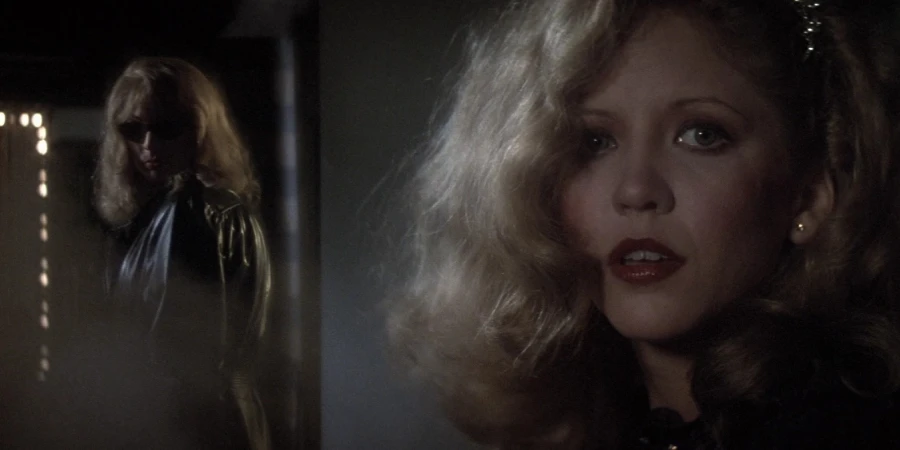

Brian De Palma’s Dressed to Kill is not merely a film; it is a meticulously crafted provocation. It wraps a lurid tale of sexual anxiety and murder in the most elegant cinematic package imaginable. Consequently, the film seduces its audience with voyeuristic style before pulling the rug out from under them in a shocking, controversial twist.
Detailed Summary
Kate’s Fantasy and Frustration
The film opens with a slow-motion shower scene. We see Kate Miller (Angie Dickinson) enjoying a sensual moment that is abruptly interrupted by a man attacking her. However, this is just a dream. Kate awakens next to her husband, clearly sexually frustrated. Subsequently, she visits her psychiatrist, Dr. Robert Elliott (Michael Caine), to discuss her dissatisfaction and fantasies.
The Museum Seduction
Following her therapy session, Kate visits the Metropolitan Museum of Art. There, she engages in a silent, cat-and-mouse flirtation with a mysterious stranger. De Palma films this entire sequence without dialogue, relying entirely on visuals and Pino Donaggio’s score to build suspense. Ultimately, Kate follows the man into a taxi, embarking on an anonymous afternoon affair.
The Fateful Encounter
After their tryst at the stranger’s apartment, Kate awakens alone. While getting dressed, she discovers a letter on his desk. The letter reveals the man has a venereal disease. Panicked, Kate flees the apartment, forgetting her wedding ring in her haste. She returns to the building to retrieve it, making a decision that seals her fate.
The Razor Murder
As Kate waits for the elevator, a tall figure in a trench coat and sunglasses appears. The mysterious figure, a blonde woman, brandishes a straight razor. Before Kate can even scream, the woman brutally slashes her to death inside the elevator. The doors open and close on the gruesome scene, a masterpiece of editing and suspense.
Liz Blake’s Involvement
Just as the murder concludes, a high-class escort named Liz Blake (Nancy Allen) enters the elevator lobby. She discovers Kate’s butchered body. Liz also catches a glimpse of the blonde killer, making her both the prime witness and, unfortunately, the lead suspect. The police, led by Detective Marino, are immediately suspicious of her profession and story.
Peter’s Investigation
Meanwhile, Kate’s brilliant teenage son, Peter Miller (Keith Gordon), learns of his mother’s murder. A science prodigy, Peter refuses to accept the police’s simplistic theories. Therefore, he begins his own amateur investigation. He uses his technical skills to plant bugs and track suspects, determined to find the real killer and clear his mother’s name.
The Trap and the Reveal
Liz, now being stalked by the blonde killer, reluctantly teams up with Peter. Their investigation leads them to Dr. Elliott’s office. Following an intense chase through the New York subway, Liz agrees to be bait. She schedules an appointment with Dr. Elliott to retrieve information from his patient files. In the film’s climax, the blonde killer attacks Liz in the office. A nurse bursts in and shoots the attacker, who is revealed to be none other than Dr. Elliott himself. Elliott, we learn, is a trans person whose request for gender-affirming surgery was denied. This created a split personality: the murderous “Bobbi” emerges whenever he is sexually aroused by a woman, punishing them for making him feel like a man.
Movie Ending
The ending provides a complete explanation of the film’s central mystery. Dr. Levy, Elliott’s psychiatrist, explains his patient’s condition. Dr. Elliott has a dissociative identity. His dominant personality wanted gender reassignment surgery, but the “male” side of him would not allow it. Therefore, his other personality, the violently jealous “Bobbi,” would take over when he was sexually attracted to a woman. Bobbi, dressed as a woman, would then murder the source of his arousal. Kate Miller triggered this reaction when she detailed her affair, and consequently, Elliott (as Bobbi) killed her. Notably, it was Elliott’s own razor, stolen from his office. Bobbi was also trying to kill Liz to eliminate the only witness.
The final scene shows Liz relaxing in a bath at Peter’s house. Suddenly, a figure emerges from behind the shower curtain. It is Dr. Elliott in his doctor’s coat, holding the razor and grinning maniacally. He slashes her throat. However, this is revealed to be a nightmare. Liz awakens screaming, safe in her bed with Peter comforting her. The film ends on her horrified face, suggesting the trauma of the events will haunt her forever.
Are There Post-Credits Scenes?
No, there are no post-credits scenes in Dressed to Kill. The story concludes before the final credits roll.
Type of Movie
Dressed to Kill is a quintessential psychological thriller with strong elements of the erotic thriller subgenre. Director Brian De Palma infuses the film with the visual and thematic stylings of Italian Giallo films. These influences are evident in its focus on a mysterious, black-gloved killer, intricate murder set-pieces, and a blend of suspense, horror, and overt sexuality. The tone is slick, suspenseful, and unapologetically voyeuristic.
Cast
- Michael Caine – Dr. Robert Elliott / Bobbi
- Angie Dickinson – Kate Miller
- Nancy Allen – Liz Blake
- Keith Gordon – Peter Miller
- Dennis Franz – Detective Marino
- David Margulies – Dr. Levy
Film Music and Composer
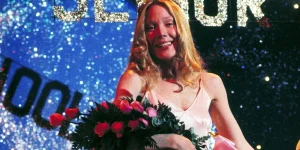
The lush, romantic, and deeply suspenseful score for Dressed to Kill was composed by Pino Donaggio. This was Donaggio’s third collaboration with Brian De Palma, following Carrie (1976) and Home Movies (1979). The score is a critical element of the film, often carrying the emotional and narrative weight of entire sequences, most notably the dialogue-free museum scene. The main theme, “The Gallery,” is a sweeping, romantic piece that brilliantly contrasts with the film’s violent subject matter, enhancing the sense of unease.
Filming Locations
Dressed to Kill was primarily shot on location in New York City and Philadelphia. The Philadelphia Museum of Art stands in for the New York Metropolitan Museum of Art in the film’s famous seduction sequence. The choice of location mattered greatly; De Palma used the grand, labyrinthine halls of the museum to create a visually stunning and suspenseful game of cat and mouse. In addition, the gritty aesthetic of the New York City subway system provides a starkly different, more claustrophobic setting for Liz Blake’s terrifying chase scene, heightening the urban paranoia.
Awards and Nominations
Angie Dickinson received a Golden Globe nomination for Best Actress in a Motion Picture – Drama. She also won the Saturn Award for Best Actress for her performance. In contrast, the film also received some negative attention. For instance, Michael Caine, Nancy Allen, and writer/director Brian De Palma all received nominations at the inaugural Golden Raspberry Awards (Razzies), though none of them “won.”
Behind the Scenes Insights
- Brian De Palma fought extensively with the MPAA over the film’s rating. He had to make several trims to the elevator murder and shower scene to avoid an X rating and secure the R rating he wanted.
- Penthouse Pet Victoria Lynn Johnson served as Angie Dickinson’s body double for the opening shower scene.
- Actress Nancy Allen was married to Brian De Palma at the time of filming. She collaborated with him on several projects, including Carrie and Blow Out.
- The role of Dr. Elliott was reportedly offered to Sean Connery, but he turned it down, stating the material was “too gruesome.”
Inspirations and References
The most significant inspiration for Dressed to Kill is Alfred Hitchcock’s Psycho (1960). Both films feature a shocking early murder of the apparent protagonist, a mystery involving a killer with a split personality tied to gender identity, and a psychiatrist’s monologue to explain the killer’s psychosis at the end. In addition, De Palma’s visual style, with its split-screen compositions, long tracking shots, and voyeuristic point-of-view, owes a heavy debt to Hitchcock’s filmography. The film is also a clear homage to Italian Giallo horror, particularly the works of directors like Dario Argento.
Alternate Endings and Deleted Scenes
There are no known alternate endings for Dressed to Kill. The primary “deleted” content involves scenes that were trimmed for theatrical release to appease the MPAA. The uncut version, later released on home video, features a more graphic depiction of Kate Miller’s murder in the elevator. It includes more explicit shots of the razor making contact and additional blood effects. Similarly, the opening shower scene was also trimmed slightly for the R-rated theatrical cut.
Book Adaptations and Differences
Dressed to Kill is not based on a book. It is an original screenplay written by director Brian De Palma himself.

Memorable Scenes and Quotes
Key Scenes
- The Museum Chase: A masterful, nearly ten-minute sequence with no dialogue, where Kate Miller silently pursues and is pursued by a handsome stranger through a museum. The scene is a masterclass in visual storytelling and building erotic tension.
- The Elevator Murder: A shocking and brutal burst of violence that eliminates the film’s biggest star within the first act. Its stylish execution and suddenness make it one of cinema’s most memorable murder scenes.
- The Subway Attack: Liz Blake is stalked by Bobbi through the graffiti-covered, menacing corridors of the New York subway. De Palma’s use of camera movement and timing creates unbearable, claustrophobic suspense.
Iconic Quotes
- Liz Blake: “Alright, who is it? Some night-school psychoanalyst who wants to get in my pants?”
- Dr. Elliott: “I’m a transsexual. I have a female personality trapped in a male body.”
- Detective Marino: (to Liz) “You know, if you’d just picked up the razor and stuck it back into the corpse, we’d have a much better case for self-defense.”
Easter Eggs and Hidden Details
- The Name Bobbi: The killer’s name, “Bobbi,” may be a subtle nod to the character of Bob from David Lynch’s Twin Peaks, another entity representing pure evil. However, the film predates the show, making it more likely a common name choice that gained coincidental significance later.
- Reflections and Doubles: De Palma fills the film with images of mirrors, reflections, and doubles. This visual motif reinforces the central theme of dual identities and the difference between appearance and reality.
- Hitchcock’s Camera: In many scenes, the camera moves in a way that mimics a character’s gaze, a technique famously employed by Alfred Hitchcock. This immerses the audience in the film’s voyeuristic perspective.
Trivia
- The film’s title, Dressed to Kill, was a last-minute change. The original working title was Cruising, but director William Friedkin was already using that title for his own controversial thriller released the same year.
- Keith Gordon, who plays the teenage son Peter, was actually 20 years old during filming.
- Angie Dickinson initially had reservations about the role, particularly due to the nudity. However, she was ultimately convinced by Brian De Palma’s vision for the film.
- The film was a significant box office success, earning over $31 million in the United States against a budget of $6.5 million.
Why Watch?
This film is a masterclass in cinematic style and suspense. Its controversial themes are matched only by its visual elegance. Consequently, it remains an essential, brilliantly crafted thriller that defines the very best of Brian De Palma’s provocative filmmaking.
Director’s Other Movies
- Carrie (1976)
- Blow Out (1981)
- Scarface (1983)
- The Untouchables (1987)
- Carlito’s Way (1993)
- Mission: Impossible (1996)
Recommended Films for Fans
- Psycho (1960)
- Don’t Look Now (1973)
- The Tenant (1976)
- Tenebre (1982)
- Body Double (1984)
- Basic Instinct (1992)