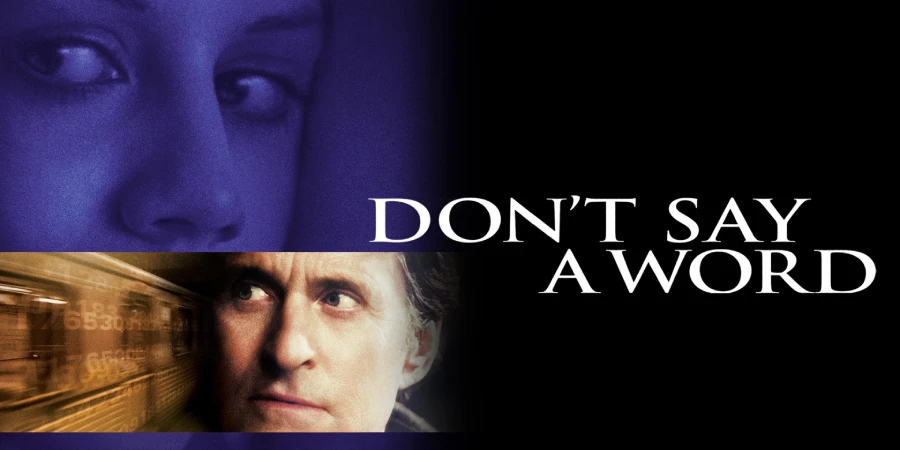
Don’t Say a Word (2001) is a psychological thriller that blends crime, mystery, and family-driven suspense. Directed by Gary Fleder and starring Michael Douglas, the film leans heavily on time pressure, buried trauma, and moral dilemmas, making it a tense watch even when its early-2000s style shows through.
Detailed Summary
The Prologue: A Crime That Refuses to Stay Buried
The film opens with a brutal crime involving the theft of a valuable gemstone and the murder of a young woman. This event seems disconnected at first, but it quietly plants the seed for everything that follows. The crime is unresolved, and its emotional and psychological consequences linger beneath the surface.
Dr. Nathan Conrad and the Dangerous Patient
Dr. Nathan Conrad (Michael Douglas) is a respected child psychiatrist living a comfortable life with his wife Aggie and daughter Jessie. His professional world changes when he begins treating Elisabeth Burrows, a deeply traumatized young woman who has been silent and catatonic since witnessing her parents’ murder years earlier.
At first, Elisabeth appears unreachable. She doesn’t speak, doesn’t respond, and seems locked inside her own mind. Nathan believes she may be beyond help.
The Kidnapping: The Clock Starts Ticking
Everything escalates when Jessie, Nathan’s daughter, is kidnapped by criminals led by the cold and methodical Patrick Koster (Sean Bean). Nathan is given a brutal ultimatum:
Get Elisabeth to reveal a six-digit number within 24 hours, or your daughter dies.
The number is supposedly hidden in Elisabeth’s memory, and the criminals believe Nathan is the only one who can extract it.
Breaking Into the Mind
As Nathan intensifies Elisabeth’s therapy, the film dives into psychological territory. Through drawings, fragmented memories, and emotional triggers, Elisabeth slowly begins to communicate. Her trauma is tied to the opening crime, and it becomes clear that her silence is not weakness, but survival.
Nathan starts realizing that the truth Elisabeth carries is more complex and dangerous than the kidnappers understand.
Lies, Manipulation, and Moral Crossroads
While racing against time, Nathan uncovers betrayals on multiple levels. Law enforcement isn’t as reliable as it seems, and the criminals themselves are hiding critical information from each other. Nathan is forced to make morally questionable decisions, balancing professional ethics against his role as a desperate father.


Movie Ending
In the final act, Elisabeth’s buried memory fully surfaces. The six-digit number is revealed to be the code to a locker containing the stolen gemstone, which Elisabeth herself hid as a child after witnessing the crime. The shock comes when it’s revealed that Elisabeth killed the original thief in self-defense, and her mind blocked out the event to survive the trauma.
Nathan gives the code to Koster, but the situation spirals. Double-crosses occur among the criminals, leading to violent confrontations. Jessie is eventually rescued, but not through negotiation alone—violence and sacrifice play a key role.
Patrick Koster is killed, and the remaining criminals are neutralized. Elisabeth, now free from her silence, is taken into protective custody rather than punishment, acknowledging her actions as the result of severe childhood trauma.
The film closes with Nathan reunited with his family, deeply changed. Elisabeth begins a new chapter, finally able to speak and confront her past. The ending emphasizes that truth extracted through force comes at a high emotional cost, but silence can be even more dangerous.
Are There Post-Credits Scenes?
No.
Don’t Say a Word does not have a post-credits or mid-credits scene. The story concludes definitively before the credits roll.
Type of Movie
Don’t Say a Word is a psychological crime thriller that mixes hostage drama with trauma-focused mystery. It leans more on suspense and emotional stakes than action, despite moments of violence.
Cast
- Michael Douglas – Dr. Nathan Conrad
- Sean Bean – Patrick Koster
- Brittany Murphy – Elisabeth Burrows
- Famke Janssen – Aggie Conrad
- Skye McCole Bartusiak – Jessie Conrad
- Oliver Platt – Dr. Louis Sachs
- Jennifer Esposito – Sandra Cassidy
Film Music and Composer
The score was composed by Mark Isham, whose music emphasizes tension and psychological unease rather than grand themes. Subtle, pulsing cues dominate the soundtrack, reinforcing the constant race against time.
Filming Locations
The film was primarily shot in New York City, using:
- Real hospitals and psychiatric facilities to enhance realism
- Urban residential neighborhoods for the Conrad family home
- Industrial and underground locations for the criminal hideouts
These grounded, real-world locations reinforce the idea that ordinary lives can be shattered without warning.
Awards and Nominations
The film did not receive major awards recognition. However:
- Brittany Murphy’s performance was widely praised by critics
- The film performed strongly at the box office, becoming a financial success
Behind the Scenes Insights
- Brittany Murphy reportedly researched severe childhood trauma and dissociative disorders extensively for her role.
- Sean Bean leaned into subtle menace rather than overt aggression, making Koster unsettlingly calm.
- The film is a remake of the 1994 Danish movie Nattens engel.
- Michael Douglas took the role specifically because of its moral ambiguity, not the action elements.
Inspirations and References
- Based on the Danish novel “Nattens engel” by Andrew Klavan
- Influenced by 1990s psychological thrillers like Se7en and The Silence of the Lambs
- Explores real psychological concepts such as repressed memory and dissociation
Alternate Endings and Deleted Scenes
- An alternate ending reportedly leaned toward a darker fate for Elisabeth but was removed to avoid excessive bleakness.
- Deleted scenes included longer therapy sessions that slowed pacing and were cut for tension.
- Some criminal backstory elements were trimmed to keep focus on Nathan and Elisabeth.
Book Adaptation and Differences
While faithful to the novel’s core concept, the film:
- Simplifies Elisabeth’s psychological complexity
- Makes Nathan more emotionally reactive than in the book
- Adds a more traditional Hollywood-style resolution
The novel is darker and more ambiguous, especially regarding justice.
Memorable Scenes and Quotes
Key Scenes
- Elisabeth breaking her silence for the first time
- Nathan realizing the number isn’t just information, but a moral weapon
- The final confrontation where loyalties collapse
Iconic Quotes
- “Some memories are locked for a reason.”
- “You asked me to open her mind. You didn’t ask what would come out.”
Easter Eggs and Hidden Details
- Elisabeth’s drawings subtly foreshadow the final reveal
- The locker number appears briefly earlier in the film as background detail
- The ticking clock motif appears visually and sonically throughout the movie
Trivia
- The movie was released just weeks after 9/11, impacting its marketing.
- Skye McCole Bartusiak later appeared in The Patriot (2000).
- Sean Bean once joked this was one of the few films where he didn’t die immediately.
Why Watch?
If you enjoy high-stakes thrillers with psychological depth, this film delivers a gripping mix of suspense, emotional conflict, and ethical tension. Brittany Murphy’s performance alone makes it worth revisiting.
Director’s Other Works
- Things to Do in Denver When You’re Dead (1995)
- Kiss the Girls (1997)
- Runaway Jury (2003)
- The Express (2008)