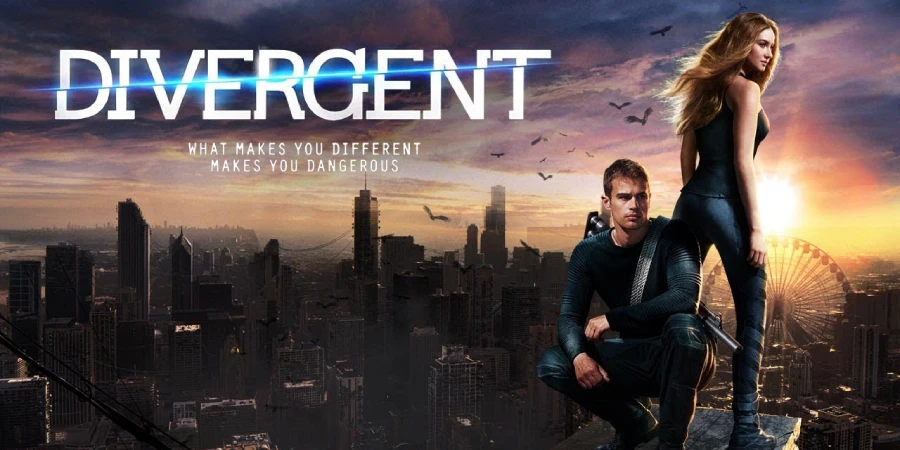

Divergent (2014) is the first installment of a dystopian sci-fi franchise based on the bestselling novel by Veronica Roth. Set in a rigidly controlled future society, the film explores identity, free will, fear, and rebellion, all wrapped in action-driven storytelling aimed especially at young adults.
Detailed Summary
A Divided Society
The story takes place in a future Chicago, enclosed by massive walls after an unspecified global catastrophe. Society is divided into five factions, each dedicated to a single human virtue:
- Abnegation – selflessness
- Dauntless – bravery
- Erudite – intelligence
- Amity – peace
- Candor – honesty
At the age of sixteen, every citizen must choose one faction to live in for the rest of their life, regardless of their birth faction.
Those who fail to belong anywhere become Factionless, living in poverty and social exile.
Beatrice Prior and the Aptitude Test
Beatrice Prior is born into Abnegation, a quiet and emotionally restrained community. During her aptitude test, something goes wrong. Her results show multiple faction compatibility, a rare condition known as being Divergent.
She is warned that Divergents are dangerous because they cannot be controlled. She must hide her identity or be executed.
This moment establishes the film’s core conflict: a society that fears people who cannot be categorized.
Choosing Dauntless
At the Choosing Ceremony, Beatrice shocks everyone by selecting Dauntless, the faction of fearless warriors. She renames herself Tris, symbolizing her rejection of her old life.
Dauntless initiation is brutal. Initiates must survive combat training, fear simulations, and psychological testing. Failure means becoming factionless.
Tris struggles physically but excels mentally, raising suspicion among instructors.
Training, Fear Landscapes, and Four
Tris meets Tobias “Four” Eaton, her instructor, who quickly recognizes her unusual abilities. He teaches her how to manipulate fear simulations, something normal people cannot do.
As Tris grows stronger, she forms friendships, rivalries, and begins a romantic connection with Four.
She also learns that Divergents can:
- Resist mind control
- Remain conscious in simulations
- Think independently under stress
Which makes them extremely threatening to the ruling elite.
The Erudite Conspiracy
Jeanine Matthews, the brilliant and ruthless leader of Erudite, believes Abnegation’s moral leadership makes them unfit to govern.
Her plan involves:
- Using mind-control serum
- Turning Dauntless soldiers into obedient weapons
- Overthrowing the government
Only Divergents remain immune.
When Tris’s Divergence is discovered, she is hunted as the Erudite coup begins.

Movie Ending
The final act of Divergent is intense, emotional, and sets up the entire franchise.
Jeanine activates the simulation serum, placing all Dauntless soldiers under mind control. They are forced to attack Abnegation, executing civilians under orders they cannot resist.
Four is also captured and placed under a stronger version of the simulation. Unlike others, he remains partially aware but trapped inside layered mental fears.
Tris infiltrates Dauntless headquarters to stop the attack. Along the way, she witnesses the horrifying reality of the system: brave people reduced to programmable weapons.
She reaches Four and enters his fear landscape to help him break free. Using emotional connection and trust, she reminds him who he is. Four regains control of his mind, proving again that Divergence represents freedom.
Together, they confront Jeanine Matthews.
Jeanine explains her belief that Divergents are unpredictable threats to societal stability. Tris rejects this ideology, stating that humanity cannot survive by suppressing individuality.
Four shuts down the simulation, instantly freeing the Dauntless army.
The attack ends.
However, Jeanine escapes.
The film closes with Tris, Four, Caleb (Tris’s brother), and other survivors boarding a train, fleeing the city as fugitives. They are now enemies of the system they once believed in.
The ending emphasizes several lingering questions:
- What lies beyond the city walls?
- How deep does the corruption go?
- Can society exist without strict control?
The rebellion has only begun.
Are There Post-Credits Scenes?
No. Divergent (2014) does not include a post-credits or mid-credits scene.
The story ends definitively with the train sequence, setting up the sequel Insurgent (2015).
Type of Movie
Divergent is a dystopian science fiction action film with strong young-adult themes. It blends futuristic world-building with coming-of-age drama, political allegory, and romantic subplots.
Cast
- Shailene Woodley – Tris Prior
- Theo James – Tobias “Four” Eaton
- Kate Winslet – Jeanine Matthews
- Jai Courtney – Eric
- Miles Teller – Peter
- Zoë Kravitz – Christina
- Ansel Elgort – Caleb Prior
- Maggie Q – Tori
Film Music and Composer
The score was composed by Junkie XL (Tom Holkenborg).
The soundtrack combines electronic pulses with orchestral tension, reflecting both emotional conflict and futuristic danger. The film also features contemporary artists such as Ellie Goulding and Woodkid.

Filming Locations
- Chicago, Illinois – skyline references and inspiration
- Navy Pier – Dauntless compound exterior
- Former Meigs Field Airport – abandoned city zones
- St. Patrick High School – interior training sequences
Chicago was essential to the story, symbolizing civilization built atop ruins and reinforcing the theme of isolation from the outside world.
Awards and Nominations
- Teen Choice Awards – Choice Movie: Sci-Fi/Fantasy
- People’s Choice Awards – Favorite Sci-Fi Movie
- MTV Movie Awards – Best Female Performance nomination
- Saturn Awards – Best Science Fiction Film nomination
While not critically acclaimed, the film was commercially successful and culturally influential among YA audiences.
Behind the Scenes Insights
- Veronica Roth was only 22 when she published the novel.
- Shailene Woodley performed many of her own stunts.
- Theo James trained extensively in parkour and combat.
- Kate Winslet joined partly because her daughter loved the book.
- Over 70 fear simulations were designed, many never used on screen.
Inspirations and References
- Veronica Roth’s Divergent novel
- Political philosophy on conformity and authoritarianism
- Influences from 1984, Brave New World, and The Hunger Games
- Psychological studies on fear response and personality theory
Alternate Endings and Deleted Scenes
Several deleted scenes include:
- A longer Choosing Ceremony with additional faction rituals
- Extended fear simulations for Four
- A deeper explanation of Divergent genetics
No alternate ending was filmed, but early scripts gave Jeanine a much larger presence in the final confrontation.
Book Adaptation and Differences
Major differences from the novel include:
- Tris is more emotionally vulnerable in the film
- The political explanations are simplified
- Eric is more villainous on screen
- The faction system is visually expanded
- Several internal monologues are removed
The core story remains faithful, but the movie prioritizes action over philosophy.

Memorable Scenes and Quotes
Key Scenes
- Tris jumping into the Dauntless initiation pit
- The knife-throwing training scene
- Fear landscape hallucinations
- Tris resisting mind control
- The train escape finale
Iconic Quotes
- “Be brave.”
- “You don’t fit into a category. That’s what makes you dangerous.”
- “I am Divergent.”
- “Fear doesn’t shut you down. It wakes you up.”
Easter Eggs and Hidden Details
- Abnegation’s gray clothing symbolizes emotional suppression.
- The Dauntless tattoos reflect personal fear victories.
- Four’s fear count (four) hints at his name long before it’s revealed.
- The city map subtly forms a circular prison shape.
- Birds appear repeatedly as symbols of freedom.
Trivia
- The film was shot before the final book was released.
- Theo James initially auditioned for a different role.
- Over 1,000 extras were used for Dauntless scenes.
- The tattoo designs were created by professional tattoo artists.
- The film grossed nearly $290 million worldwide.
Why Watch?
You should watch Divergent if you enjoy:
- Dystopian futures with social commentary
- Strong female protagonists
- Action mixed with emotional growth
- Stories about identity and rebellion
- Young-adult science fiction franchises
Despite its flaws, the film asks an important question:
What happens when society fears people who cannot be controlled?