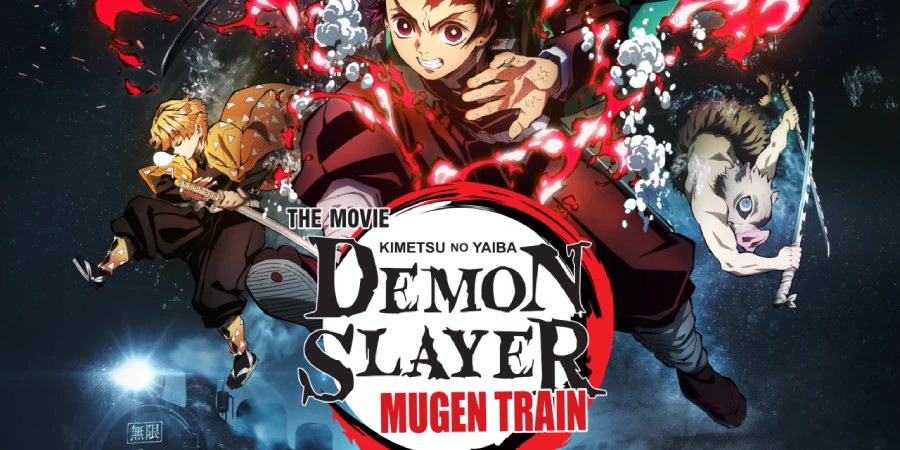

Demon Slayer: Mugen Train is one of the most successful anime films ever released, serving as a direct continuation of the Kimetsu no Yaiba TV anime. It is emotional, action-packed, visually gorgeous, and completely unapologetic about breaking your heart.
Detailed Summary
Boarding the Mugen Train
Tanjiro, Nezuko, Inosuke, and Zenitsu board the mysterious Mugen Train to assist Flame Hashira Kyojuro Rengoku with investigating a series of disappearances. The atmosphere is eerie from the start; the train feels alive, and the passengers seem strangely unaware of the danger lurking around them.
Enmu’s Dream Trap
Lower Rank One demon Enmu casts the demon slayers into deep dreams, intending to destroy their spirits by severing their “spiritual cores.”
Tanjiro dreams of his family still being alive—a heartbreaking illusion. He realizes it’s fake and forcefully kills himself within the dream to escape. This is one of the film’s most emotionally crushing sequences.
Fighting Enmu on the Train
Enmu reveals that he fused with the train itself, becoming a grotesque flesh monster. The slayers split tasks: Rengoku protects the passengers, Tanjiro and Inosuke aim for Enmu’s core, and Zenitsu unexpectedly shows off incredible reflexes (while “asleep,” naturally). They eventually defeat Enmu and derail the train, saving hundreds of passengers.
Arrival of Upper Rank Three: Akaza
Just as everyone believes it’s over, Akaza, an Upper Rank demon, appears. This turns into the most important and devastating battle of the film.
Akaza tries to recruit Rengoku, praising his strength. Rengoku refuses, staying true to his values and the Demon Slayer Corps motto.
This leads to a visually stunning and emotionally heavy duel. Rengoku fights with everything he has, pushing his body far beyond its limits.


Movie Ending
The film ends with Rengoku engaging Akaza in a ferocious battle. Although he sustains fatal injuries, Rengoku traps Akaza and nearly kills him. Akaza escapes only because the sunrise approaches—he flees by tearing his own arms off.
Rengoku, mortally wounded, spends his final moments speaking with Tanjiro.
He entrusts his will to the new generation of Demon Slayers, telling Tanjiro:
- To visit his family.
- That Nezuko is accepted as a demon fighting for humanity.
- That Tanjiro must continue growing stronger.
Tanjiro screams at the fleeing Akaza, calling him a coward for running from the sun—a moment that is both heartbreaking and defining for Tanjiro’s character growth.
The Corps receives the news of Rengoku’s death, and the remaining Hashira react with grief and respect. The film closes with Tanjiro crying but determined to keep moving forward.
Are There Post-Credits Scenes?
There is no traditional post-credits scene.
However, the film ends with a brief epilogue-style moment before the credits showing reactions from the Demon Slayer Corps. Once the credits roll, nothing additional follows.
Type of Movie
It is an action-fantasy anime film with strong emotional drama and character-driven storytelling, continuing directly from the Season 1 anime.
Cast (Japanese & English Highlights)
- Natsuki Hanae / Zach Aguilar – Tanjiro Kamado
- Akari Kitō / Abby Trott – Nezuko Kamado
- Hiro Shimono / Aleks Le – Zenitsu Agatsuma
- Yoshitsugu Matsuoka / Bryce Papenbrook – Inosuke Hashibira
- Satoshi Hino / Mark Whitten – Kyojuro Rengoku
- Akira Ishida / Lucien Dodge – Akaza
- Daisuke Hirakawa / Landon McDonald – Enmu
Film Music and Composer
The score was composed by Yuki Kajiura and Go Shiina, a powerhouse duo known for their dramatic, emotional, and heavily orchestral soundscapes.
The theme song, “Homura” by LiSA, became internationally iconic and is deeply tied to the film’s emotional finale.


Filming Locations
As an animated film, it was produced at Ufotable Studios in Japan.
The “locations” of the film are stylized based on:
- Taishō-era Japan rail systems
- Foggy rural regions and early industrial landscapes
- Traditional Japanese architecture reflected in Rengoku’s Flame Breathing visuals
These artistic inspirations are used to create atmospheric tension and highlight themes of transition between old and new Japan.
Awards and Nominations
- Won Japan Academy Film Prize for Animation of the Year (2021)
- Won multiple Crunchyroll Anime Awards
- Became the highest-grossing Japanese film of all time
- Nominated for Best Animated Film in several international award circuits
Behind the Scenes Insights
- Ufotable used advanced 4K digital compositing, which gave the flame effects and train sequences their distinctive look.
- The fight between Rengoku and Akaza reportedly took some animators months for only a few minutes of footage.
- Director Haruo Sotozaki collaborated closely with Koyoharu Gotouge to ensure the film stayed faithful to the manga.
- The voice actors recorded some scenes multiple times to emphasize grief and emotional weight, especially Tanjiro’s final farewell to Rengoku.
- Rengoku’s big scenes had extra animators assigned due to the complexity of flame effects.
Inspirations and References
- Based directly on the Mugen Train Arc of the Demon Slayer manga.
- The train imagery draws from classic Japanese folklore about wandering spirits and haunted travel routes.
- Rengoku’s design and philosophy take inspiration from samurai ideals, particularly the Bushido code.
Alternate Endings and Deleted Scenes
The film closely follows the manga, so no alternate ending exists.
A few small character moments were trimmed from the original manga chapters:
- An extended conversation between Rengoku and the conductor.
- Additional comedic moments from Zenitsu and Inosuke on the train.
None significantly alter the story.
Book Adaptations and Differences
The movie adapts chapters 54–66 of the manga with high accuracy. Differences include:
- More detailed dream sequences in the film for emotional impact.
- Slower build-up to the Enmu battle compared to the manga’s pacing.
- Additional visual details, such as the symbolic representation of spiritual cores.


Memorable Scenes and Quotes
Key Scenes
- Tanjiro waking himself by choosing to die in his dream.
- Rengoku repeatedly saving passengers at superhuman speed.
- The train derailing and Enmu’s monstrous final form.
- The full Rengoku vs. Akaza duel, especially the Esoteric Art, Ninth Form: Rengoku attack.
- Tanjiro’s emotional outburst after Akaza escapes.
Iconic Quotes
- “Set your heart ablaze.” – Rengoku
- “Don’t stop. Keep moving forward.” – Tanjiro
- “Growing old and dying is what gives meaning to a human’s life.” – Rengoku
- “I will fulfill my duty. I will not allow anyone here to die.” – Rengoku
Easter Eggs and Hidden Details
- Rengoku’s mother appears in a brief flash that mirrors a manga panel exactly.
- The flame patterns during Rengoku’s attacks contain traditional Japanese calligraphy-inspired shapes.
- The opening moments foreshadow Rengoku’s fate through warm, sunset-like color tones.
- Akaza’s fight stance hints at his martial arts origin, later revealed in the manga.
Trivia
- It became the highest-grossing R-rated animated film ever.
- LiSA’s “Homura” won multiple music awards and topped Japanese charts.
- The film sold more tickets in Japan than Spirited Away, a feat once considered impossible.
Why Watch?
If you want a film that blends breathtaking animation, powerful emotional storytelling, and high-intensity action, this is the one.
It delivers a story that pushes characters forward, sets the tone for the rest of the series, and gives viewers one of anime’s most unforgettable final acts.
Director’s Other Movies
- Tales of Symphonia: The Animation (2007)
- Demon Slayer: Kimetsu no Yaiba – To the Swordsmith Village (2023)
- Demon Slayer: Hashira Training Arc (2024)
Recommended Films for Fans
- Your Name (2016)
- A Silent Voice (2016)
- Jujutsu Kaisen 0 (2021)
- Attack on Titan: Chronicle (2020)
- Fate/stay night: Heaven’s Feel III. Spring Song (2020)