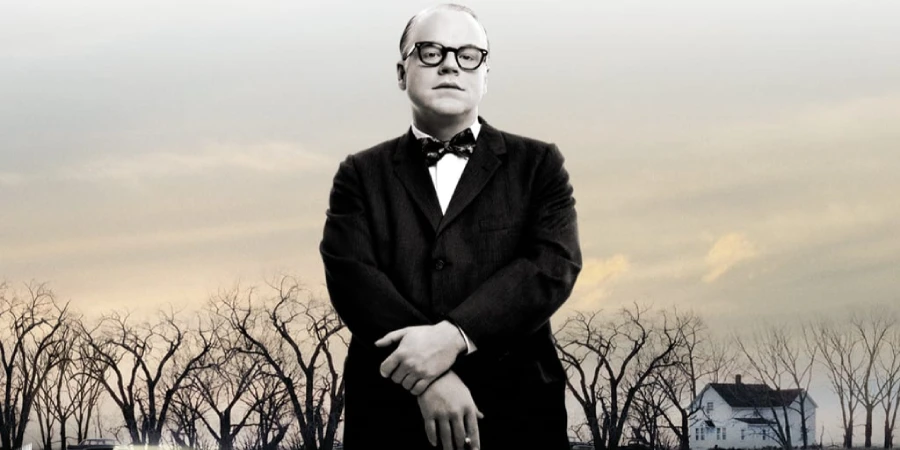

Bennett Miller’s Capote is not a conventional biopic. It is a psychological portrait of a writer at work while quietly, disturbingly documenting the emotional cost of turning real tragedy into literary immortality. The film follows Truman Capote during the years he researched and wrote In Cold Blood, the groundbreaking “nonfiction novel” about the brutal 1959 murder of the Clutter family in Kansas.
What makes this film gripping is not the crime itself, but the moral and emotional erosion of the man telling the story.
Detailed Summary
The Clutter Murders Shake America
The film opens with the quiet life of the Clutter family in Holcomb, Kansas, before their shocking murder by Perry Smith and Richard Hickock. The case captures national attention, and Capote sees an opportunity: not just for a magazine article, but for something much larger.
He pitches the story to The New Yorker and travels to Kansas with his childhood friend Harper Lee, who would later write To Kill a Mockingbird. This pairing is crucial. Lee is warm, empathetic, and grounded. Capote is theatrical, charming, and strategic.
Capote Enters Kansas
Capote is initially met with suspicion by the locals. His voice, mannerisms, and flamboyance stand in stark contrast to the reserved Midwestern town. Harper Lee’s presence helps him gain trust.
Here, the film shows Capote’s brilliance: he listens, observes, flatters, and slowly inserts himself into the community. He becomes less an outsider and more a sympathetic listener.
But the real key to his book lies not in the townspeople, but in the killers.
The First Meeting with Perry Smith
Capote meets Perry Smith in prison, and something immediate and unsettling happens. Capote recognizes himself in Perry. They share troubled childhoods, feelings of alienation, and emotional fragility.
This relationship becomes the emotional core of the film.
Capote begins to form a bond with Perry that is part friendship, part manipulation, part fascination. He gains Perry’s trust by offering companionship, legal assistance, and emotional support. Perry begins to confide in him deeply.
The Ethical Trap
The deeper Capote gets into the story, the more trapped he becomes by a horrifying truth: he needs Perry to be executed.
As long as Perry and Hickock remain alive, the book cannot have its ending. The legal appeals delay the executions for years, and Capote grows impatient and emotionally strained.
He drinks more. He lies more. He begins distancing himself from Perry while pretending to remain loyal. Harper Lee starts to notice the emotional toll this is taking on him.
This is where the film becomes devastating. Capote is no longer simply documenting a tragedy. He is waiting for one to conclude.
The Confession
In one of the film’s most powerful scenes, Perry finally confesses the full details of the murder to Capote. It is raw, disturbing, and intimate. Capote listens with tears in his eyes, knowing this confession is literary gold.
But also knowing what it means for Perry.
This scene captures the central tension of the film: Capote the friend versus Capote the writer.
Movie Ending
The final portion of the film is emotionally crushing and morally complex.
After years of appeals, Perry Smith and Richard Hickock are finally executed by hanging in 1965. Capote is present for the execution. He watches Perry die. The moment is not triumphant, not cathartic, not relieving. It is hollow and traumatic.
He has what he needs to finish the book, but at the cost of a human connection that was real, however distorted.
Capote returns home and completes In Cold Blood. The book becomes a massive success and transforms literary journalism forever. He becomes internationally famous.
But the film makes it painfully clear: he is never the same again.
A title card reveals that Capote never finished another book after In Cold Blood. He struggled with alcoholism, depression, and emotional decline for the rest of his life. He died in 1984, having lived decades in the shadow of this work.
The ending leaves the audience with an unsettling question: Was the masterpiece worth the price?
Are There Post-Credits Scenes?
There are no post-credits scenes. The film ends quietly, allowing the emotional weight of the story to linger.
Type of Movie
Capote is a psychological biographical drama that explores the intersection of journalism, morality, and personal obsession through an intimate character study.
Cast
- Philip Seymour Hoffman as Truman Capote
- Catherine Keener as Harper Lee
- Clifton Collins Jr. as Perry Smith
- Mark Pellegrino as Richard Hickock
- Bruce Greenwood as Jack Dunphy
Film Music and Composer
The subtle and melancholic score was composed by Mychael Danna. The music avoids melodrama and instead enhances the emotional unease and introspective tone of the film.
Filming Locations
The film was shot primarily in Manitoba, Canada, which doubled convincingly for rural Kansas. The flat landscapes and small-town settings are essential in emphasizing Capote’s cultural displacement and the isolation of the crime. The prison scenes were filmed in authentic, stark environments that heighten the realism and emotional claustrophobia.
Awards and Nominations
- Academy Award for Best Actor — Philip Seymour Hoffman (Win)
- Nominated for Best Picture
- Nominated for Best Director — Bennett Miller
- Nominated for Best Supporting Actress — Catherine Keener
- Nominated for Best Adapted Screenplay
Behind the Scenes Insights
- Philip Seymour Hoffman spent months studying Capote’s voice and physical mannerisms with extreme precision.
- The film was shot in sequence to help Hoffman track Capote’s emotional deterioration.
- Harper Lee’s real-life involvement in the Kansas trip was carefully researched from letters and historical records.
- The production kept the atmosphere on set deliberately quiet to maintain the film’s somber tone.
Inspirations and References
The film is based on Gerald Clarke’s biography Capote. It also draws directly from Capote’s own letters and historical documentation surrounding the writing of In Cold Blood.
Alternate Endings and Deleted Scenes
Some deleted scenes included longer interactions between Capote and Jack Dunphy, showing more of Capote’s life outside the case. These were removed to keep the focus tightly on the Kansas events and Perry Smith.
No alternate ending was filmed.
Book Adaptations and Differences
While the movie is not an adaptation of In Cold Blood, it depicts the process behind its creation. The film takes minor dramatic liberties with dialogue but remains largely faithful to documented events and Capote’s biography.
Memorable Scenes and Quotes
Key Scenes
- Capote’s first uneasy arrival in Holcomb
- The initial prison meeting with Perry Smith
- Perry’s full murder confession
- Capote witnessing the execution
Iconic Quotes
- “I think this could be the most important book I’ll ever write.”
- “It’s as if Perry and I grew up in the same house. And then I left.”
Easter Eggs and Hidden Details
- Harper Lee is often shown quietly observing, mirroring her real-life role as the moral anchor.
- Capote’s increasing alcohol use subtly marks the timeline of the story.
- The film’s color palette becomes colder as Capote’s emotional state deteriorates.
Trivia
- The role earned Hoffman numerous awards beyond the Oscar, including a Golden Globe and BAFTA.
- The real town of Holcomb praised the film’s respectful portrayal.
- The film was made on a modest budget but received immense critical acclaim.
Why Watch?
Because this is not just a story about a writer. It is a study of how far someone can go in the name of art, and what it costs to turn real human suffering into literature.