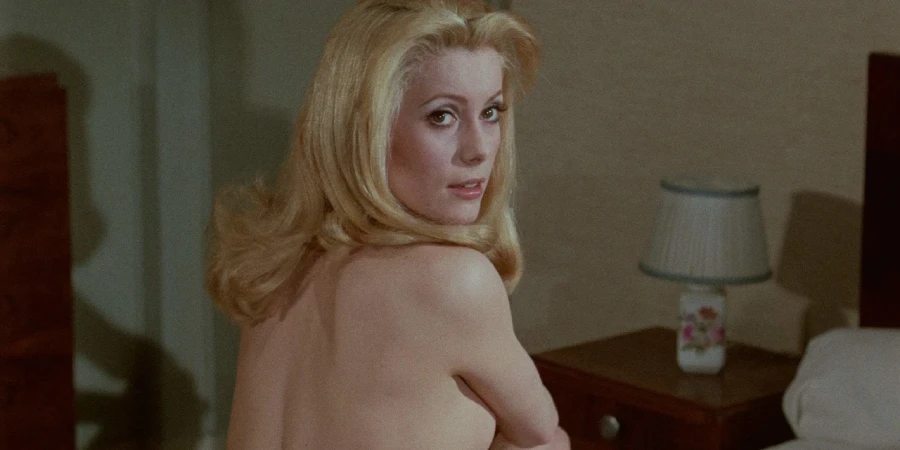

A pristine surface can hide the most turbulent desires. In Belle de Jour, director Luis Buñuel masterfully peels back the elegant façade of a bourgeois marriage. He consequently reveals a world of masochistic fantasy and clandestine transgression. The film remains a disquieting look into the human psyche.
Detailed Summary
Séverine’s Frigid Reality
Séverine Serizy is a young, beautiful, and wealthy Parisian housewife. She is married to Pierre Serizy, a kind and handsome surgeon who adores her. However, their physical relationship is strained; Séverine is unable to be intimate with him, recoiling from his touch.
Her cold exterior, interestingly, masks a rich inner world of violent masochistic fantasies. These daydreams often involve her being humiliated and abused. In one notable fantasy, Pierre has her tied to a tree, whipped, and then offered up to other men.
An Indecent Proposal
Their family friend, the cynical and lecherous Henri Husson, makes advances toward Séverine. She firmly rejects him. During a conversation, Husson tells her about high-class brothels where women from respectable backgrounds sometimes work for pleasure.
This idea plants a seed in Séverine’s mind. Haunted by her fantasies and frustrated by her unfulfilled desires, she finds the address of one such establishment run by Madame Anaïs.
Becoming Belle de Jour
After much hesitation, Séverine finally enters the brothel. Madame Anaïs is initially skeptical but ultimately gives her a chance. She christens Séverine “Belle de Jour” because she can only work in the afternoons, from two until five, before returning to her life as a dutiful wife.
Séverine’s initial experiences are terrifying, yet she finds a strange fulfillment in them. She services a variety of clients, each catering to different and often bizarre fetishes. For instance, one man simply wants to lie beside her while buzzing a mysterious small box.
A Dangerous Obsession
Her double life becomes complicated with the arrival of Marcel, a young, charismatic gangster. He is immediately smitten with Belle de Jour. Their relationship is passionate but also volatile and possessive.
Marcel gives her the physical excitement she craves but lacks the tenderness of her husband. Meanwhile, Séverine grows increasingly paranoid about her secret being discovered. She has a close call when one of Pierre’s friends visits the brothel, forcing her to hide.
The Collision of Worlds
Fearing exposure, Séverine decides to quit her afternoon job. Marcel, however, refuses to let her go. He becomes dangerously obsessive, promising to find her no matter what.
Consequently, he follows her home and confronts her. When Pierre arrives, Marcel shoots him three times before fleeing. Pierre survives but is left paralyzed, blind, and unable to speak. Consumed by guilt, Séverine confesses her secret life to her unresponsive husband.


Movie Ending
The final act feels like a fever dream. Sometime after the shooting, Husson visits the now-despondent Séverine. He informs her he knows everything about her time as Belle de Jour. In a moment of quiet cruelty, he goes into Pierre’s room to tell her paralyzed husband the entire sordid truth.
Séverine waits, bracing for an unknown reaction. After Husson leaves, she enters Pierre’s room. She then imagines him suddenly sit up, fully recovered, asking “What are you thinking about, Séverine?” The sound of sleigh bells from her fantasies fills the air as an empty carriage rolls by outside.
Ultimately, this ending leaves everything ambiguous. One interpretation is that the entire film, from her first visit to the brothel onward, was another elaborate fantasy. Another view is that only this final “miraculous recovery” is a fantasy, a moment of wishful thinking from a woman trapped by her guilt. Buñuel provides no clear answer, leaving the audience to ponder where reality ends and dreams begin.
Are There Post-Credits Scenes?
No, there are no post-credits or mid-credits scenes in Belle de Jour.
Type of Movie
Belle de Jour is a surrealist psychological drama. It masterfully blends a straightforward narrative about a woman’s double life with bizarre, dreamlike sequences that disrupt the audience’s sense of reality.
The tone is coolly detached and clinical, observing Séverine’s journey without overt judgment. This is punctuated by moments of dark, satirical humor aimed at the hypocrisies of the bourgeoisie.
Cast
- Catherine Deneuve – Séverine Serizy / Belle de Jour
- Jean Sorel – Pierre Serizy
- Michel Piccoli – Henri Husson
- Geneviève Page – Madame Anaïs
- Pierre Clémenti – Marcel
- Françoise Fabian – Charlotte
- Macha Méril – Renée
Film Music and Composer
Director Luis Buñuel made a deliberate choice to use almost no non-diegetic music in the film. The soundtrack is instead composed of ambient city sounds, dialogue, and specific diegetic noises that take on symbolic weight. For example, the recurring sound of sleigh bells is a critical audio cue that signals a shift into Séverine’s fantasy world.
While Michel Magne is credited as the composer, his role was minimal. Buñuel’s goal was to create a stark, realistic atmosphere that the surreal elements would then violently disrupt, a task a traditional score would have undermined.


Filming Locations
The film was shot almost entirely on location in Paris, France. This setting is crucial for establishing the central conflict. Séverine’s life unfolds in the chic, orderly apartments and streets of the affluent 16th arrondissement.
In contrast, the brothel is located on the less glamorous Rue de Virnon, visually separating her two worlds. The film also features scenes shot in the forests around Saint-Cloud for some of Séverine’s outdoor fantasy sequences.
Awards and Nominations
Belle de Jour was a major critical success upon its release. Its most prestigious award was the Golden Lion at the 1967 Venice Film Festival, the festival’s highest honor.
In addition, Catherine Deneuve’s performance earned her a nomination for Best Actress at the 1969 British Academy Film Awards (BAFTAs).
Behind the Scenes Insights
- Luis Buñuel was reportedly uninterested in the source novel, which he found melodramatic. He only agreed to direct it on the condition that the producers give him complete artistic freedom to alter the story, specifically the ending.
- The iconic wardrobe worn by Catherine Deneuve was designed by Yves Saint Laurent. The clothing’s stiff, buttoned-up elegance became a visual metaphor for Séverine’s repressed nature.
- Buñuel and Deneuve had a respectful but distant working relationship. The director found her cool, almost icy demeanor perfect for the character of Séverine, as it left her motivations ambiguous.
- The surreal sequences were not explained to the actors. Buñuel simply directed the actions, allowing the bizarre imagery to stand on its own without justification from the performances.
Inspirations and References
The film is a direct adaptation of the 1928 novel of the same name by French author Joseph Kessel. However, the film’s surrealist elements and ambiguous ending are signature additions from director Luis Buñuel.
Buñuel’s entire body of work, with its consistent attacks on the Catholic Church and bourgeois morality, serves as the primary thematic inspiration. The film fits perfectly alongside his other explorations of repressed desire and societal hypocrisy.
Alternate Endings and Deleted Scenes
There are no known official alternate endings or significant deleted scenes for Belle de Jour. Director Luis Buñuel was known for his precise and economical filmmaking style. He delivered a final cut that reflected his exact vision.
The ambiguity of the existing ending has sparked decades of debate. Nonetheless, this was Buñuel’s clear intention rather than the result of cut material.
Book Adaptations and Differences
The film is based on Joseph Kessel’s novel Belle de Jour, but it diverges significantly, especially in its conclusion. Kessel’s book is a more straightforward psychological tragedy without Buñuel’s surrealist flourishes.
In the novel’s ending, Pierre is indeed shot and paralyzed. Séverine confesses, and he forgives her. His unconditional love becomes her ultimate punishment, as she is forever trapped in a chaste, devoted life, unable to pursue the transgressive desires she can no longer repress. Buñuel completely discards this moralistic ending in favor of his famously unsolvable final scene.
Memorable Scenes and Quotes
Key Scenes
- The Opening Fantasy: The film opens with Séverine and Pierre in a carriage. When she resists him, he has the coachmen tie her to a tree and whip her, setting the stage for the film’s exploration of masochism.
- The First Visit: Séverine’s agonizingly slow walk to and from Madame Anaïs’s brothel for the first time is a masterclass in building tension without dialogue, capturing her fear and compulsion.
- The Buzzing Box: An unassuming Asian client brings a small, lacquered box that emits a strange buzzing sound. We never see what is inside, forcing the audience to imagine what fetish it could possibly serve, a classic Buñuel mystery.
- The “Cure”: The final confounding scene where the paralyzed Pierre suddenly sits up, healed and speaking, forcing viewers to question everything they have just watched.
Iconic Quotes
- Henri Husson: “I can’t imagine you in a brothel. It’s so contrary to your principles.”
- Madame Anaïs: “We call her Belle de Jour. She’s free only in the afternoon, from two to five.”
- Séverine: (To a client wanting to see her in the evening) “I’m sorry, sir. I only work until five.”
Easter Eggs and Hidden Details
- The French phrase “belle de jour” is the common name for the morning glory flower, which blooms during the day and closes at night. This is a perfect, poetic symbol for Séverine’s double life.
- The recurring sound of sleigh bells acts as a Pavlovian trigger. It appears in Séverine’s fantasies and bleeds into reality, signaling a blurring of the two states.
- Buñuel frequently used characters with physical disabilities or ailments to critique societal or spiritual decay, a theme clearly present in Pierre’s eventual paralysis.
Trivia
- Belle de Jour was one of the most commercially successful films of Luis Buñuel’s long career, despite its challenging, non-commercial themes.
- Producers Harry and Robert Hakim were notorious for interfering with their directors. They gave Buñuel final cut on the condition that he include a few nude scenes, which he cleverly placed within the ambiguous fantasy sequences.
- Catherine Deneuve was only 23 years old when she played Séverine, delivering a performance of remarkable maturity and subtlety that cemented her status as an international star.
Why Watch?
This is a challenging, beautiful, and unforgettable cinematic puzzle. It powerfully explores themes of desire and repression that remain relevant today. Furthermore, Catherine Deneuve’s iconic, coolly enigmatic performance anchors this masterclass in surrealist filmmaking from a true cinematic legend.
Director’s Other Movies
- Un Chien Andalou (1929)
- L’Age d’Or (1930)
- Viridiana (1961)
- The Exterminating Angel (1962)
- The Discreet Charm of the Bourgeoisie (1972)
- That Obscure Object of Desire (1977)