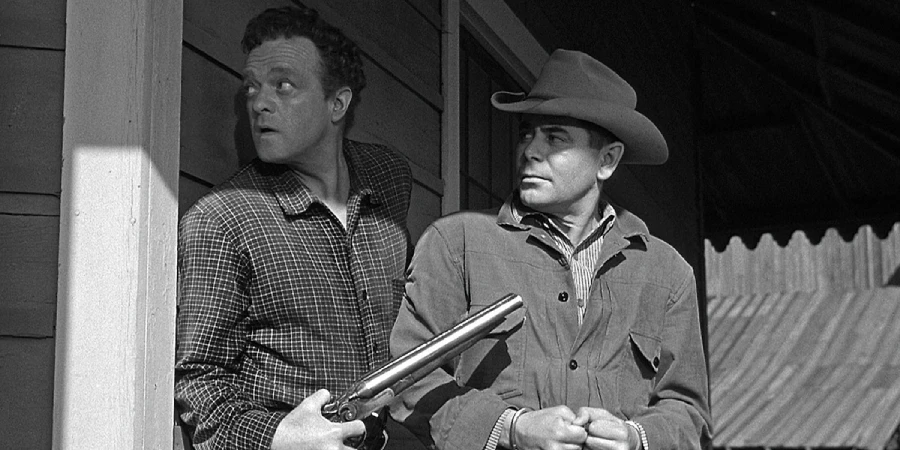

Delmer Daves’ 3:10 to Yuma (1957) is considered one of the most important psychological Westerns ever filmed. It combines moral tension, tight storytelling, and a surprising amount of emotional depth, making it a standout in the classic Western era.
Detailed Summary
The Desperate Rancher and the Captured Outlaw
The film follows Dan Evans, a struggling rancher who witnesses the aftermath of a stagecoach robbery committed by the infamous outlaw Ben Wade. Wade is eventually caught due to his own overconfidence, offering the authorities a rare chance to bring him to justice. Evans, desperate for money to save his drought-stricken ranch, volunteers to help escort Wade to the train station in Contention City, where the 3:10 train will take him to Yuma Territorial Prison.
The Journey to Contention City
Evans and the sheriff’s deputies hide Wade in a hotel room until the train arrives. Here the psychological duel begins. Wade, charismatic and cunning, repeatedly tries to undermine Evans’ resolve—sometimes with intimidation, other times with charm. Wade’s gang, led by the chillingly loyal Charlie Prince, scours the town and tightens the noose around them.
This is where the film shifts from a simple Western into a study of moral courage, desperation, and temptation. Wade tests Evans at every turn.
Tension Boils as the Gang Closes In
The townspeople refuse to help. Deputies desert. The gang takes over the streets. Evans becomes the only person still willing to see the task through. Wade recognizes that Evans is one of the few truly decent men he has ever encountered, which complicates the standoff and adds depth to their dynamic.
Movie Ending
As the 3:10 train approaches, Evans insists on finishing the job even though it’s basically a death sentence. Wade unexpectedly decides to help Evans, partly out of respect, partly out of boredom, and partly because Evans’ moral clarity fascinates him.
The gang surrounds them, bullets flying through the rain-soaked streets. Evans pushes Wade forward despite his injuries and fear. In a surprising twist, Wade willingly boards the train, telling Evans that he’s escaped from Yuma before and likely will again. It’s both an admission of his own nature and a gesture of mutual respect.
Evans, battered but alive, watches as the train pulls away. His wife arrives at the last moment and sees that her husband achieved the seemingly impossible. It’s a life-changing moment for their family and a symbolic restoration of Evans’ pride.
The ending is bittersweet, morally complex, and one of the reasons this film is still studied today.
Are There Post-Credits Scenes?
No. The 1957 version has no post-credits scenes.
Type of Movie
A psychological Western that blends classic frontier elements with an intimate character-driven story focusing on morality, pressure, and courage.
Cast
- Van Heflin as Dan Evans
- Glenn Ford as Ben Wade
- Felicia Farr as Emmy
- Leora Dana as Mrs. Evans
- Henry Jones as Alex Potter
- Richard Jaeckel as Charlie Prince
Film Music and Composer
The soundtrack was composed by George Duning, known for atmospheric and emotionally rich scores. His work here—especially the theme “The 3:10 to Yuma”—adds a haunting, lonely quality to the film’s tense moral landscape.

Filming Locations
- Old Tucson Studios, Arizona
- Sedona, Arizona
These rugged landscapes weren’t chosen just for their beauty but to underline the film’s themes. The barren, sun-blasted terrain reflects Evans’ financial desperation and the personal dryness of a man struggling to reclaim his own sense of worth.
Awards and Nominations
While the film did not win major Academy Awards, it was widely praised by critics and has since become a staple in “best Westerns of all time” lists. Its reputation has only grown, especially after the successful 2007 remake.
Behind the Scenes Insights
- Glenn Ford traditionally played heroic roles, so audiences were shocked (in a good way) to see him as a charming villain.
- Ford insisted his name appear after Van Heflin’s to show respect for the story’s true protagonist.
- The rain-soaked final sequence was difficult to shoot, requiring careful coordination and night filming.
- Director Delmer Daves preferred emotional realism over typical Western gun-slinging spectacle.
Inspirations and References
The film is based on Elmore Leonard’s 1953 short story, which provided the core plot: a rancher escorting an outlaw to a prison train. Leonard’s story is tighter and smaller in scope, but the film expands the psychological tension significantly.
Alternate Endings and Deleted Scenes
No confirmed alternate endings exist for the 1957 film, and deleted scenes from this era are rarely preserved. The ending was deliberately written to be more hopeful than Leonard’s original story, in which the tone is harsher and more cynical.
Book Adaptations and Differences
- In the short story, the psychological battle is just as important, but the film adds more depth to Dan Evans’ family life.
- The film softens Wade slightly, giving him more charm and complexity.
- The ending of the story is more abrupt, whereas the film builds to a symbolic, emotional resolution.
Memorable Scenes and Quotes
Key Scenes
- Dan Evans first volunteering for the mission—establishing the core moral stakes.
- The hotel-room psychological chess match between Evans and Wade.
- The tense rooftop sequences as Wade’s gang takes over the town.
- The final run to the train during the heavy rain.
Iconic Quotes
- “Sometimes a man has to be big enough to see how small he is.”
- “I’ll tell you what you are, Dan: you’re the bravest man I ever met.”
- “Funny, ain’t it? How a man can do a whole lot of things, and sometimes he can’t do the one thing that other people think he ought to be able to do.”
Easter Eggs and Hidden Details
- Ben Wade’s gentle treatment of the hotel waitress hints at his conflicted moral nature.
- The rain in the final act symbolizes Evans’ emotional cleansing and rebirth.
- Wade’s small smiles during the hotel conversation reveal how much he enjoys testing Evans.
Trivia
- Glenn Ford considered Wade one of his favorite roles.
- The film’s minimalist style influenced later directors like James Mangold, who remade the film in 2007.
- The hotel-room scenes were shot in sequence to maintain rising tension between the actors.
Why Watch?
Because it’s one of the most intelligent, character-driven Westerns ever made. If you want a film that offers suspense without relying on constant gunfire, and one that tests characters’ morality, desperation, and pride, this is a must-see.
Director’s Other Works (Movies)
- Broken Arrow (1950)
- The Last Wagon (1956)
- Cowboy (1958)
- Parrish (1961)
Recommended Films for Fans
- High Noon (1952)
- The Gunfighter (1950)
- The Big Country (1958)
- Shane (1953)
- The Man Who Shot Liberty Valance (1962)