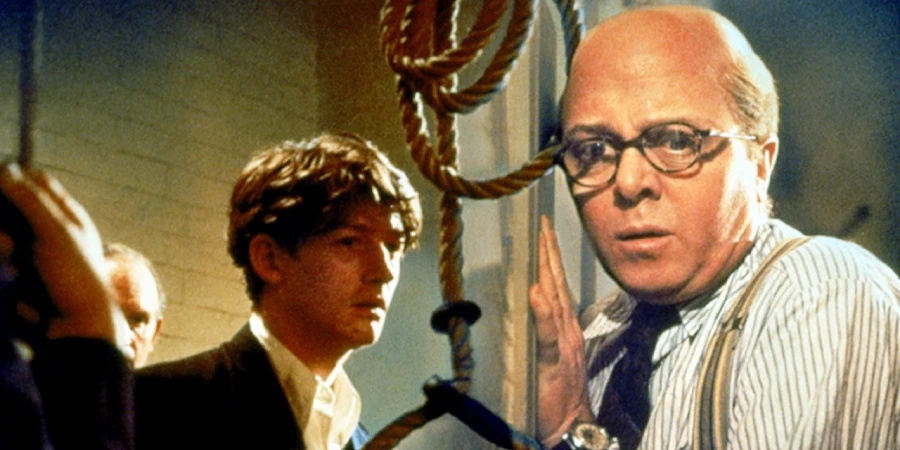

Richard Attenborough’s transformation into the serial killer John Christie is one of cinema’s most terrifying feats. He masterfully presents a man whose mundane exterior masks an unspeakable evil. Consequently, the film 10 Rillington Place functions as a chilling docudrama. Its primary goal, moreover, is exposing a grotesque failure of the British legal system.
Detailed Summary
The film meticulously reconstructs a horrifying true story. It starts in 1944 London and charts the grim path of murderer John Reginald Christie. Each moment builds upon the last, leading to an infamous miscarriage of justice.
The Arrival of the Evans Family
The main narrative begins in 1949. Timothy Evans (John Hurt), an illiterate and boastful van driver, moves into the top-floor flat of 10 Rillington Place with his wife, Beryl (Judy Geeson). Their landlord is the quiet, unassuming Reg Christie. Christie, however, has a dark history; the film opens by showing him murdering a woman, Muriel Eady, years earlier. He presents himself as a former special constable with medical knowledge, a lie that will prove fatal for his new tenants.
Christie’s Deception
Beryl soon becomes pregnant with a second child. The Evanses, already struggling financially with their infant daughter Geraldine, cannot afford another baby. Therefore, Timothy recklessly suggests an illegal abortion. Christie overhears their arguments and cunningly offers to perform the procedure himself. He claims to have the necessary medical training, a complete fabrication designed to exploit Beryl’s desperation.
The Murder of Beryl and Geraldine
Christie convinces a reluctant Beryl to go through with the “procedure.” He uses a makeshift device to feed her domestic gas, rendering her unconscious. After incapacitating her, he strangles her to death and sexually assaults her body. He then tells Timothy that Beryl died from a complication during the procedure. Manipulated and terrified, Timothy agrees to Christie’s plan to hide the body and sell their furniture. Meanwhile, Christie murders the baby, Geraldine, by strangling her, telling Timothy he placed her with a good family in East Acton.
The Framing of Timothy Evans
Overcome with guilt and confusion, Timothy flees to his family in Wales. Eventually, he confesses to the police, but his story is a jumbled, contradictory mess, partly due to his low intelligence and Christie’s manipulation. The police disbelieve his claims about Christie. When they search 10 Rillington Place, they find the bodies of Beryl and Geraldine in the small outdoor washroom. As a result, Timothy Evans is arrested, and his confession, though flawed, is taken as proof of guilt. During the trial, Christie serves as the star witness for the prosecution, delivering a calm, credible performance that seals Timothy’s fate. Subsequently, Timothy Evans is found guilty and hanged in 1950 for the murder of his daughter.
Christie’s Downfall
The film then jumps forward three years. Christie’s wife, Ethel, has also disappeared, another one of his victims. He continues his killing spree until he is evicted from the now-decaying flat. A new tenant, Beresford Brown, discovers three female bodies hidden in a sealed-off kitchen pantry. In addition, police find two more bodies buried in the garden, including Ethel’s. This discovery launches a massive manhunt for Christie. He is eventually found, destitute and dishevelled, by a river embankment. Christie’s confession reveals the full extent of his crimes, though his mind is clearly addled by his years of depravity.

Movie Ending
The ending of 10 Rillington Place is both a factual conclusion and a powerful indictment. After his capture, a mentally deteriorating John Christie confesses to the murders, including that of Beryl Evans. However, he never admits to killing baby Geraldine. His trial is swift, as his guilt is overwhelming. The final scenes show Christie being led to the gallows, passing the same spot where the innocent Timothy Evans had been executed three years prior. The film concludes not with Christie’s death, but with a stark text overlay on the screen. It states that Timothy Evans was granted a posthumous Royal Pardon in 1966 and that his case contributed significantly to the abolition of capital punishment in Great Britain.
Are There Post-Credits Scenes?
No, there are no post-credits scenes in 10 Rillington Place. The film presents its final, damning information via on-screen text before the credits roll. As was standard for films of this era, the story concludes completely when the credits begin.
Type of Movie
10 Rillington Place is a biographical crime drama and a psychological thriller. Its tone is relentlessly grim, somber, and documentary-like. Director Richard Fleischer avoids sensationalism, instead favouring a cold, detached style. This approach amplifies the horror by grounding it in a mundane, everyday reality. The film feels less like an entertainment piece and more like a historical document of a terrible crime and a catastrophic legal failure.
Cast
- Richard Attenborough – John Reginald Christie
- John Hurt – Timothy Evans
- Judy Geeson – Beryl Evans
- Pat Heywood – Ethel Christie
- André Morell – Lord Chief Justice
- Robert Hardy – Malcolm Morris
- Geoffrey Chater – Christmas Humphreys
Film Music and Composer
The score for 10 Rillington Place was composed by the renowned British jazz musician and composer John Dankworth. Interestingly, the music is used very sparingly throughout the film. Dankworth’s score is not a traditional emotional guide; on the contrary, it is eerie, dissonant, and unsettling. The main theme is a mournful, haunting piece that perfectly captures the bleakness of the story. The near-silence in many key scenes, for instance during the murders, makes the events on screen feel starkly and uncomfortably real.


Filming Locations
Authenticity was paramount to director Richard Fleischer. Remarkably, the film’s exterior scenes were shot at the actual 10 Rillington Place in Notting Hill, London, shortly before the entire street was demolished. This decision lends the film a palpable sense of place and historical weight. The interiors, however, were meticulously recreated studio sets, as the real building was too small for film crews. Filming on location provided a chilling connection to the real events, making the story feel all the more immediate and disturbing for the cast and crew.
Awards and Nominations
While the film did not win major awards, its performances were highly praised. Richard Attenborough received a Golden Globe nomination for Best Actor – Motion Picture Drama for his bone-chilling portrayal of Christie. In addition, at the BAFTA Awards, John Hurt was nominated for Best Supporting Actor, and Judy Geeson was nominated for Best Supporting Actress. The film’s power lies more in its historical impact than in its trophy cabinet.
Behind the Scenes Insights
- Richard Attenborough was extremely hesitant to take the role of John Christie. He was a close friend of the Evans family’s Member of Parliament and deeply respected the campaign to clear Timothy’s name. Ultimately, he accepted the role precisely because he felt the story needed to be told.
- Attenborough went to great lengths to capture Christie’s physical and vocal mannerisms. For example, he studied newsreel footage and even wore a prosthetic to mimic Christie’s bald head and a vocal device to replicate his whispery, gas-damaged voice.
- John Hurt, a dedicated method actor, reportedly isolated himself and remained in character throughout much of the shoot to authentically portray Timothy Evans’s alienation and confusion.
- The original gas-and-rubber-tube murder device that Christie used was an actual prop in the film, borrowed from Scotland Yard’s Black Museum.
Inspirations and References
The film is a direct adaptation of the 1961 non-fiction book Ten Rillington Place by journalist and broadcaster Ludovic Kennedy. Kennedy’s book was a detailed investigative work that argued passionately for Timothy Evans’s innocence. It played a crucial role in the campaign that eventually led to Evans’s posthumous pardon. Consequently, the film owes its structure, tone, and factual basis almost entirely to Kennedy’s groundbreaking research into the Christie murders and the subsequent miscarriage of justice.
Alternate Endings and Deleted Scenes
There are no known alternate endings or significant deleted scenes for 10 Rillington Place. The director, Richard Fleischer, aimed for a documentary-style account of the facts as presented in Ludovic Kennedy’s book. As such, the final cut is a faithful and complete version of the story the filmmakers intended to tell. The film’s power comes from its stark portrayal of the true events, leaving little room for fictionalized alternatives.
Book Adaptations and Differences
The film is an exceptionally faithful adaptation of Ludovic Kennedy’s book, Ten Rillington Place. It follows the book’s timeline and central thesis: that Timothy Evans was an innocent man framed by a cunning serial killer. Both the book and the film meticulously detail Christie’s methods and the police’s procedural failures. On the whole, any differences are minor compressions for cinematic pacing. For instance, the film effectively visualizes the claustrophobic atmosphere of the house, something the book could only describe.


Memorable Scenes and Quotes
Key Scenes
- Beryl’s “Procedure”: The film’s most horrifying sequence shows Christie calmly preparing his gas apparatus and murdering Beryl under the guise of medical help. The clinical, quiet nature of the scene is far more disturbing than any dramatic flourish could be.
- Timothy’s Confession: John Hurt brilliantly portrays Timothy’s panicked and confused state as he gives a false confession to police officers who are clearly leading and pressuring him. This scene powerfully illustrates how an innocent person could be coerced into admitting to a crime they did not commit.
- The Discovery in the Pantry: The moment the new tenant breaks through the wallpapered-over pantry door to find Christie’s victims is a shocking reveal. It confirms Christie’s monstrous nature beyond all doubt and kicks off the film’s final act.
Iconic Quotes
- “It’s the gas… for the inhaler. It’s a special mixture. Perfectly harmless but it fills the lungs… helps you breathe.” – Christie, lying to Beryl about his murder weapon.
- “He’s a proper monster, Christy is.” – Timothy Evans, a tragically ironic and truthful statement the police ignore.
- “A helping hand. That’s all we’re here for, isn’t it?” – Christie’s chillingly duplicitous offer to help the desperate Evans family.
Easter Eggs and Hidden Details
- Subtle Breathing Trouble: Attenborough consistently adopts a shallow, wheezing breath throughout the film, a real physical ailment of John Christie’s resulting from a mustard gas attack in World War I.
- The Worn Wallpaper: The grimy, peeling wallpaper and decaying state of the house serve as a visual metaphor for Christie’s own moral and psychological decay hidden behind a thin veneer of normalcy.
- Legal Inaccuracy: In a rare departure from reality for dramatic effect, Timothy Evans is seen being tried in the same courtroom as Christie. In truth, they were tried in different courtrooms at the Old Bailey.
Trivia
- After the film’s production, the real Rillington Place was demolished and the area was redeveloped. The street was renamed Wesley Square to erase the stigma of the murders.
- The real-life executioner, Albert Pierrepoint, served as an uncredited technical advisor on the film to ensure the hanging scene was depicted accurately.
- Richard Attenborough so despised the character he was playing that he would reportedly apologize to his co-stars after filming particularly difficult or violent scenes.
- During his own trial, the real John Christie initially confessed to killing Beryl Evans but later retracted it, claiming he was trying to protect Timothy Evans.
Why Watch?
This film is a masterclass in tension and quiet horror. Moreover, it stands as a vital cinematic document, fueled by incredible performances from Richard Attenborough and John Hurt. Watch it for its unflinching look at evil and its powerful critique of a justice system that failed catastrophically.
Director’s Other Movies
- 20,000 Leagues Under the Sea (1954)
- The Vikings (1958)
- Fantastic Voyage (1966)
- Doctor Dolittle (1967)
- Tora! Tora! Tora! (1970)
- Soylent Green (1973)
- Twisted Nerve (1968)
- Conan the Destroyer (1984)
Recommended Films for Fans
- In Cold Blood (1967)
- Frenzy (1972)
- The Boston Strangler (1968)
- Henry: Portrait of a Serial Killer (1986)
- Zodiac (2007)
- Monster (2003)