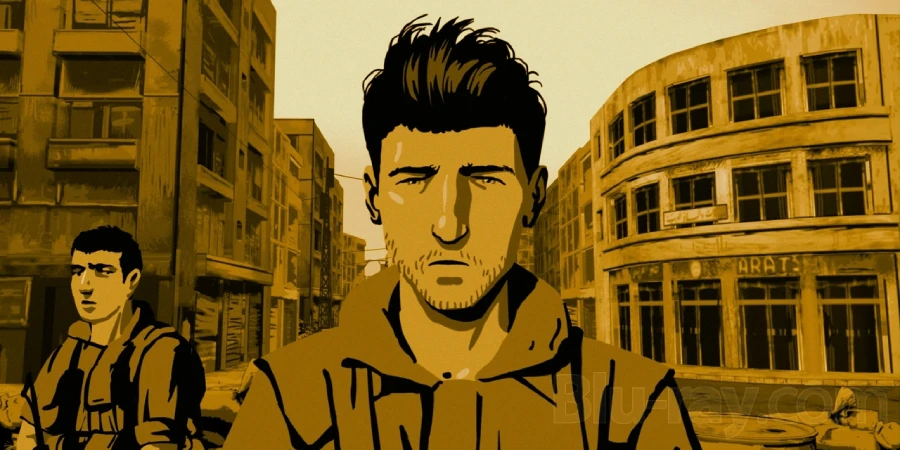
Ari Folman’s Waltz with Bashir is not just a war film. It is a cinematic act of memory excavation. Blending documentary, animation, psychology, and autobiography, the film investigates a very specific historical trauma through the fragile, unreliable lens of human memory. What begins as a conversation between old friends slowly becomes a haunting investigation into what the mind chooses to forget.
Detailed Summary
The Nightmare That Starts Everything
The film opens with Folman’s friend describing a recurring nightmare: 26 angry dogs running through the streets of Tel Aviv. He connects this dream to his time as a soldier during the 1982 Lebanon War, where he had to shoot dogs to prevent them from barking and revealing their unit’s position.
This conversation triggers something in Folman. He realizes he cannot remember anything from his own time in the war, especially around the Sabra and Shatila massacre. This absence of memory becomes the central mystery of the film.
Searching for Lost Memories
Folman begins interviewing former fellow soldiers, psychologists, and friends, attempting to reconstruct what happened. Each person recalls fragmented experiences: hallucinations, surreal visions, moments of fear, confusion, and detachment.
Through these interviews, the film reveals how trauma reshapes memory. Some memories appear dreamlike and symbolic, such as soldiers floating naked in the sea at night, illuminated by flares over Beirut. These are not presented as fantasy, but as the mind’s distorted method of coping.
The Waltz with Bashir
One of the most striking stories comes from a soldier who recalls walking alone through Beirut under heavy gunfire, firing wildly while waltzing through the streets. In front of him is a massive poster of Bashir Gemayel, the Lebanese president-elect whose assassination triggered the massacre.
This moment becomes symbolic of the film’s title and themes: absurdity, detachment, and the surreal nature of war.
The Role of the Israeli Army
Gradually, a painful truth emerges. Israeli forces did not directly carry out the massacre at Sabra and Shatila, but they surrounded the refugee camps, fired illuminating flares into the sky during the night, and allowed the Christian Phalangist militia to enter.
The interviews begin circling around a question Folman is afraid to ask: What exactly was his role during those nights?
The Reconstruction of the Night
Piece by piece, Folman’s suppressed memories start returning. He remembers standing on the beach, firing flares into the sky to light up the camps. He remembers hearing distant gunfire and screams. He remembers knowing something terrible was happening, yet not fully confronting it at the time.
This is where the film becomes deeply uncomfortable. It stops being about war and becomes about moral responsibility and collective denial.
Movie Ending
In the final sequence, Folman’s memory fully returns. He remembers walking into the Sabra and Shatila camps the morning after the massacre. He recalls seeing the bodies. Women crying. Children dead in the streets. The scale of the horror becomes undeniable.
Up to this point, the entire film has been animated. Then, without warning, the animation cuts to real archival footage from the massacre’s aftermath. We see real bodies. Real grieving civilians. Real devastation.
This sudden shift is devastating. The viewer is forced out of the psychological, dreamlike state of animation into raw historical reality. It makes a clear statement: this is not metaphor, not memory distortion, not art — this happened.
The film ends without comfort, without resolution. Folman regains his memory, but what he recovers is guilt, complicity, and trauma.
Are There Post-Credits Scenes?
No. The film ends definitively after the archival footage and credits. There are no post-credits scenes.
Type of Movie
Waltz with Bashir is an animated documentary war film that blends autobiography, psychology, and historical investigation into a deeply personal exploration of trauma and memory.
Cast
- Ari Folman as himself
- Ori Sivan
- Ron Ben-Yishai
- Dror Harazi
- Ronny Dayag
Most participants appear as animated versions of themselves, recounting real memories.
Film Music and Composer
The music was composed by Max Richter. His minimalist, haunting score plays a crucial role in maintaining the film’s melancholic, reflective atmosphere. The soundtrack enhances the dreamlike tone while underlining the emotional weight of the narrative.
Filming Locations
Although animated, the film is based on real locations in:
- Beirut, Lebanon (Sabra and Shatila refugee camps)
- Tel Aviv, Israel
- Various interview locations where Folman met former soldiers
The realism of these locations, recreated through animation, is essential to grounding the film’s psychological journey in historical truth.
Awards and Nominations
- Golden Globe Award for Best Foreign Language Film (Winner)
- César Award for Best Foreign Film (Winner)
- Academy Award Nomination for Best Foreign Language Film
- BAFTA Nomination for Best Film Not in the English Language
- Annie Award for Best Animated Feature (Nomination)
Behind the Scenes Insights
- The film took four years to complete due to the complex animation process.
- Folman originally intended to make a live documentary but chose animation to portray memory and dreams more accurately.
- Many interviewees had never spoken publicly about these memories before.
- The final archival footage was a last-minute decision to break the animated illusion.
Inspirations and References
The film is based on Ari Folman’s real experiences as a soldier during the 1982 Lebanon War. It draws heavily from psychological studies on trauma and memory repression, as well as real testimonies from soldiers and journalists.
Alternate Endings and Deleted Scenes
Early cuts of the film reportedly ended with animation only. The inclusion of real footage at the end replaced earlier, less confrontational conclusions.
Some interviews were shortened significantly to maintain narrative focus.
Book Adaptations and Differences
The film was later adapted into a graphic novel using frames from the movie. There is no original book; the film is the primary source material.

Memorable Scenes and Quotes
Key Scenes
- Soldiers rising from the sea under yellow flares
- The waltz under gunfire in front of Bashir’s poster
- The slow realization of what happened in the camps
- The sudden transition from animation to real footage
Iconic Quotes
- “Memory is dynamic. It’s alive.”
- “I remember nothing. That’s the problem.”
Easter Eggs and Hidden Details
- The number of dogs (26) corresponds to the exact number Folman’s friend killed.
- Yellow lighting throughout the film mirrors the flare lights over Beirut.
- Repeated water imagery symbolizes suppressed memory rising to the surface.
Trivia
- It is one of the first animated documentaries ever nominated for an Oscar.
- The animation style combines Flash, classic animation, and 3D techniques.
- Ari Folman did not remember these events until making the film.
Why Watch?
Because it is one of the most powerful explorations of memory, guilt, and war ever put on screen. It uses animation not for fantasy, but to show how the mind hides unbearable truths.
Director’s Other Works (Movies)
- Saint Clara (1996)
- Made in Israel (2001)
- The Congress (2013)
- Where Is Anne Frank (2021)
Recommended Films for Fans
- Persepolis (2007)
- Grave of the Fireflies (1988)
- The Act of Killing (2012)
- Apocalypse Now (1979)
- Come and See (1985)