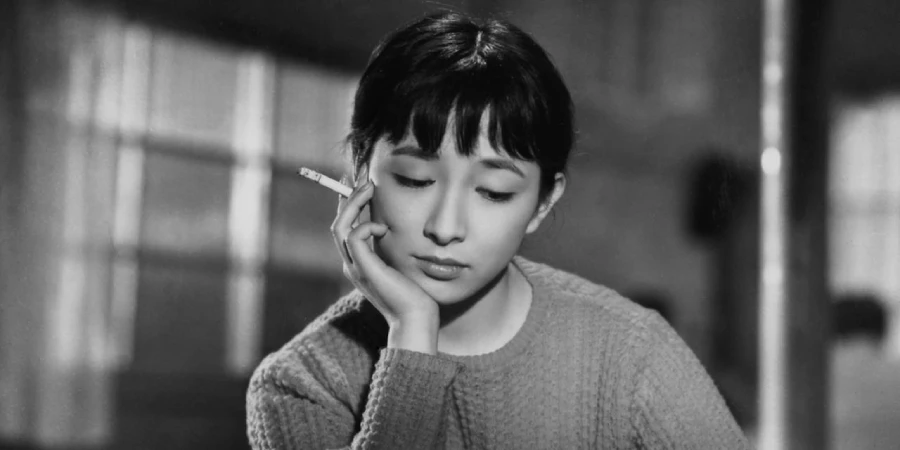

Tokyo Twilight (Japanese: 東京暮色, Tōkyō boshoku) is a 1957 Japanese drama film directed by Yasujirō Ozu, one of cinema’s most subtle yet emotionally devastating storytellers. It is one of Ozu’s darkest and most mature works, exploring themes of family estrangement, loneliness, and postwar disillusionment through the eyes of two sisters searching for meaning in Tokyo’s cold winter.
Detailed Summary
Introduction: A Family in Disarray
Set in postwar Tokyo, the film follows two sisters—Takako (played by Setsuko Hara) and Akiko (played by Ineko Arima)—who live very different lives under the same emotional shadow. Their father, Shukichi (Chishū Ryū), is a widower who quietly endures his daughters’ turmoil. The family appears respectable on the surface, but Ozu gradually reveals the loneliness and alienation beneath.
Takako’s Return Home
Takako, the elder sister, returns to her father’s home with her young daughter after separating from her alcoholic husband. She struggles between duty and exhaustion, embodying the societal expectations placed on women in Japan’s postwar era. Despite her calm demeanor, she is clearly weighed down by disappointment and resignation.
Akiko’s Secret and Her Search
Meanwhile, Akiko, the younger sister, is a college student dealing with far deeper turmoil. She is secretly pregnant and searching for her lover, Kenji (Masami Taura), who has vanished. Akiko’s story becomes the emotional center of the film—a raw, painful portrait of a young woman abandoned and desperate for love and guidance.
The Revelation of the Mother
In a shocking turn, Akiko learns that her estranged mother, whom she believed to be dead, is actually alive and living in Tokyo. Even more painfully, her mother, Kisako (Isuzu Yamada), is running a mahjong parlor—a morally ambiguous place associated with gambling and nightlife. Their reunion is heartbreaking. Kisako, filled with shame, cannot face Akiko properly, and their conversation is awkward and emotionally restrained. Ozu captures this scene with devastating quietness: no shouting, just unbearable silence and sadness.
Akiko’s Downward Spiral
After this failed reunion, Akiko spirals further into despair. Kenji, the man she loves, coldly rejects her and denies responsibility for her pregnancy. Rejected by both her lover and her mother, Akiko’s world collapses. In one of Ozu’s most haunting sequences, she wanders through the snowy streets of Tokyo, aimless and broken.
Movie Ending
In the final act, Akiko’s despair leads her to attempt an abortion, but things go tragically wrong. She is brought home gravely ill, her body and spirit both shattered. Takako and Shukichi can do nothing but watch as Akiko slowly fades away, embodying the quiet tragedy of unspoken pain.
Before she dies, Akiko mumbles incoherently about her mother—still longing for love and understanding she never received. Her death is not sensationalized; Ozu presents it with simplicity and grace, emphasizing emotional truth over dramatics. Takako, deeply affected, decides to reconcile with her husband, suggesting a cyclical pattern of resignation that mirrors her father’s own passivity.
In the final scene, Shukichi quietly mourns in solitude, sitting in his home as a train passes outside—a recurring Ozu motif symbolizing the flow of life and the inescapable passage of time. The film ends not with closure, but with a profound sense of melancholy and reflection on generational distance, family failures, and the loneliness of modern urban life.
Are There Post-Credits Scenes?
No, Tokyo Twilight does not have any post-credits scenes. Like most of Ozu’s works, the film ends quietly, with the emotional resolution occurring before the credits. The final moments serve as the natural, contemplative conclusion to the story.
Type of Movie
Tokyo Twilight is a Japanese family drama and melancholic psychological film, known for its restrained emotional delivery and social realism. It delves deeply into themes of family alienation, moral decay, and postwar identity crisis.
Cast
- Chishū Ryū as Shukichi Sugiyama
- Setsuko Hara as Takako Numata
- Ineko Arima as Akiko Sugiyama
- Isuzu Yamada as Kisako Soma
- Masami Taura as Kenji
- Kiyoko Kagawa as Aya
Film Music and Composer
The score, composed by Takanobu Saitō, is sparse and melancholic, complementing Ozu’s minimalist direction. Music is used sparingly, often replaced by the natural rhythm of dialogue and silence. The absence of constant background music amplifies the emotional weight of key scenes.
Filming Locations
The film was shot primarily at Shochiku Studios in Tokyo, with additional on-location shooting around the city’s wintry streets and train stations. The gray urban landscape reflects the inner emptiness of the characters, while the recurring image of trains underscores the idea of transience and lost connections—a frequent visual motif in Ozu’s work.
Awards and Nominations
While Tokyo Twilight did not receive major international awards at the time of its release, it is now regarded as one of Ozu’s late masterpieces and is praised by modern critics for its raw emotional honesty and social critique. It frequently appears on lists of the greatest Japanese films ever made.
Behind the Scenes Insights
- Ozu described Tokyo Twilight as one of his most “pessimistic” films.
- Setsuko Hara, known for her radiant optimism in other Ozu films, considered this role her most emotionally draining.
- Ozu originally planned to include a brief reconciliation between Akiko and her mother, but he removed it to maintain the film’s tragic realism.
- The snow scenes were filmed using artificial snow at Shochiku Studios due to weather inconsistencies.
- Chishū Ryū mentioned in interviews that Ozu deliberately avoided melodrama, insisting that “suffering must be quiet.”
Inspirations and References
The story was inspired by Ozu’s interest in postwar moral decay and the breakdown of traditional family values in Japan. While not based on a book, the film reflects the social realities of the 1950s, when Japan was struggling with modernization, Western influence, and shifting gender roles.
Alternate Endings and Deleted Scenes
Originally, Ozu wrote a version of the script in which Akiko survives and leaves Tokyo to start a new life. However, he felt this ending betrayed the emotional truth of her despair and changed it to the bleaker, more realistic version we see today.
Some minor domestic scenes were also cut for pacing, but the overall structure remained intact.
Book Adaptations and Differences
Tokyo Twilight is not adapted from a novel but reflects the narrative structure of Japanese shōshimin-geki (everyday-life dramas). However, the screenplay draws thematic parallels to Ozu’s earlier films like Late Spring and Early Summer, exploring generational conflict and unspoken grief.

Memorable Scenes and Quotes
Key Scenes
- Akiko’s tense reunion with her mother in the mahjong parlor.
- The snowy night when Akiko wanders alone through Tokyo’s streets.
- Takako’s quiet breakdown as she decides to return to her husband.
- Shukichi sitting silently at the end, framed by a passing train.
Iconic Quotes
- Takako: “We all make compromises to keep living.”
- Shukichi: “You can’t hold on to people forever.”
- Akiko: “It’s cold… colder than I imagined.”
Easter Eggs and Hidden Details
- The mahjong parlor’s neon sign is a visual metaphor for false warmth—bright outside, empty inside.
- The repeated sound of trains marks emotional transitions, symbolizing time passing and life moving forward despite loss.
- The absence of tatami-level camera shots in key moments breaks Ozu’s usual style, emphasizing the emotional dislocation of the characters.
Trivia
- Tokyo Twilight was Ozu’s last black-and-white film.
- The film was not well received upon release due to its grim tone but later gained acclaim as one of his most emotionally mature works.
- Setsuko Hara retired from acting only a few years later, making this one of her final performances.
- The title “Tokyo Twilight” reflects both the literal time of day and Japan’s fading traditional values.
Why Watch?
Watch Tokyo Twilight if you appreciate emotional realism, masterful restraint, and human vulnerability. It is one of Ozu’s most heartbreaking works, a film that examines love, shame, and the quiet devastation of modern life without ever resorting to melodrama. Every scene feels like a whisper that lingers long after the credits roll.
Director’s Other Movies
- Late Spring (1949)
- Early Summer (1951)
- Tokyo Story (1953)
- An Autumn Afternoon (1962)
- Equinox Flower (1958)
Recommended Films for Fans
- Tokyo Story (1953)
- Floating Clouds (1955)
- The Life of Oharu (1952)
- Late Chrysanthemums (1954)
- The End of Summer (1961)