
The Triplets of Belleville is a wildly original animated film by Sylvain Chomet that blends slapstick comedy, noir atmosphere, and sharp social satire. Almost entirely dialogue-free, it tells an emotionally rich story through music, movement, and unforgettable visuals.
Detailed Summary
A Childhood Built on Obsession
The film begins in Belleville with a young boy, Champion, living with his grandmother, Madame Souza. Champion is quiet, withdrawn, and socially awkward. The grandmother, determined to give him purpose, notices his fascination with cycling and begins training him relentlessly. This sequence establishes one of the film’s core themes: love expressed through sacrifice and discipline rather than words.
Parallel to this, we are introduced to The Triplets of Belleville, once-famous music hall performers now long forgotten. Their exaggerated opening musical number acts as both parody and historical setup.
Training for the Tour de France
Champion grows into a professional cyclist and competes in the Tour de France. Madame Souza follows him everywhere with their loyal dog, Bruno, whose obsession with trains becomes a recurring visual gag. The training scenes are humorous but also slightly unsettling, portraying devotion bordering on obsession.
This part of the film subtly criticizes modern performance culture, where human value is tied to productivity and endurance.
Kidnapping and the Dark Side of Belleville
During the Tour de France, Champion and several other cyclists are kidnapped by mysterious men in black. Madame Souza refuses to accept his disappearance and follows the trail to the city of Belleville, a grotesque, exaggerated version of American urban sprawl.
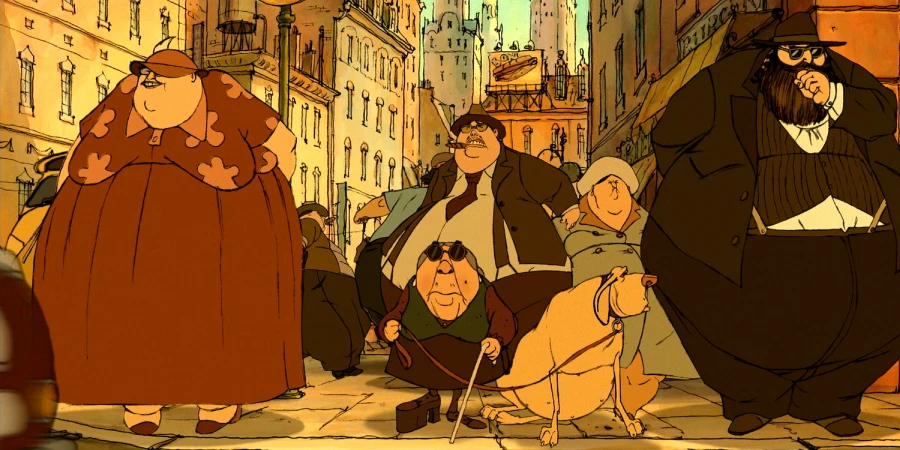
Belleville is loud, obese, corrupt, and indifferent. Wealthy elites gamble on underground cycling races where kidnapped athletes are forced to pedal until collapse. This shift in tone turns the film into a near-noir thriller without abandoning its absurd humor.
Meeting the Triplets
Madame Souza encounters the now-elderly Triplets of Belleville, who live in poverty, surviving on frogs and memories of fame. Despite their frailty, they agree to help rescue Champion.
This section highlights one of the film’s most poignant ideas: those discarded by society often retain the greatest humanity. The Triplets, though forgotten, still act with purpose and solidarity.
The Rescue Mission
Together, Madame Souza, the Triplets, and Bruno infiltrate the criminal operation. The action escalates into a chaotic chase involving gangsters, corrupt police, and the grotesque Belleville elite.
The climax is fast, violent, and darkly comic, reinforcing the film’s cynical view of institutional power and capitalism.
Movie Ending
In the final act, Madame Souza successfully rescues Champion, interrupting the illegal cycling race where he is being exploited. The criminal organization collapses in chaos as the gangsters attempt to flee. One by one, they are eliminated in slapstick fashion, including being crushed by their own excess and greed.
The corrupt Belleville police, who were complicit throughout the film, are accidentally destroyed during the chase, emphasizing the film’s message that systems built on exploitation eventually consume themselves.
Madame Souza, Champion, the Triplets, and Bruno escape Belleville. The Triplets, having fulfilled their final purpose, quietly fade from the story. In the closing scene, time has passed. Madame Souza is now elderly and fragile, mirroring the Triplets at the start. Champion, now grown and successful, continues cycling, while Bruno remains faithfully by their side.
The ending is bittersweet rather than triumphant. Champion is saved, but the cost of obsession, aging, and sacrifice lingers. The film closes on the unspoken truth that love endures, even as bodies fail and fame disappears.
Are There Post-Credits Scenes?
No. The Triplets of Belleville does not include a post-credits or mid-credits scene. However, the end credits themselves are visually playful and musically expressive, staying true to the film’s storytelling style.
Type of Movie
This is a hand-drawn animated film that blends surreal comedy, dark satire, and silent-era visual storytelling. It appeals as much to adult audiences as to animation enthusiasts, using exaggeration and irony rather than conventional narrative structure.
Cast
The film features minimal dialogue, but notable contributors include:
- Michèle Caucheteux as Madame Souza
- Jean-Claude Donda as Champion
- Monica Viegas as one of the Triplets
Sound design and physical performance are far more important than spoken lines.
Film Music and Composer
The score was composed by Benoît Charest, whose work is essential to the film’s identity. The jazzy, accordion-heavy soundtrack functions as narration, emotion, and pacing mechanism. The song “Belleville Rendez-vous” became iconic and was nominated for an Academy Award.


Filming and Animation Production
The film was produced across France, Belgium, and Canada. Its hand-drawn animation style deliberately rejects clean digital aesthetics in favor of:
- Distorted anatomy
- Grotesque caricatures
- Muted, grimy color palettes
These choices reinforce the film’s critique of modern urban life and consumerism.
Awards and Nominations
- Academy Award Nominee – Best Animated Feature
- Academy Award Nominee – Best Original Song
- BAFTA Winner – Best Animated Film
- Cannes Film Festival – Official Selection
Though it did not win the Oscar, it became one of the most respected animated films of the decade.
Behind the Scenes Insights
- Sylvain Chomet intentionally minimized dialogue to make the film universally accessible.
- Character designs were inspired by European caricature art and 1930s cartoons.
- The city of Belleville is a satirical blend of Paris and New York, exaggerated to the point of grotesque absurdity.
- The animators studied silent film comedians like Jacques Tati and Buster Keaton.
Inspirations and References
- Jacques Tati’s films, especially Playtime
- French music hall culture
- Silent cinema
- Anti-consumerist European graphic novels
The film is deeply rooted in Old World European sensibilities, resisting Hollywood animation norms.
Alternate Endings and Deleted Scenes
No official alternate ending has been released. However, early storyboards included longer sequences focusing on Belleville’s elite spectators, which were cut to maintain pacing and mystery.
Book Adaptations and Differences
The film is not based on a book. However, an illustrated companion book was later released, expanding on the artwork and character concepts without altering the story.

Memorable Scenes and Quotes
Key Scenes
- Champion’s childhood training montage
- The Tour de France kidnapping
- The Triplets’ frog-catching dinner routine
- The underground cycling race
- The final escape from Belleville
Iconic Quotes
The film contains almost no spoken dialogue. Its most iconic “quotes” are musical cues and visual motifs, particularly the recurring song “Belleville Rendez-vous.”
Easter Eggs and Hidden Details
- The opening musical number subtly references early Disney and Fleischer cartoons
- Belleville’s obese elite are visual metaphors for unchecked consumerism
- The gangsters are nearly identical, symbolizing faceless systemic evil
- Bruno’s train obsession mirrors Champion’s cycling obsession
Trivia
- Over 80% of the storytelling is done without dialogue
- Sylvain Chomet later expanded his visual style in live-action projects
- The dog Bruno was animated with more expressive detail than most human characters
Why Watch This Movie?
You should watch The Triplets of Belleville if you value animation as art, enjoy visual storytelling, or appreciate films that trust the audience’s intelligence. It’s funny, unsettling, touching, and completely unlike mainstream animated movies.
Director’s Other Works
- The Illusionist (2010)
- The Old Lady and the Pigeons (1997) – short film
- Attila Marcel (2013)
Recommended Films for Fans
- Persepolis (2007)
- My Life as a Zucchini (2016)
- Mary and Max (2009)
- Ernest & Celestine (2012)
- The Red Turtle (2016)
- Song of the Sea (2014)