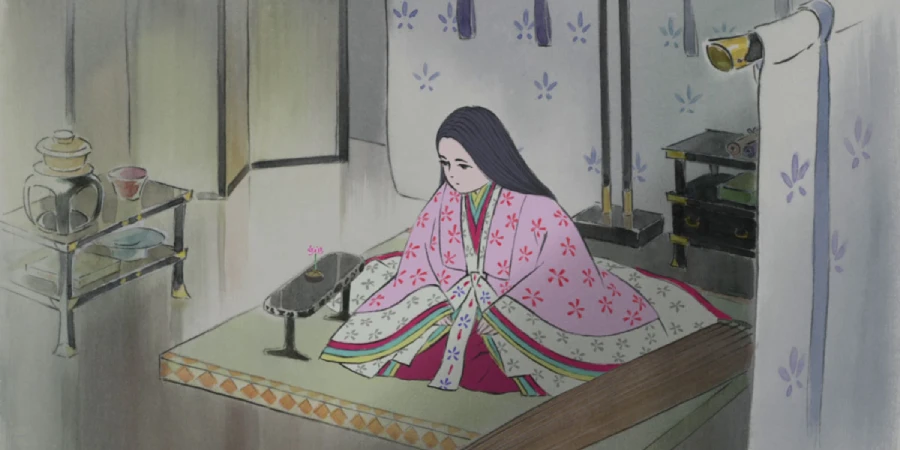

Isao Takahata’s The Tale of the Princess Kaguya is one of Studio Ghibli’s most poetic, visually daring, and emotionally devastating films. Adapted from Japan’s oldest surviving folktale (The Tale of the Bamboo Cutter), it blends hand-drawn watercolors with an almost spiritual sense of storytelling.
Detailed Summary
The Bamboo Cutter’s Miracle Discovery
A humble bamboo cutter finds a tiny, glowing girl inside a bamboo stalk. Believing she’s a divine gift, he brings her home. The child instantly transforms into a real human baby. He and his wife raise her with affection, calling her simply “Little Bamboo.”
The Rapid Growth and Rural Joy
Little Bamboo grows at an unnatural speed. She forms deep friendships with local children, most importantly Sutemaru, a boy who shares her love of nature. These early scenes show her happiest days—full of freedom, laughter, and earthy simplicity.
The Unwanted Nobility
The bamboo cutter discovers gold and fine garments appearing inside bamboo stalks. Convinced the heavens want Kaguya to become a noble lady, he moves the family to the capital. Kaguya is trained in court etiquette, music, writing, and deportment—everything she never asked for.
But nobility becomes a slow suffocation. She hides her loneliness behind a polite smile while longing for her old rural life.
The Suitors and the Impossible Tasks
Enchanted by her beauty, noblemen beg for her hand in marriage. Kaguya cleverly avoids them by assigning impossible quests, each based on mythical items they falsely compare her to. Their failures reveal their shallowness, and Kaguya’s frustration grows.
The Emperor’s Proposal
Even the Emperor wants to marry her. When he tries to force himself on her, she magically disappears. Terrified, she runs home and cries out to the moon, revealing a deeper truth even she does not fully understand.
The Moon’s Looming Shadow
After returning to the capital, Kaguya confesses to her parents that she is not human but a being from the moon who will one day be taken back. She dreads this fate. Her joy on Earth has changed her; she has tasted human emotion, love, sorrow—things her celestial people do not experience.

Movie Ending
Kaguya’s moon people arrive in a grand, serene procession. They descend calmly, without malice, but with a chilling sense of inevitability. Her parents desperately try to protect her, but human wills are powerless against celestial law.
Kaguya begs to stay, because she has found something precious on Earth: the full, painful spectrum of human feeling. But the moon emissaries gently place a divine robe on her, erasing her earthly memories—memories she desperately wants to keep.
For a brief moment, she turns back and looks down at Earth, a world she now loves profoundly. Then she is carried to the moon, leaving her grieving parents behind. The film ends with an aching, quiet acceptance: sometimes love makes us human, and loss confirms it.
Are There Post-Credits Scenes?
No. The film ends with the final emotional shot and does not include any post-credits scenes.
Type of Movie
A poetic, hand-drawn fantasy drama blending folklore with philosophical reflections on life, joy, and impermanence.
Cast
- Aki Asakura as Princess Kaguya
- Takeo Chii as The Bamboo Cutter
- Nobuko Miyamoto as The Bamboo Cutter’s Wife
- Kengo Kora as Sutemaru
- Takuya Kimura as The Emperor
- Atsuko Takahata as Lady Sagami
(English cast also exists, but above is the original Japanese voice cast.)
Film Music and Composer
Music by Joe Hisaishi, whose score here is delicate, melancholic, and crucial to the film’s emotional power. The theme song, When I Remember This Life, is sung by Kazumi Nikaido.
Filming Locations
As an animated film, it was “shot” primarily within Studio Ghibli, though its visual style draws heavily from:
- Traditional Japanese ink wash painting
- Heian-era court culture
These inspirations serve not only as aesthetic choices but reinforce the film’s themes of impermanence and cultural heritage.
Awards and Nominations
- Academy Award Nomination: Best Animated Feature
- Japan Academy Prize Nomination
- Annie Awards Nominations
- Multiple international critics’ awards, often honoring its unique animation style
Behind the Scenes Insights
- Director Isao Takahata spent eight years crafting the film due to his meticulous hand-drawn approach.
- The watercolor, sketch-like style was chosen to evoke ephemeral childhood memories.
- Some scenes were animated entirely in rough lines (the running sequence) to portray raw emotion over realism.
- Takahata pushed animators to avoid perfect outlines, insisting on a look that felt alive and in motion.
- Ghibli staff jokingly called the movie “the endless production” due to Takahata’s perfectionism.
Inspirations and References
- Based on the 10th-century folktale The Tale of the Bamboo Cutter.
- Themes of impermanence reflect the Japanese aesthetic concept mono no aware.
- Kaguya’s transformation sequences are inspired by traditional emakimono scrolls.
Alternate Endings and Deleted Scenes
No widely released alternate ending exists, but early drafts suggested:
- A version where Kaguya remembers Sutemaru in the final moment.
- A slightly longer moon farewell scene that was trimmed for emotional clarity.
Book Adaptations and Differences
As it adapts a folktale, not a single novel, the changes include:
- Greater focus on Kaguya’s emotional interior life.
- Expansion of her childhood and her relationship with Sutemaru.
- A more pointed critique of societal expectations, especially for women of the era.

Memorable Scenes and Quotes
Key Scenes
- Kaguya sprinting through the capital in a moment of raw emotional rebellion.
- The moon procession descending slowly and beautifully.
- The reunion of Kaguya and Sutemaru during the dreamlike flight sequence.
- Her painful farewell to her parents.
Iconic Quotes
- “The more beautiful things are, the more painful they are.”
- “I want to stay here… with you.”
- “We humans are foolish, but because we’re human, we can cherish things.”
Easter Eggs and Hidden Details
- Several character designs mirror figures from historical Japanese paintings.
- Kaguya’s kimono patterns symbolically shift with her emotional state.
- The final moon robe features motifs from early Heian art manuscripts.
- Sutemaru’s name references a type of heroic youth common in Japanese folklore.
Trivia
- This was Isao Takahata’s final film before his passing.
- One of the most expensive Japanese animated films ever produced.
- It took over 50,000 hand-drawn frames.
- Joe Hisaishi returned to work with Takahata after a long hiatus.
Why Watch?
Because it’s a rare film that feels like a painting come to life, exploring life’s beauty and sorrow with a depth few animated films attempt. It is meditative, emotional, visually daring, and rich with cultural history—an unforgettable experience.
Director’s Other Movies
- Grave of the Fireflies (1988)
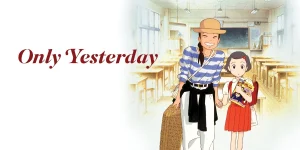
- Only Yesterday (1991)
- Pom Poko (1994)
- My Neighbors the Yamadas (1999)