
Few films portray a protagonist’s descent into madness with such chilling finality. The Sword of Doom offers no path to redemption for its central character. Instead, audiences witness a portrait of a man whose soulless eyes and peerless swordsmanship carve a wake of nihilistic destruction. Consequently, it stands as one of the bleakest, most unforgettable samurai films ever made.
Detailed Summary
The First Killing
The film opens at the Great Bodhisattva Pass. An elderly Buddhist pilgrim is praying. Out of nowhere, samurai Ryunosuke Tsukue (Tatsuya Nakadai) appears and cuts him down without provocation or remorse. Ryunosuke continues on his way, his actions establishing his amoral nature from the very first scene. This unmotivated act of violence, therefore, sets the tone for his entire journey.
A Fateful Duel
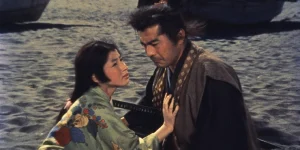
Next, Ryunosuke is scheduled for an exhibition fencing match against Bunnojo Utsuki. Bunnojo’s wife, Hama, fears for her husband, who is not Ryunosuke’s equal. As a result, she offers herself to Ryunosuke in exchange for him throwing the match. Ryunosuke accepts her offer but then breaks his promise. During the duel, he kills Bunnojo with a single, brutal stroke, showcasing his dishonorable and cruel nature.
The Assassin’s Path
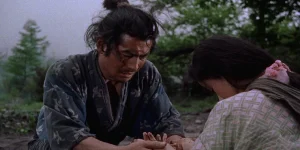
Shunned by his own clan for his actions, Ryunosuke leaves his village with Hama now bound to him. He eventually finds work in the city as an assassin for a group of political militants. His skill with a blade makes him a valuable, if unsettling, tool for them. Meanwhile, Hama lives as his common-law wife, trapped in a miserable existence. She gives birth to his son, though Ryunosuke shows little interest in the child.
The Shadow of Hyoma
Bunnojo’s younger brother, Hyoma, vows to avenge his brother’s death. However, he knows he is not yet skilled enough to face Ryunosuke. He therefore seeks out the master swordsman Toranosuke Shimada (Toshiro Mifune) for training. Shimada represents everything Ryunosuke is not: a man who sees the sword as a tool for perfecting the soul, not for mindless killing. Shimada’s philosophy directly contrasts with Ryunosuke’s destructive path.
The Final Massacre
Ryunosuke’s paranoia and inner demons begin to consume him. After he kills Hama in a fit of jealous rage, her ghost, along with the ghosts of his other victims, begins to haunt him. His militant employers, deciding he has become a liability, plot to kill him. In a snow-covered brothel, they ambush him. Ryunosuke, now completely unhinged and seeing phantoms everywhere, slaughters dozens of attackers in a stunning, seemingly endless battle. The film ends on a freeze-frame of him, mid-slash, forever trapped in his personal hell.
Movie Ending
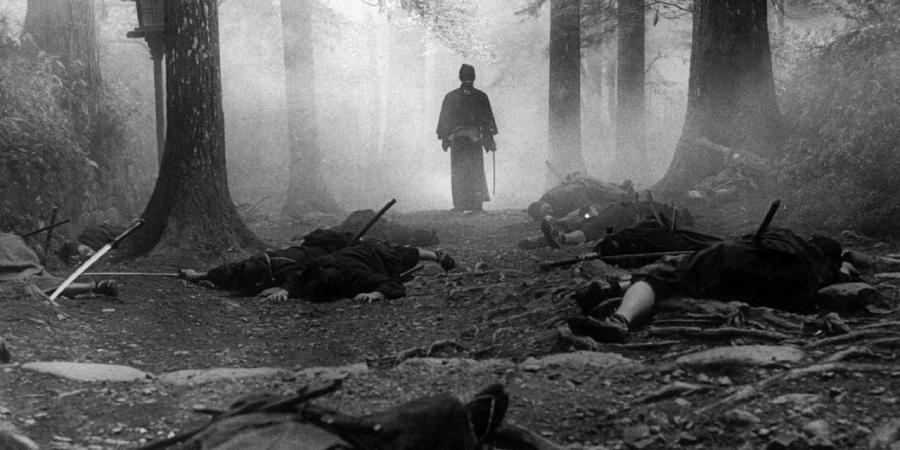
The ending of The Sword of Doom is famously abrupt and profoundly unsettling. Ryunosuke is not defeated by a hero in a climactic duel. Instead, he completely succumbs to his insanity. After murdering Hama, he is ambushed in a brothel. Believing he is fighting the ghosts of his past victims, he embarks on an astonishingly violent rampage, cutting down countless assassins sent to kill him. The director, Kihachi Okamoto, uses quick cuts and disorienting angles to place the viewer inside Ryunosuke’s fractured mind.
Furthermore, the final shot is a freeze-frame of Ryunosuke mid-swing, an image of perpetual, unending violence. This was not the originally intended ending. The film was meant to be the first part of a trilogy, but the subsequent installments were never made. Consequently, this accidental ending becomes a powerful statement. Ryunosuke is not killed or captured; he is simply doomed to an eternal loop of his own making, a Sisyphus fated to forever swing his blood-soaked sword against the demons of his own creation.
Are There Post-Credits Scenes?
No, there are no post-credits scenes in The Sword of Doom. The film concludes with the final freeze-frame and the credits roll immediately after.
Type of Movie
The Sword of Doom is a Japanese jidaigeki (period drama) and specifically a chanbara (sword-fighting) film. However, its tone is far darker than typical action-adventure samurai fare. It functions primarily as a psychological horror film, charting the moral and mental disintegration of its sociopathic protagonist. The atmosphere is overwhelmingly bleak, nihilistic, and grim.
Cast
- Tatsuya Nakadai – Ryunosuke Tsukue
- Michiyo Aratama – Ohama
- Yuzo Kayama – Hyoma Utsuki
- Toshiro Mifune – Toranosuke Shimada
- Reiko Dan – Omatsu
- Ichiro Nakatani – Bunnojo Utsuki
Film Music and Composer
The score for The Sword of Doom was composed by the legendary Masaru Sato. Sato was a frequent collaborator with director Akira Kurosawa, having scored iconic films like Yojimbo and Sanjuro. For this film, however, his music is notably more jarring and modernistic. Instead of heroic themes, Sato uses dissonant woodwinds, sharp percussion, and unsettling electronic sounds. As a result, the score perfectly mirrors Ryunosuke’s psychological collapse, avoiding traditional melodies to create a soundscape of pure dread.
Filming Locations
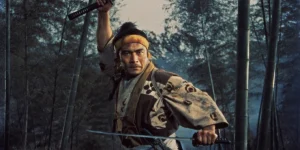
Most of The Sword of Doom was filmed on meticulously crafted sets at Toho Studios in Tokyo. The production design brilliantly captures the late Edo period. However, some key exterior scenes were shot on location. The opening scene, for instance, was filmed at the actual Daibosatsu Pass (Great Bodhisattva Pass) in Yamanashi Prefecture, Japan. Grounding this pivotal first murder in a real, intimidating landscape gives the film’s descent into darkness an immediate sense of reality.
Awards and Nominations
While The Sword of Doom is now considered a masterpiece of Japanese cinema, it did not receive major international awards upon its release in 1966. Its primary recognition came from Japanese film circles. Notably, it won the award for Best Cinematography (Hiroshi Murai) at the Mainichi Film Concours that year. Despite its lack of widespread awards, its critical standing and influence have grown immensely over the decades.
Behind the Scenes Insights
- The film was intended to be the first part of an epic trilogy, but it performed poorly at the box office. Consequently, the studio cancelled all plans for sequels, leaving the story on its iconic cliffhanger.
- Tatsuya Nakadai famously developed a “no-blink” technique for his performance as Ryunosuke. He kept his eyes unnervingly wide in many scenes to convey the character’s vacant, predatory nature.
- Director Kihachi Okamoto intentionally sought to deconstruct the heroic samurai archetype. He wanted to show the sword not as an instrument of honor, but as a tool of madness and destruction.
- The final, chaotic battle reportedly used so much fake blood and took such a physical toll on the actors and stuntmen that production was extremely challenging, yet Okamoto insisted on capturing the frenzied energy perfectly.
Inspirations and References
The film is based on the notoriously long and unfinished Japanese serial novel Daibosatsu Toge (The Great Bodhisattva Pass) by author Kaizan Nakazato. The novel was published in newspapers from 1913 to 1941. Due to its sprawling nature, the film only adapts the first few major arcs of the book, focusing entirely on Ryunosuke’s initial descent into evil.
Alternate Endings and Deleted Scenes
Because the film was planned as the first of a trilogy, the original script did not end with the freeze-frame. The story was supposed to continue, with Ryunosuke escaping the brothel and eventually confronting Hyoma and his master, Shimada. However, when the sequels were cancelled, director Okamoto chose the freeze-frame as the most thematically appropriate and powerful conclusion. No footage of these intended future scenes was ever shot, and no significant deleted scenes from the filmed portion are known to exist.
Book Adaptations and Differences
The Sword of Doom is an adaptation of the novel Daibosatsu Toge. The film is largely faithful to the spirit and plot of the early parts of the book. It accurately portrays Ryunosuke’s “silent” sword style, his murder of the pilgrim, and his relationships with Hama and Bunnojo. The primary difference is scope. The novel is a vast epic with dozens of characters and subplots, stretching on for volumes. In contrast, the film narrows its focus to Ryunosuke’s perspective, effectively making him the dark, psychological center of the narrative, which is a key to its cinematic power.
Memorable Scenes and Quotes
Key Scenes
- The Opening Murder: Ryunosuke’s unprovoked killing of the pilgrim at the Great Bodhisattva Pass immediately establishes his demonic character without a single word of dialogue.
- The Duel: Ryunosuke’s single, devastating stroke to kill Bunnojo is a masterclass in tension and brutal efficiency, sealing his pact with evil.
- Shimada’s Demonstration: Toshiro Mifune, as Shimada, calmly dispatches a gang of thugs in a snowy forest, demonstrating a sword style rooted in spiritual calm—the polar opposite of Ryunosuke’s.
- The Final Rampage: The climactic sequence where Ryunosuke, haunted by ghosts, slaughters an army of assassins in a brothel is one of the most exhilarating and terrifying action scenes in cinema history.
Iconic Quotes
- “The sword is the soul. Study the soul to know the sword. Evil mind, evil sword.” – Toranosuke Shimada, summarizing the film’s core theme.
- “I don’t understand.” – Hyoma, questioning Shimada’s passive yet deadly technique.
- “He’s afraid his father is going to die… what a good son.” – A cynical observer, watching Bunnojo’s son before the fateful duel.
Easter Eggs and Hidden Details
- The “silent style” (muon no kamae) of swordsmanship Ryunosuke uses is a fictional invention for the novel, designed to reflect his empty, reactive soul. He baits opponents into attacking and then counters with a single, fatal blow.
- The title of the film and novel, Daibosatsu Toge, refers to the mountain pass where Ryunosuke commits his first onscreen murder, tying his dark journey to that specific, cursed location.
- Throughout the film, shadows are used to an almost expressionistic effect. Often, Ryunosuke’s face is half-covered in shadow, visually representing his divided and corrupted soul.
Trivia
- Toshiro Mifune‘s role as the wise master Shimada is a stark contrast to his more chaotic ronin characters in films like Yojimbo and Seven Samurai.
- The film’s stark black-and-white cinematography was a deliberate artistic choice by director Kihachi Okamoto and cinematographer Hiroshi Murai to enhance the grim, fatalistic tone.
- Despite being the protagonist, Tatsuya Nakadai has very little dialogue. His performance is almost entirely physical, relying on his intense gaze and precise body language.
- The novel Daibosatsu Toge has been adapted into film and television numerous times in Japan, but Okamoto’s 1966 version remains the most famous internationally.
Why Watch?
This is the antithesis of the heroic samurai epic. Watch for Tatsuya Nakadai’s terrifying performance and for some of the most stunningly choreographed sword fights ever filmed. It is a haunting, unforgettable journey into the abyss of a corrupted soul.
Director’s Other Movies
- The Human Condition I: No Greater Love (1959)
- Samurai Assassin (1965)
- Japan’s Longest Day (1967)
- Kill! (1968)
Recommended Films for Fans
- Harakiri (1962)
- Yojimbo (1961)
- Samurai Rebellion (1967)
- Lone Wolf and Cub: Sword of Vengeance (1972)
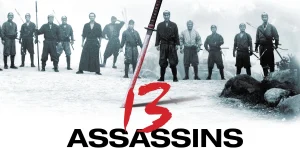
- 13 Assassins (2010)