
The perfect suburban dad is a myth. The Stepfather brilliantly exploits this myth, presenting a man obsessed with an unattainable family ideal. When reality fails to match his fantasy, however, he simply trades one family for another. Consequently, this leaves a trail of bodies in his quest for perfection.
Detailed Summary
The Bloody Beginning
The film opens on an unsettlingly calm scene. A man, Henry Morrison, shaves and changes his appearance in a bathroom. Subsequently, he packs a suitcase and walks through a suburban home littered with the bodies of his wife and children. He has murdered them all. After calmly retrieving the morning paper, he leaves the house and disappears, ready to start a new life.
A New Life as Jerry Blake
One year later, Henry has become Jerry Blake, a cheerful real estate agent in Ogden, Washington. He recently married a widow named Susan Maine, becoming the stepfather to her teenage daughter, Stephanie. On the surface, Jerry is the model husband and father. In reality, he is a powder keg of repressed rage, desperately trying to impose his vision of a perfect family onto his new life.
Stephanie’s Suspicions
Stephanie, however, struggles to accept Jerry. She acts out in school and tells her therapist, Dr. Bondurant, that she finds Jerry unsettlingly perfect. Her suspicions grow when she sees a newspaper article about the unsolved family massacre from the film’s opening. Although the killer’s face is obscured, Stephanie notes a resemblance, which fuels her paranoia. Jerry, in contrast, tries to win her over, but his attempts only feel more controlling and strange.
The Cracks Appear
Jerry’s perfect facade begins to crack under pressure. For instance, when he discovers Stephanie’s private stash of photos of her deceased father, he flies into a rage while building a birdhouse in his workshop. He violently smashes the birdhouse, revealing his terrifying temper for the first time. Meanwhile, Jim Ogilvie, the brother of Susan’s late husband, grows suspicious of Jerry and begins his own private investigation.
The Body in the Basement
Jim Ogilvie poses as a potential client to get information about Jerry’s past. Unfortunately, his digging leads him directly into a trap. Jerry, realizing he is being investigated, lures Jim to a vacant house and brutally kills him. He then stores Jim’s body in a freezer in the basement of his own home. Susan and Stephanie remain completely unaware that a corpse is hidden right beneath their feet.
The Final Meltdown
Jerry’s world finally unravels. He is unexpectedly fired from his job, which triggers his decision to eliminate his current family and move on. Consequently, he begins creating a new identity as “Bill” for his next life in another town. When Dr. Bondurant confronts Jerry with suspicions about his true identity, Jerry kills him. This sets the stage for a final, violent confrontation at home as he prepares to kill both Susan and Stephanie.



Movie Ending
The climax is a terrifying showdown inside the family home. After Jerry attacks Susan in the basement, Stephanie arrives and shoots him with a gun she retrieved from the family safe. Wounded but not dead, Jerry stumbles upstairs. As Stephanie helps her mother, Jerry reappears, leading to a final struggle in the attic.
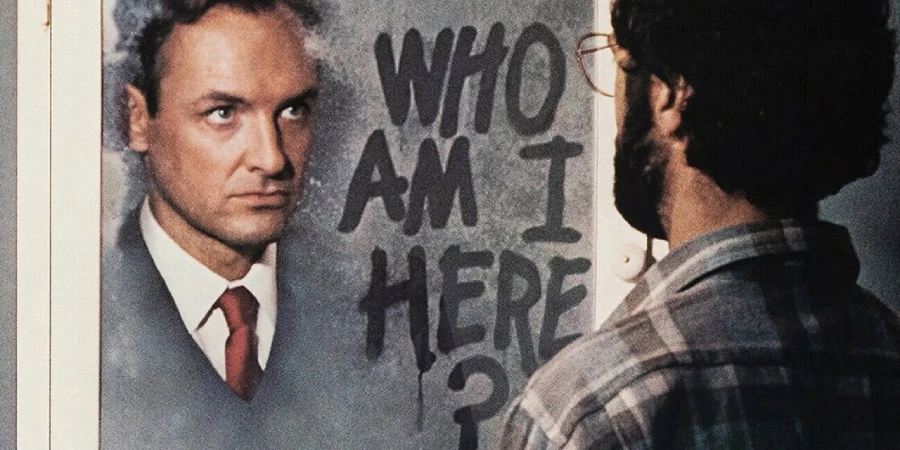
In his delirium, Jerry becomes confused about his identity, famously asking, “Wait a minute, who am I here?” This moment of psychological breakdown gives Stephanie an opening. She fatally stabs him in the chest with a shard of a broken mirror. For the final blow, she picks up the gun again and shoots him, sending his lifeless body crashing through the attic floor into the living room below, right in front of a wedding photo of him and Susan.
Are There Post-Credits Scenes?
No, there are no post-credits or mid-credits scenes in The Stepfather.
Type of Movie
The Stepfather is a psychological thriller with strong elements of horror and slasher films. The film masterfully builds suspense through its character study of a seemingly normal man who is actually a monster. Furthermore, it operates as a dark satire of the Reagan-era obsession with the nuclear family, twisting the American dream into a suburban nightmare.
Cast
- Terry O’Quinn – Jerry Blake / Henry Morrison / Bill Hodgkins
- Jill Schoelen – Stephanie Maine
- Shelley Hack – Susan Maine
- Charles Lanyer – Dr. Bondurant
- Stephen Shellen – Jim Ogilvie
- Stephen E. Miller – Norman, the Mailman
Film Music and Composer
The score was composed by Patrick Moraz, the former keyboardist for the bands Yes and The Moody Blues. His music cleverly contrasts two distinct styles. Notably, a bright, synth-pop theme represents Jerry’s phony “perfect dad” persona. This cheerful music is often juxtaposed with tense, atmospheric electronic cues that signal his underlying rage and the film’s horror elements. The score, therefore, perfectly mirrors the killer’s dual nature.

Filming Locations
Director Joseph Ruben shot The Stepfather primarily in and around Vancouver, British Columbia. The anodyne, picture-perfect suburban neighborhoods of Vancouver served as an excellent stand-in for the fictional town of Ogden, Washington. This choice of a generic, “anytown” location was intentional. Ultimately, it emphasizes the film’s theme that such hidden horrors could exist behind the pristine facade of any suburban home in America.
Awards and Nominations
While not a major awards contender, The Stepfather earned critical acclaim, especially for its lead performance. For instance, Terry O’Quinn received nominations for Best Actor from both the Saturn Awards and the Independent Spirit Awards. In addition, the film won the Critics’ Award at the 1988 Cognac Festival du Film Policier.
Behind the Scenes Insights
- Screenwriter Donald E. Westlake initially wrote the script in the late 1970s, but it remained in development hell for years before finally being produced.
- Terry O’Quinn fully committed to the role, finding the humanity within the monster. He believed Jerry was not inherently evil but was a deeply broken man desperately trying to achieve an impossible ideal.
- Director Joseph Ruben wanted to balance horror with social commentary. He focused on making the family dynamics feel authentic to heighten the terror when Jerry’s mask finally slipped.
- The film’s iconic line, “Who am I here?” was reportedly ad-libbed by Terry O’Quinn during the climactic scene.
Inspirations and References
The Stepfather was directly inspired by the chilling true story of John List. In 1971, List, a mild-mannered accountant in Westfield, New Jersey, murdered his wife, mother, and three children. He believed they were straying from their religious faith and wanted to “save their souls.” Afterwards, he crafted a new identity and remained a fugitive for nearly 18 years before being captured, eerily mirroring Jerry Blake’s method of operation.
Alternate Endings and Deleted Scenes
There are no known major alternate endings for The Stepfather. The director and writers were reportedly very satisfied with the powerful attic showdown and the killer’s final, confused moments. Some minor trims were made for pacing, but no significant scenes that would have altered the narrative have ever surfaced.
Book Adaptations and Differences
The Stepfather is not based on a book. Its story was conceived as an original screenplay, taking its main inspiration from the John List true crime case rather than any fictional source material.



Memorable Scenes and Quotes
Key Scenes
- The Opening Massacre Aftermath: The chillingly calm sequence where Henry Morrison cleans up and leaves a house full of his dead family.
- The Birdhouse Meltdown: Jerry’s violent explosion in the basement, where he smashes a birdhouse after feeling his authority challenged. It is the first major reveal of his true nature.
- “Who Am I Here?”: The definitive climax where Jerry, wounded and cornered, loses his grip on his current identity, cycling through his various personas.
Iconic Quotes
- “Wait a minute, who am I here?”
- “We’re going to have some order in this house!”
- “Have you been a good girl? Things are going to be different around here.”
- “Here’s to us. The family we’re going to be. The best.”
Easter Eggs and Hidden Details
- Changing Faces: Throughout the film, Jerry is often framed looking into mirrors or reflective surfaces, subtly hinting at his fractured and multiple identities.
- Workshop Perfection: Jerry’s workshop is obsessively neat and organized. This serves as a powerful visual metaphor for his need for absolute control, contrasting with the chaos he ultimately unleashes.
- The Stepfather Magazine: When Jim Ogilvie researches serial killers, he looks through a magazine. One of the photos he passes is a picture of the real-life murderer John List.
Trivia
- The film spawned two sequels: Stepfather II: Make Room for Daddy (1989) and Stepfather III (1992), with the latter being a made-for-TV movie.
- A modern remake of The Stepfather was released in 2009, starring Dylan Walsh in the title role.
- Terry O’Quinn’s character on the TV show Lost, John Locke, shares a name with a famous philosopher, but his role as Jerry Blake remains one of his most iconic performances.
- Donald E. Westlake, who co-wrote the screenplay, was a prolific and celebrated crime novelist, known for his Parker and Dortmunder series of books.
Why Watch?
This film is a masterclass in tension. Terry O’Quinn delivers a legendary performance, swinging from charming dad to terrifying monster in an instant. It is a taut, smart, and genuinely scary thriller that deconstructs the fallacy of the perfect family.
Director’s Other Movies
- Dreamscape (1984)
- Sleeping with the Enemy (1991)
- The Good Son (1993)
- Money Train (1995)
- Return to Paradise (1998)
- The Forgotten (2004)
Recommended Films for Fans
- Psycho (1960)
- Fatal Attraction (1987)
- Mommie Dearest (1981)
- The Hand That Rocks the Cradle (1992)
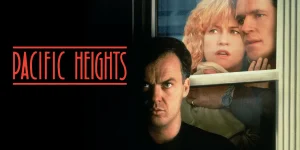
- Pacific Heights (1990)
- Single White Female (1992)