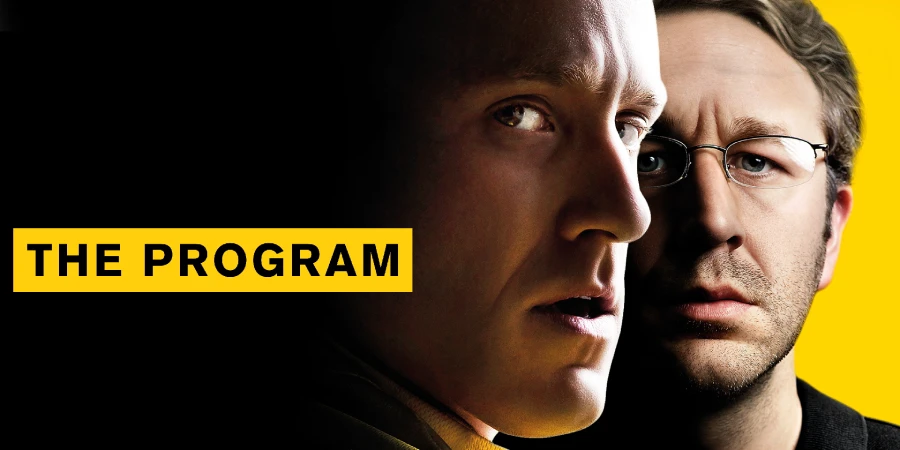

Stephen Frears’s The Program is a tense, sharply focused biographical drama about cyclist Lance Armstrong’s meteoric rise, shocking doping scandal, and spectacular fall from grace. The film is based on journalist David Walsh’s book Seven Deadly Sins: My Pursuit of Lance Armstrong and stars Ben Foster in one of his most unsettling, committed performances.
Detailed Summary
The Rise of Lance Armstrong
The film begins by charting Lance Armstrong’s early career. Though undeniably talented, he struggles to keep up with top European cyclists who are rumored to be using performance-enhancing drugs. His loss becomes a turning point: instead of accepting defeat, Armstrong seeks a way to level the playing field.
Enter Dr. Michele Ferrari
Armstrong meets Dr. Michele Ferrari, an infamous sports physician whose “program” of doping is designed to maximize red-blood-cell production and endurance. Ferrari introduces Armstrong to EPO, blood transfusions, and highly controlled doping cycles that evade detection. This partnership becomes the backbone of Armstrong’s success.
David Walsh’s Investigation
Parallel to Armstrong’s rise, journalist David Walsh becomes increasingly suspicious of the cyclist’s performances. Walsh’s skepticism grows as Armstrong’s wins become almost superhuman. While others in the press flock to Armstrong’s charisma and compelling cancer-survivor narrative, Walsh becomes the lone voice questioning his legitimacy.
The US Postal Service Team and Systematic Doping
Armstrong is shown orchestrating an industrial-scale doping program within the US Postal Service cycling team. The team undergoes micro-dosing, blood transfusions in hotel rooms, and highly coordinated methods to avoid drug tests. Armstrong uses intimidation to keep everyone silent and loyal. Riders who question the system are bullied or pushed out.
Cracks in the Armor
Whistleblowers like Floyd Landis begin to come forward, pushing authorities to investigate. Journalists, ex-teammates, and anti-doping agencies slowly gather evidence. Armstrong continues to deny everything publicly, leveraging his foundation, fame, and influence to silence critics.
The Investigation Tightens
As the evidence becomes unavoidable, Armstrong’s empire begins to crumble. His seven Tour de France titles come under scrutiny, former teammates testify, and the public narrative begins to shift.

Movie Ending
The film ends with Armstrong finally being exposed. After years of intimidation, manipulation, and denial, he is stripped of his seven Tour de France titles and banned from professional cycling for life. The once-celebrated hero is now disgraced.
The final scenes show Armstrong still trying to maintain control of his image during the downfall. In interviews, he avoids accepting full responsibility, revealing his inability to give up the illusion of control and greatness. His arrogance remains intact even as the empire collapses.
David Walsh, who spent years being dismissed, vindicated, or even ridiculed, emerges as one of the few who saw through the myth from the beginning. The film closes on a sobering note: Armstrong’s downfall is not just about a man lying, but about an entire system that allowed, encouraged, and protected the lie for years.
Are There Post-Credits Scenes?
No. The Program does not include a post-credits scene. Once the credits roll, the story is complete.
Type of Movie
- Biographical drama
- Sports drama
- Thriller-like investigative journalism film
Cast
- Ben Foster as Lance Armstrong
- Chris O’Dowd as David Walsh
- Guillaume Canet as Dr. Michele Ferrari
- Jesse Plemons as Floyd Landis
- Dustin Hoffman as Bob Hamman
- Lee Pace as Bill Stapleton
Film Music and Composer
The film’s score is composed by Alex Heffes, who delivers a restrained yet tense soundtrack that reinforces the paranoia, pressure, and high-stakes atmosphere surrounding Armstrong’s doping program and Walsh’s investigation.



Filming Locations and Their Importance
- France (notably Paris and various Tour de France–related regions): Essential for authenticity, as the story revolves around cycling culture and French racing history.
- Belgium: Used for European racing scenes that stand in for large parts of the Tour.
- United Kingdom: Many interiors and newsroom scenes were shot here, representing David Walsh’s journalistic environment.
The shooting locations help maintain realism, especially during race sequences that mimic Tour de France conditions.
Awards and Nominations
While the film did not win major mainstream awards, Ben Foster received significant critical praise for the intensity and physical commitment of his performance. The movie was recognized in several European film discussions and cycling-related circles for its bold portrayal of Armstrong’s scandal.
Behind the Scenes Insights
- Ben Foster admitted to using small doses of performance-enhancing drugs to understand the physical and psychological effects for his role.
- The filmmakers consulted cyclists and anti-doping experts to ensure realism in depicting EPO use and transfusion procedures.
- The production had difficulty recreating Tour de France crowd sizes, requiring extensive CGI to replicate the race atmosphere.
- Chris O’Dowd spent time with journalist David Walsh to replicate his mannerisms and investigative tone.
- Stephen Frears insisted on a documentary-like approach for many scenes to create immediacy and tension.
Inspirations and References
- Primary inspiration: David Walsh’s book Seven Deadly Sins
- Additional reference materials included real interviews, USADA reports, and extensive public footage of Armstrong’s races and press conferences.
Alternate Endings and Deleted Scenes
The released film remains relatively close to its intended structure, but some deleted moments existed:
- Extended interviews with fictionalized journalists.
- Longer, more detailed doping-procedure scenes that were cut to avoid overwhelming the narrative.
- Additional scenes depicting Armstrong’s charity work were shortened to maintain focus on the doping storyline.
No alternate ending has been officially released.
Book Adaptations and Differences
Since the film is adapted from Walsh’s nonfiction account, the differences are mainly structural:
- The movie streamlines several characters and investigative threads for clarity.
- Some composite characters are created to represent groups of journalists or investigators.
- Real-life timelines are condensed to improve pacing.
- Walsh’s role is given even more centrality than in the book, to maintain narrative cohesion.

Memorable Scenes and Quotes
Key Scenes
- Armstrong’s first meeting with Dr. Ferrari, where he learns about the full “program.”
- The hotel blood transfusion sequence, one of the most unsettling depictions of systematic doping.
- Floyd Landis’s confession and its impact on Armstrong’s downfall.
- David Walsh confronting his editor, insisting that Armstrong’s story doesn’t add up.
- Armstrong’s final interviews where denial gives way to forced reckoning.
Iconic Quotes
- “Everybody wants to believe in miracles.”
- “The program is not cheating; it’s leveling the playing field.”
- “Winning is everything. Losing is nothing.”
Easter Eggs and Hidden Details
- Real Tour de France footage is subtly intercut with staged scenes, creating seamless transitions.
- Armstrong’s color-coded doping calendar (briefly visible) mirrors leaked reports from real investigations.
- Cyclists’ coded language references actual terminology used in the peloton to disguise drug talk.
- The film shows Armstrong’s hospital bracelet from his cancer battle, used symbolically to represent his dual image as hero and manipulator.
Trivia
- Ben Foster did much of his own cycling, training with professional riders.
- Chris O’Dowd was cast largely because the real David Walsh loved his dry, understated comedic style.
- Armstrong himself responded publicly to the movie, criticizing it for inaccuracies while also admitting it captured the “culture of the time.”
- Stephen Frears originally envisioned a more documentary-style film but shifted to a narrative structure after Ben Foster was cast.
Why Watch?
Because The Program offers a gripping look at one of the biggest sports scandals in history, blending journalism, thriller elements, and a character study of ambition gone toxic. Even if you’re not a cycling fan, the movie provides a fascinating insight into deception, hero-worship, and the cost of chasing greatness at all costs.
Director’s Other Movies
- Philomena (2013)
- The Queen (2006)
- Dangerous Liaisons (1988)
- High Fidelity (2000)
- Florence Foster Jenkins (2016)
Recommended Films for Fans
- Icarus (2017)
- The Armstrong Lie (2013)
- Foxcatcher (2014)
- Moneyball (2011)
- Rush (2013)