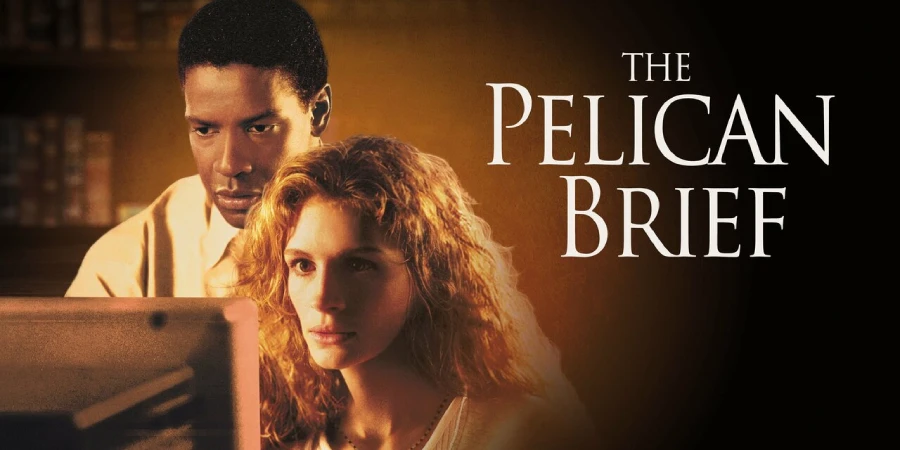
The Pelican Brief is a classic 1990s political thriller that blends investigative journalism, legal drama, and conspiracy paranoia into a tightly paced story. Directed by Alan J. Pakula and adapted from John Grisham’s bestselling novel, the film explores how truth becomes dangerous when it threatens the most powerful people in the country.
Detailed Summary
The Double Assassination That Changes Everything
The film opens with the shocking murder of two U.S. Supreme Court justices, shot execution-style in separate locations. The crime destabilizes the entire political system and triggers a massive FBI investigation. No clear motive is found, which immediately raises suspicion that the killings are politically motivated rather than random acts of violence.
Darby Shaw and “The Pelican Brief”
Darby Shaw, a brilliant law student at Tulane University, begins theorizing about the assassinations as a legal exercise. She connects the murdered judges to a controversial environmental case involving oil drilling in Louisiana wetlands.
Her theory, nicknamed “The Pelican Brief,” suggests that the judges were killed because they threatened a future Supreme Court ruling that could block a powerful oil company’s interests. The brief is never meant for public eyes, but once it reaches Washington insiders, people start dying.
From Academic Theory to Deadly Reality
Soon after the brief circulates, Darby’s professor and lover is murdered in a car bombing. This marks the turning point of the movie. What began as intellectual speculation becomes a fight for survival.
Darby realizes that the theory is not only correct but extremely dangerous. Unknown assassins begin tracking her, and federal agencies may already be compromised.
Enter the Journalist
Gray Grantham, a seasoned investigative reporter for The Washington Herald, starts digging into the assassinations. Initially skeptical, he soon finds disturbing patterns linking corporate interests, political donations, and covert operatives.
Darby and Gray eventually connect, forming an uneasy alliance built on mutual distrust and urgency. Their partnership becomes the emotional and narrative core of the film.
A Government That Cannot Be Trusted
As the conspiracy widens, the film paints a chilling picture of Washington power dynamics. The President, his chief of staff, the FBI, and the CIA appear more focused on political survival than justice.
The story emphasizes one of its strongest themes: truth is dangerous not because it is false, but because it is real.
The Man Behind the Murders
The investigation leads to Victor Mattiece, a ruthless oil tycoon who orchestrated the assassinations to protect billions of dollars in drilling rights. He employs a professional killer who eliminates anyone who comes close to exposing the plot.
Darby becomes the last loose end.
Movie Ending
In the final act, Darby and Gray gather enough evidence to expose the conspiracy but realize that handing it to law enforcement would be useless, as too many agencies are compromised.
Instead, they leak the entire story to the press.
The Washington Post publishes the exposé, triggering nationwide outrage. Congressional hearings are announced, the President’s administration collapses, and Victor Mattiece is arrested after attempting to flee the country.
The film strongly implies that the President resigns under political pressure, though this occurs off-screen. The assassinations are officially tied to corporate corruption, restoring faith in the judicial system—at least temporarily.
The ending is deliberately restrained. There is no triumphant celebration, only exhaustion and quiet relief. Darby walks away from the spotlight, while Gray returns to journalism, having reaffirmed the power of the press.
The final message is clear: justice is possible, but fragile, and it survives only when someone dares to publish the truth.
Are There Post-Credits Scenes?
No. The Pelican Brief does not include any post-credits or mid-credits scenes. The story concludes entirely before the credits roll.
Type of Movie
The film is a political conspiracy thriller mixed with legal drama and investigative journalism. It focuses more on tension, dialogue, and realism than action, reflecting the paranoid atmosphere of early-1990s American politics.
Cast
- Julia Roberts – Darby Shaw
- Denzel Washington – Gray Grantham
- Sam Shepard – Thomas Callahan
- John Heard – FBI Director Denton Voyles
- Tony Goldwyn – Fletcher Coal
- Stanley Tucci – Khamel
- Hume Cronyn – Justice Rosenberg
- Robert Culp – President of the United States
Film Music and Composer
The score was composed by James Horner, known for emotionally driven orchestral themes. His music reinforces suspense rather than overpowering scenes, using low strings and subtle motifs to maintain constant tension.
Filming Locations
The movie was filmed primarily in:
- Washington, D.C.
- New Orleans, Louisiana
- New York City
New Orleans grounds the story in realism, while Washington locations emphasize institutional power. The authentic political settings enhance the film’s credibility and sense of danger.
Awards and Nominations
- Nominated for Golden Globe – Best Actor (Denzel Washington)
- Nominated for ASCAP Film and Television Music Award
- Commercial success worldwide, becoming one of the highest-grossing thrillers of 1993
Behind the Scenes Insights
- Alan J. Pakula was famous for political thrillers and treated the film as a spiritual continuation of his paranoia trilogy.
- Julia Roberts was at the height of her stardom after Pretty Woman.
- Denzel Washington was deliberately cast against expectations to avoid typical “action hero” stereotypes.
- Several scenes were rewritten to reduce violence and focus on psychological tension.
- Real journalists consulted on the screenplay to ensure authenticity.
Inspirations and References
- Based on John Grisham’s 1992 novel The Pelican Brief
- Influenced by Watergate-era paranoia films
- Strong thematic similarities to All the President’s Men (1976)
Alternate Endings and Deleted Scenes
- A darker ending showing greater political fallout was scripted but never filmed.
- Several deleted scenes involved deeper FBI corruption but were cut to maintain pacing.
- The novel’s more explicit political consequences were softened for the film version.
Book Adaptation and Differences
Major differences from the novel include:
- The book is more detailed in legal explanations.
- Darby is more emotionally hardened in the novel.
- The film shortens the conspiracy timeline significantly.
- The ending in the movie is more hopeful and less cynical than the book.
Memorable Scenes and Quotes
Key Scenes
- The assassination of the Supreme Court justices
- Darby discovering her professor’s car bombing
- The parking garage chase sequence
- The newsroom publication climax
- The quiet final conversation between Darby and Gray
Iconic Quotes
- “They’re not after the truth. They’re after anyone who knows it.”
- “The law doesn’t protect people. People protect people.”
- “You publish it. That’s how this ends.”
Easter Eggs and Hidden Details
- Several fictional court cases mirror real Supreme Court environmental disputes.
- Newspaper headlines reference actual 1990s political scandals.
- The assassin’s name “Khamel” subtly references classic spy-thriller archetypes.
- John Grisham appears briefly in a background cameo.
Trivia
- The film was released just one year after the novel’s publication.
- It helped solidify the “John Grisham cinematic universe” trend of the 1990s.
- Denzel Washington and Julia Roberts reunited later in The Manchurian Candidate (2004).
- The movie earned over $195 million worldwide on a $45 million budget.
Why Watch?
If you enjoy smart thrillers where information is more dangerous than bullets, this film is essential viewing. It remains relevant for its exploration of corporate power, media responsibility, and political manipulation. Even decades later, its themes feel uncomfortably current.
Director’s Other Works
- Klute (1971)
- The Parallax View (1974)
- All the President’s Men (1976)
- Sophie’s Choice (1982)
- Presumed Innocent (1990)