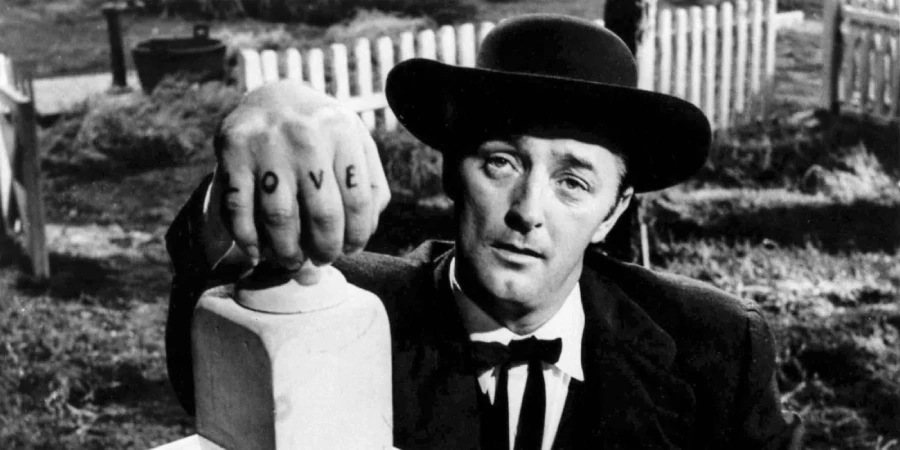

Few cinematic villains are etched into memory like Preacher Harry Powell. His knuckles, tattooed with “LOVE” and “HATE,” tell a twisted story of good versus evil. Consequently, The Night of the Hunter unfolds not as a simple thriller, but as a haunting, expressionistic fairy tale that remains deeply unsettling. It is, without a doubt, a singular masterpiece of American cinema.
Detailed Summary
The Robbery and the Secret
The story begins in the Depression-era Ohio Valley. Ben Harper robs a bank of $10,000, killing two men in the process. Before police capture him, however, he rushes home and hides the stolen money inside his young daughter Pearl’s rag doll. He makes his son, John, and Pearl swear on their lives to never reveal the money’s location, not even to their mother Willa.
The Arrival of the Preacher
Ben Harper is sentenced to hang for his crimes. In prison, he shares a cell with the charismatic yet sinister Harry Powell, a self-proclaimed preacher who is, in fact, a serial killer. Powell preys on lonely widows for their money. Although Ben never reveals the exact location of the stolen cash, Powell pieces together enough information to begin his hunt. Therefore, after his release, he makes his way to Ben’s hometown.
A Wolf in Sheep’s Clothing
Powell uses his charm to quickly win over the entire town, including Ben’s vulnerable widow, Willa. Young John, however, sees through the preacher’s facade immediately. He remains deeply suspicious of the man with “LOVE” and “HATE” tattooed on his fingers. Despite John’s misgivings, Willa falls for Powell’s promises of salvation and marries him. As a result, Powell is one step closer to finding the money.
The Murder of Willa
Once married, Powell’s true nature surfaces. He torments Willa, trying to force her to reveal where the money is hidden. When he realizes she genuinely doesn’t know, her usefulness ends. One night, in a chillingly surreal scene, he murders her in their bedroom. He then puts her body in their Ford Model T and sinks it in the river. He subsequently tells the townspeople that Willa abandoned her family in a fit of sinful passion.
The Children’s Escape
With Willa gone, Powell turns his full attention to the children. He terrorizes them relentlessly. Eventually, he frightens little Pearl into revealing that the money is hidden inside her doll. John, ever the protector, grabs the doll and his sister. Under the cover of darkness, they escape in their father’s old skiff and begin a desperate journey down the Ohio River. Powell, however, is not far behind, his silhouette a constant, menacing presence on the horizon.
Sanctuary with Rachel Cooper
Their journey down the river is a dreamlike odyssey. The exhausted children float past a landscape populated by watchful animals. Finally, they are discovered by Rachel Cooper, a tough, devout woman who takes in orphaned and abandoned children. She provides them with a safe haven. Nevertheless, their nightmare is not over, as Powell eventually tracks them to Rachel’s farmhouse.
Movie Ending
The film’s climax is a tense standoff between pure good and absolute evil. Powell arrives at Rachel Cooper’s home, attempting his charming preacher routine. However, Rachel sees his true nature instantly. When he refuses to leave, she grabs her shotgun. The two engage in a long, nocturnal vigil, with Rachel sitting in her rocking chair, guarding the children from the predator lurking outside. Powell eventually charges and she shoots him, wounding him.
His pained cries attract the attention of the authorities, who finally apprehend him. At Powell’s trial for the murder of Willa, John is put on the stand. Overcome with trauma, he has a complete breakdown when asked to identify the monster who terrorized his family. In the end, Powell is convicted. John and Pearl find a new, safe life with Rachel Cooper. The final scene shows the children celebrating their first Christmas with their new family, with Rachel reminding them that children are resilient. They abide, and they endure.
Are There Post-Credits Scenes?
No, there are no post-credits scenes in The Night of the Hunter. The practice was not common for films released in the 1950s. The movie concludes after the final shot of the children with Rachel Cooper.
Type of Movie
The Night of the Hunter defies easy categorization. It blends elements of film noir, Southern Gothic horror, and suspenseful thriller. What truly sets it apart, however, is its highly stylized, expressionistic tone. Director Charles Laughton crafts a world that feels more like a dark fairy tale or a child’s nightmare than a realistic drama. The stark lighting, distorted perspectives, and theatrical sets all contribute to its unique and unsettling atmosphere.
Cast
- Robert Mitchum – Reverend Harry Powell
- Shelley Winters – Willa Harper
- Lillian Gish – Rachel Cooper
- Billy Chapin – John Harper
- Sally Jane Bruce – Pearl Harper
- James Gleason – Birdie Steptoe
- Evelyn Varden – Icey Spoon
- Peter Graves – Ben Harper
Film Music and Composer
Walter Schumann composed the film’s haunting and evocative score. The music is essential to the movie’s fairy-tale atmosphere, masterfully balancing suspense with lyrical beauty. Powell is often introduced by his ominous singing of the hymn “Leaning on the Everlasting Arms,” a melody which Schumann twists into a theme of pure dread. In contrast, the gentle lullaby “Dream, Little One, Dream,” sung by Rachel Cooper, represents safety and innocence. This musical duality, therefore, perfectly mirrors the film’s central conflict.
Filming Locations
Despite its West Virginia and Ohio setting, the film was shot almost entirely in California. Production took place on soundstages at Republic Studios and Pathe Studios, as well as on ranch backlots in the San Fernando Valley. Director Charles Laughton and cinematographer Stanley Cortez deliberately avoided realism. Instead, they opted for stylized, artificial sets to enhance the German Expressionist aesthetic. This choice ultimately makes the film feel timeless and unmoored from a specific reality, reinforcing its nightmarish quality.
Awards and Nominations
Upon its initial release, The Night of the Hunter was a critical and commercial failure, receiving no major awards or nominations. Over time, however, its reputation has grown immensely. In 1992, the United States Library of Congress deemed it “culturally, historically, or aesthetically significant” and selected it for preservation in the National Film Registry. It is now widely considered one of the greatest films ever made.
Behind the Scenes Insights
- This was the only film directed by the acclaimed actor Charles Laughton. The movie’s poor initial reception sadly discouraged him from ever directing again.
- Robert Mitchum was Laughton’s first choice for Harry Powell, but Mitchum initially turned it down, feeling the character was too monstrous. Laughton eventually convinced him to take the now-iconic role.
- Laughton had a unique way of directing the child actors. For instance, to capture Billy Chapin’s genuine reactions of fear, Laughton would direct him by yelling and berating him off-camera, though he would always apologize and comfort the child afterward.
- The memorable underwater shot of Willa’s corpse was filmed in a studio tank. Laughton used a customized mannequin for some shots and a stunt performer for others to achieve the eerily beautiful and serene image.
Inspirations and References
The film is adapted from the 1953 novel of the same name by West Virginia author Davis Grubb. Grubb based the character of Harry Powell on Harry Powers, a real-life serial killer. In 1931, Powers lured several widows and their children to his home in Quiet Dell, West Virginia, where he murdered them for their money. He was subsequently arrested, convicted, and hanged in 1932.
Alternate Endings and Deleted Scenes
Charles Laughton shot an enormous amount of footage for the film. The first rough cut was reportedly nearly five hours long. Consequently, producer Paul Gregory and editor Robert Golden had to trim it down significantly to a tight 92 minutes. This vast collection of outtakes, often called “the Laughton scrolls,” is considered one of cinema’s great lost treasures. Unfortunately, all of this excised footage is believed to have been destroyed.
Book Adaptations and Differences
The film is a remarkably faithful adaptation of Davis Grubb’s novel. It successfully translates the book’s poetic, lyrical prose and dark, folkloric tone to the screen. Key dialogue, including Powell’s “LOVE/HATE” sermon, is lifted almost verbatim from the source material. The primary difference is one of focus; the film streamlines the narrative, cutting some subplots and secondary characters to concentrate on the central conflict between Powell and the children. Ultimately, the movie captures the spirit of the novel with stunning visual precision.

Memorable Scenes and Quotes
Key Scenes
- The “LOVE/HATE” Sermon: Powell delivers a chilling monologue about the struggle between good and evil, illustrated by the tattoos on his knuckles.
- Willa’s Underwater Grave: The hauntingly beautiful shot of Willa’s body sitting in her car at the bottom of the river, her hair flowing like seaweed.
- The River Escape: A stunning, dreamlike sequence where the children float downriver at night, observed by the nocturnal animals of the forest, while Powell’s silhouette stalks them from the shore.
- The Night Watch: Rachel Cooper’s stoic, shotgun-wielding defense of her home and children against Powell’s final assault, culminating in a duet where she sings the gentle counter-melody to his menacing hymn.
Iconic Quotes
- “Would you like me to tell you the little story of Right-Hand-Left-Hand? The story of good and evil?” – Harry Powell
- “It’s a hard world for little things.” – Rachel Cooper
- “Don’t he never sleep?” – John Harper
- “Lord, save the little children… They abide and they endure.” – Rachel Cooper
Easter Eggs and Hidden Details
- The film’s visual style is a direct homage to German Expressionist cinema of the 1920s. The use of stark shadows, sharp angles, and stylized sets is reminiscent of films like The Cabinet of Dr. Caligari (1920).
- Iris shots, a technique common in silent films where the screen irises in or out on a subject, are used several times. This was a deliberate choice to evoke an older, more fairy-tale-like mode of storytelling.
- When Willa is telling Powell about her late husband, the sharp, triangular shape of their bedroom ceiling visually suggests a church steeple, ironically framing their unholy union.
Trivia
- Silent film superstar Lillian Gish, who plays Rachel Cooper, was the one who suggested Stanley Cortez for the role of cinematographer.
- Charles Laughton coaxed a masterful performance out of Robert Mitchum, whom Laughton considered one of the best actors he had ever worked with.
- The film was a commercial failure upon release. Its critical standing has grown significantly over the decades, and it now appears on many lists of the greatest films ever made.
- Initial storyboards for the film were drawn by author Davis Grubb himself.
Why Watch?
This is a film that gets under your skin. Its stunning cinematography and Robert Mitchum’s terrifying performance are unforgettable. More than a thriller, it’s a timeless fable about the resilience of childhood innocence. This cinematic masterpiece is essential viewing for any serious film fan.
Director’s Other Movies
- The Night of the Hunter (1955) was Charles Laughton’s only film as director.
Recommended Films for Fans
- M (1931)
- Cape Fear (1962)
- The Innocents (1961)
- Touch of Evil (1958)
- The Spirit of the Beehive (1973)