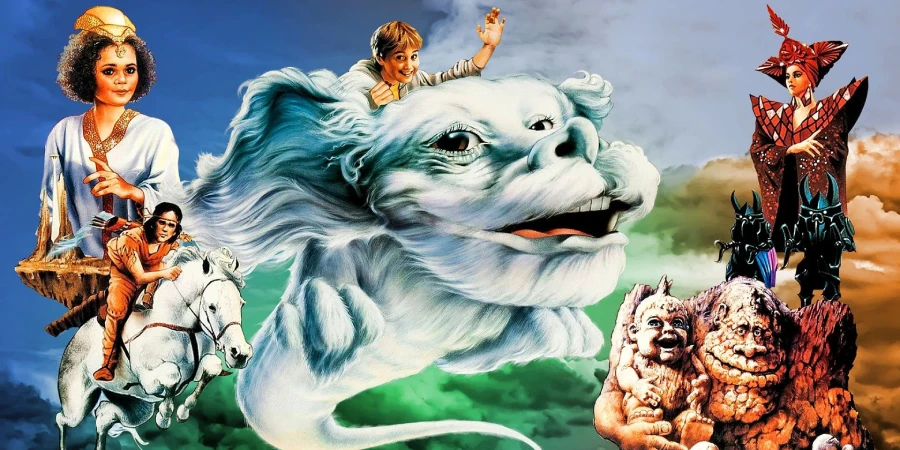

The NeverEnding Story II: The Next Chapter is the direct sequel to the 1984 fantasy classic. Released in 1990 and directed by George T. Miller, the film continues Bastian’s journey into Fantasia, this time focusing less on discovery and more on temptation, memory, and personal responsibility. While often debated among fans, the sequel has its own darker identity and cautionary tone.
Detailed Summary
Return to Fantasia
Bastian Balthazar Bux is once again a lonely boy struggling with life in the real world, especially under the pressure of his strict father and school bullies. Fantasia calls to him again through the magical book, drawing him back into its world. This time, however, Fantasia is not dying from Nothingness but from a far more personal danger: Bastian himself.
The City of the Old Emperors
Upon returning, Bastian encounters the ruins of a city filled with former humans who once entered Fantasia. These figures have lost their identities entirely. This sequence introduces the core theme of the movie: every wish has a price. Each emperor is a warning of what Bastian could become.
The Power and Cost of Wishes
The Childlike Empress allows Bastian to make wishes using the Auryn, but every wish causes him to lose a memory from the real world. At first, the wishes seem harmless and empowering. Bastian becomes stronger, braver, and more admired. However, he slowly forgets his father, his home, and even his true self. This internal conflict replaces the external threat of the first film.
Xayide’s Manipulation
The antagonist, Xayide, is a powerful sorceress who manipulates Bastian by encouraging him to use his wishes recklessly. Unlike The Nothing, Xayide does not destroy Fantasia directly. Instead, she seeks to control it by controlling Bastian, turning him into a ruler without empathy.
Friendship Tested
Atreyu returns, but his friendship with Bastian becomes strained. As Bastian’s ego grows, he begins to see Atreyu as a rival rather than an ally. Their bond, once built on trust, deteriorates into conflict, symbolizing Bastian’s loss of humility and emotional grounding.



Movie Ending
In the final act, Bastian has lost almost all memories of the real world. He declares himself Emperor of Fantasia and fully embraces Xayide’s influence. However, when she orders him to destroy Atreyu to prove his loyalty, Bastian hesitates. This moment is crucial: his last remaining memories are tied to friendship and love.
Xayide reveals her true intention—to use Bastian until he becomes one of the mindless Old Emperors. Realizing this, Bastian turns against her. Xayide is destroyed when her power source is disrupted, and Fantasia begins to recover.
Bastian is left with only one wish. Guided by the Childlike Empress, he finally understands that true power lies not in domination but in love. He wishes to remember his father. This restores his memories and allows him to return to the real world.
Back home, Bastian reconciles with his father, openly expressing his feelings for the first time. The ending emphasizes emotional growth rather than spectacle: Bastian has learned responsibility, empathy, and the importance of human connection.
Are There Post-Credits Scenes?
No. The NeverEnding Story II: The Next Chapter does not include any post-credits or mid-credits scenes. The story ends definitively with Bastian’s return to the real world.
Type of Movie
This film is a fantasy adventure with strong coming-of-age elements. Compared to the first movie, it leans more toward psychological fantasy, focusing on inner conflict rather than epic world-saving quests.
Cast
- Jonathan Brandis as Bastian Balthazar Bux
- Kenny Morrison as Atreyu
- Clarissa Burt as Xayide
- Alexandra Johnes as the Childlike Empress
- John Wesley Shipp as Barney (Bastian’s father)
Film Music and Composer
The score was composed by Robert Folk, replacing Klaus Doldinger from the first film. The music is more subdued and dramatic, reflecting the darker and more introspective tone of the sequel rather than sweeping fantasy heroics.



Filming Locations
The movie was filmed primarily in Germany, including Bavaria Studios in Munich. These controlled studio environments allowed for elaborate fantasy sets such as the City of the Old Emperors and Xayide’s fortress. Unlike the first film, fewer real-world landscapes were used, giving Fantasia a more artificial and theatrical feel.
Awards and Nominations
The film did not receive major awards or nominations. It was generally overshadowed by the legacy of the original movie and received mixed to negative critical reception, though it later gained a modest cult following among younger viewers.
Behind the Scenes Insights
- The original author, Michael Ende, openly criticized both films but was especially vocal about disliking the sequel.
- Jonathan Brandis replaced Barret Oliver as Bastian, giving the character a more confident and assertive personality.
- The production had a significantly lower budget than the first film.
- Several elaborate creature designs were planned but scrapped due to budget constraints.
- George T. Miller aimed to make the sequel more psychological than mythological.
Inspirations and References
The film is loosely based on the second half of Michael Ende’s novel The Neverending Story. However, it heavily simplifies and alters the source material, focusing on moral lessons rather than philosophical depth.
Alternate Endings and Deleted Scenes
Early drafts reportedly included a darker ending where Bastian nearly becomes an Old Emperor permanently. This was changed to provide a more hopeful resolution suitable for younger audiences. Several character interactions, especially involving Atreyu, were shortened or removed.
Book Adaptations and Differences
In the novel, Bastian’s descent into arrogance is far more gradual and complex. The book explores identity, desire, and self-creation in much greater depth. The movie condenses these ideas into a straightforward moral arc, reducing philosophical ambiguity for accessibility.



Memorable Scenes and Quotes
Key Scenes
- The reveal of the City of the Old Emperors
- Bastian’s transformation into Emperor of Fantasia
- The confrontation between Bastian and Atreyu
- Bastian’s final wish and return home
Iconic Quotes
- “Every wish has a price.”
- “You can rule Fantasia, but you cannot rule your heart.”
- “Power without memory is emptiness.”
Easter Eggs and Hidden Details
- The Auryn inscription is more prominently shown, emphasizing its moral weight.
- Some background emperors resemble characters from the first film.
- Xayide’s color palette intentionally contrasts with the Childlike Empress’s soft tones to symbolize corruption.
Trivia
- Jonathan Brandis later became a major teen star in the 1990s.
- This film was intended to set up a trilogy.
- The Rock Biter’s role was drastically reduced compared to the first movie.
- Practical effects were favored over early CGI.
Why Watch?
If you’re interested in fantasy stories that explore character flaws and emotional consequences, this sequel offers a cautionary tale about ego, escapism, and maturity. It may not match the magic of the original, but it asks more uncomfortable and meaningful questions.
Director’s Other Works
- Mad Max 2: The Road Warrior (1981) – producer
- The Man from Snowy River (1982) – producer
- Robinson Crusoe (1997)