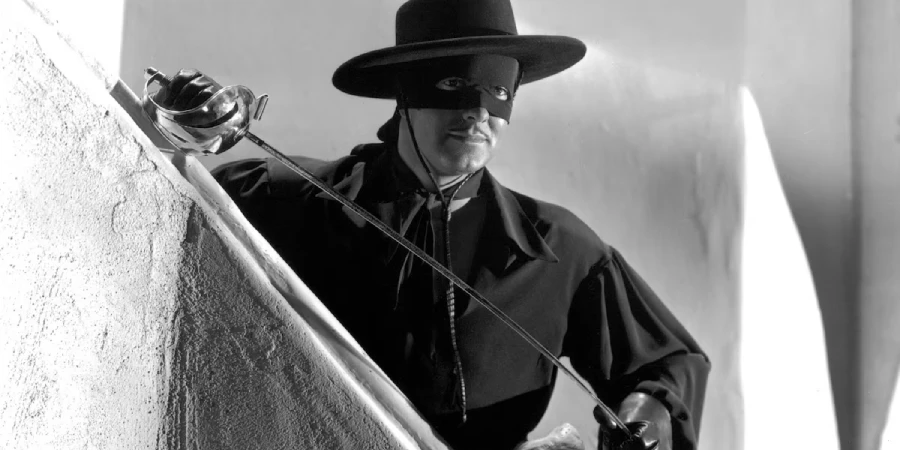

Tyranny meets its match through a flick of the wrist and a sharp blade. Tyrone Power delivers a masterclass in duality as the flamboyant Don Diego Vega. Masked heroes rarely feel this sophisticated or dangerously charming.
Detailed Summary
Return to Los Angeles
Don Diego Vega leaves his military training in Spain after receiving an urgent summons from his father. He arrives in California only to find his home transformed into a land of fear. A new Governor named Quintero has replaced Diego’s father and exploits the local citizens through heavy taxes.
Diego decides to play a strategic game rather than fighting openly. He adopts the persona of a shallow, weak fop to lower the guard of his enemies. Consequently, the villains dismiss him as a harmless aristocrat who cares only for fashion and scents.
The Rise of Zorro
The mysterious Zorro begins a campaign of terror against the corrupt government officials. He robs the tax collectors and returns the stolen wealth to the impoverished villagers. Captain Esteban Pasquale grows suspicious but cannot pin the crimes on any specific nobleman.
Meanwhile, Diego falls in love with Quintero’s beautiful niece, Lolita. She finds herself repulsed by Diego’s cowardly public act while she admires the bravery of the masked outlaw. This creates a classic romantic triangle involving only two actual people.
A Dangerous Double Game
Diego uses his proximity to the Governor’s palace to gather vital intelligence. He learns that Pasquale is the true mastermind behind the systemic cruelty. In contrast to the bumbling Governor, the Captain represents a lethal threat to the resistance movement.
Zorro eventually forces the Governor to sign a resignation letter at sword point. This bold move brings the conflict to a boiling point within the palace walls. The mask barely protects Diego as his two worlds begin to collide violently.
Movie Ending
Captain Pasquale finally discovers Diego’s secret identity and challenges him to a duel. This climactic sword fight showcases incredible choreography as the two experts trade blows throughout the room. Diego eventually runs the Captain through, killing the primary antagonist of the story.
The victory allows Diego to overthrow the corrupt administration and restore his father to power. He reveals his true heroic nature to Lolita, who accepts him with joy. Peace returns to the pueblo as the legendary mask is retired, at least for the moment.
Are There Post-Credits Scenes?
Modern audiences might expect a teaser, but this 1940 production contains no post-credits scenes. Narrative threads conclude fully before the final title card appears. The film adheres to the traditional studio system structure of its era.
Type of Movie
Critics classify The Mark of Zorro as a classic swashbuckler film. It blends high-stakes adventure with romantic drama and lighthearted comedy. The tone remains spirited and energetic throughout the entire runtime.
Cast
- Tyrone Power – Don Diego Vega / Zorro
- Linda Darnell – Lolita Quintero
- Basil Rathbone – Captain Esteban Pasquale
- Eugene Pallette – Friar Felipe
- Gale Sondergaard – Inez Quintero
- J. Edward Bromberg – Don Luis Quintero
- Montagu Love – Don Alejandro Vega
Film Music and Composer
Alfred Newman composed the stirring musical score for this adventure. His work earned an Academy Award nomination for its thematic depth and excitement. The main theme captures the galloping energy of a horse ride across the Spanish frontier.
Filming Locations
The production took place primarily on the 20th Century Fox backlot in California. Authentic Spanish-style sets recreated early nineteenth-century Los Angeles with impressive detail. These locations successfully simulate the dusty, sun-drenched atmosphere of the old frontier.
Awards and Nominations
The film received a single Academy Award nomination for Best Original Score in 1941. While it did not win, the movie remains a landmark achievement in the adventure genre.
Behind the Scenes Insights
- Tyrone Power performed many of his own stunts to ensure the action looked authentic.
- Basil Rathbone was actually a superior fencer in real life compared to Power.
- The legendary sword fight sequence required weeks of meticulous rehearsal and planning.
- Director Rouben Mamoulian focused heavily on the visual contrast between light and shadow.
Inspirations and References
The story originates from the 1919 serialized novel The Curse of Capistrano by Johnston McCulley. Earlier silent versions of the tale also influenced the pacing and visual style of this remake. Historical legends of Californian bandits provided a loose foundation for the character of Zorro.
Alternate Endings and Deleted Scenes
No recorded alternate endings exist for this tightly edited studio production. The narrative follows the established script without significant deviations in the final cut. Historical archives suggest most filmed material made it into the theatrical release.
Book Adaptations and Differences
The 1940 film stays relatively faithful to the core spirit of the McCulley book. However, it emphasizes the political corruption of the Governor more than the original text. Diego’s persona as a fop is also more exaggerated here than in the source material.
Memorable Scenes and Quotes
Key Scenes
- The iconic moment where Zorro carves a “Z” into the wall during a narrow escape.
- The final duel between Diego and Pasquale in the Governor’s study.
- Diego performing magic tricks to distract the suspicious Quintero family.
Iconic Quotes
- “I have no wish to be a hero. I am a very busy man.”
- “The sword is for the gentleman. The lash is for the dog.”
- “I shall leave my mark!”
Easter Eggs and Hidden Details
- The sword fighting style used by Basil Rathbone is technically anachronistic for the period.
- A stunt double replaced Power for the most dangerous leaps despite his athletic ability.
- Background paintings in the Governor’s palace depict real historical figures from Spanish history.
Trivia
- This film served as a major inspiration for the creation of Batman in comic book lore.
- Bruce Wayne typically sees this specific movie on the night his parents are murdered.
- The Mark of Zorro was one of the highest-grossing films for the studio in late 1940.
Why Watch?
Experience the definitive swashbuckling performance of the Golden Age. The chemistry between Power and Rathbone creates genuine cinematic electricity. Furthermore, the sharp script offers a perfect balance of humor and high-stakes tension.
Director’s Other Movies
- Dr. Jekyll and Mr. Hyde (1931)
- Queen Christina (1933)
- Becky Sharp (1935)
- Blood and Sand (1941)
Recommended Films for Fans
- The Adventures of Robin Hood (1938)
- Scaramouche (1952)
- The Mask of Zorro (1998)