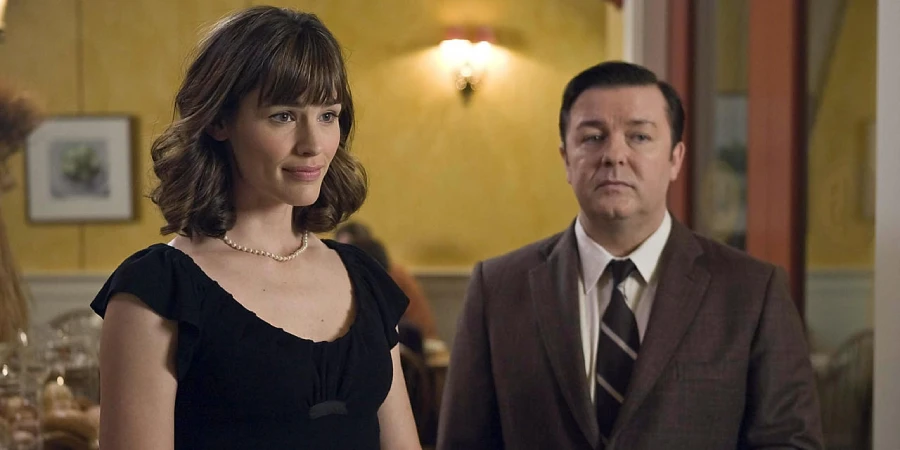

The Invention of Lying is a high-concept comedy that asks a deceptively simple question: What if humans had never learned how to lie… until one guy did? Written, directed by, and starring Ricky Gervais, the film mixes satire, romance, and philosophy while poking fun at religion, morality, and social norms.
Detailed Summary
A World Without Lies
The movie is set in an alternate reality where lying does not exist at all. Everyone says exactly what they think, all the time. There is no fiction, no acting, no marketing spin, no religious belief system. Movies are literal historical reenactments, dating profiles are brutally honest, and people openly insult each other without malice because honesty is the only possible state of being.
Mark Bellison lives in this world. He is a screenwriter who writes boring historical scripts because imagination, as we know it, doesn’t exist. He’s overweight, poor, unlucky, and constantly reminded of these facts by everyone around him. The woman he loves, Anna, likes him but openly admits she won’t be with him because he has “bad genes.”
The First Lie
Mark’s life collapses when he loses his job and is about to be evicted. At the bank, while trying to withdraw money he doesn’t have, something unexpected happens: he lies. He tells the teller there is more money in his account than the computer shows. Shockingly, it works.
This is the most important turning point of the film. Mark realizes he can say things that aren’t true, and people will believe him because no one else can even comprehend the concept of lying.
Lying as a Superpower
Mark begins using his new ability to improve his life. He gets money, success, and confidence. He becomes a wildly successful screenwriter by inventing stories that are not historical facts, creating the first fictional movies in human history.
His lies are not malicious at first. He lies to comfort his dying mother, telling her that death leads to a wonderful place filled with happiness. This compassionate lie spreads rapidly. People want reassurance, meaning, and hope.
The Birth of Religion
Without intending to, Mark becomes a prophet-like figure. His comforting explanation of the afterlife evolves into a full belief system. People ask him questions about morality, rules, and purpose. Under pressure, he improvises answers, claiming they come from a higher authority.
This is where the film’s satire sharpens. Organized religion forms almost instantly, complete with rules, followers, and unquestioned faith. Mark is uncomfortable with this role, knowing it’s all invented, but the world desperately wants something to believe in.
Love, Guilt, and Consequences
Despite his success, Mark cannot achieve the one thing he truly wants: a genuine relationship with Anna. She still believes that biological fitness is more important than love, a belief reinforced by the brutally honest society.
Mark struggles with guilt. He sees how lies can comfort, inspire, but also manipulate and mislead. He realizes that truth without empathy is cruel, but lies without responsibility can be dangerous.



Movie Ending
In the final act, Mark confronts the consequences of his actions on every level: personal, social, and moral.
Anna is about to marry another man purely because he has “better genetic material.” Mark considers telling the ultimate lie to win her over, promising her happiness, security, and destiny. Instead, he does something radical in this world: he tells the truth, even though he could lie.
He confesses that the stories about the afterlife and divine rules were made up, born from compassion and fear, not truth. He explains that love is a choice, not a genetic calculation. This moment is crucial because it proves that honesty can be meaningful when paired with empathy, not just brutal transparency.
Anna realizes that Mark’s honesty is different from the rest of the world’s blunt cruelty. She understands that love isn’t about perfect genes but about kindness, loyalty, and emotional connection. She chooses Mark freely, without manipulation.
The movie ends with the world continuing to believe in comforting ideas, while Mark steps away from being a false prophet. He keeps the one thing that truly matters: a relationship built on mutual understanding. The ending deliberately leaves the question open: Is a comforting lie worse than a painful truth? Or does meaning matter more than factual accuracy?
Are There Post-Credits Scenes?
No. The Invention of Lying does not include any post-credits or mid-credits scenes. The story concludes fully before the credits roll.
Type of Movie
The film is a satirical romantic comedy with strong elements of social commentary. It blends humor with philosophical questions about truth, belief, and human nature, often walking the line between comedy and existential reflection.
Cast
- Ricky Gervais as Mark Bellison
- Jennifer Garner as Anna McDoogles
- Jonah Hill as Frank Finkleman
- Louis C.K. as Greg Kleinschmidt
- Rob Lowe as Brad Kessler
- Tina Fey as Shelley Bailey
- Jeffrey Tambor as Anthony James
- Fionnula Flanagan as Martha Bellison
Film Music and Composer
The score was composed by Tim Atack, a frequent collaborator of Ricky Gervais. The music stays understated, allowing the dialogue and ideas to take center stage while subtly supporting emotional moments.



Filming Locations
The movie was filmed primarily in Massachusetts, USA, including Worcester and surrounding areas. These ordinary, modern locations reinforce the idea that the world is almost identical to ours, except for one crucial difference. The familiarity makes the high-concept premise feel grounded and believable.
Awards and Nominations
The film did not receive major award wins but gained attention for its originality. It was nominated at several comedy and fantasy-focused festivals and earned strong recognition among critics for its screenplay concept rather than its box office performance.
Behind the Scenes Insights
- Ricky Gervais has said the idea came from wondering why humans lie when it often complicates life.
- Many actors improvised their brutally honest dialogue to make conversations feel more natural.
- Religious satire sparked controversy before and after release, especially in the United States.
- Gervais intentionally avoided making Mark a traditional hero, keeping him flawed and insecure.
- The world-building rules were carefully enforced on set to ensure no character lied accidentally.
Inspirations and References
The film draws inspiration from:
- Philosophical thought experiments about truth and morality
- George Orwell–style social satire
- Classic romantic comedies, subverted through logic-based storytelling
- Gervais’s own stand-up material about religion and belief
Alternate Endings and Deleted Scenes
Some deleted scenes expanded on the religious movement and showed its rapid commercialization. These were cut to prevent the film from becoming too cynical and to keep the focus on Mark’s personal journey rather than global consequences. No fully alternate ending was filmed.
Book Adaptations and Differences
The movie is not based on a book. It is an original screenplay. However, its themes strongly resemble philosophical essays and speculative fiction rather than traditional narrative adaptations.

Memorable Scenes and Quotes
Key Scenes
- Mark lying to the bank teller for the first time
- The deathbed conversation with his mother
- The first fictional movie screening
- Mark explaining the “rules from above” to a crowd
- The final honest confession to Anna
Iconic Quotes
- “I just said something that wasn’t true.”
- “A world without lying is a world without hope.”
- “Love isn’t about good genes.”
Easter Eggs and Hidden Details
- Movies in this world are labeled with exact historical dates instead of titles.
- Advertisements openly insult the consumer, reflecting total honesty.
- Religious symbols gradually appear in the background as belief spreads.
- Mark’s success mirrors classic “chosen one” tropes, intentionally exaggerated.
- The number of “rules” mirrors common religious commandments as satire.
Trivia
- This was Ricky Gervais’s first major Hollywood directing project.
- Many comedians in the cast appear in small, almost cameo-like roles.
- The concept was pitched as “a rom-com inside a philosophical experiment.”
- Some theaters reportedly received audience complaints due to religious satire.
- The budget was modest compared to the scope of its ideas.
Why Watch?
You should watch The Invention of Lying if you enjoy smart comedy that makes you uncomfortable in a thoughtful way. It’s funny, awkward, occasionally blunt, and surprisingly sincere. It asks big questions without pretending to have perfect answers.
Director’s Other Works
- Ghost Town (2008)
- Cemetery Junction (2010)
- David Brent: Life on the Road (2016)