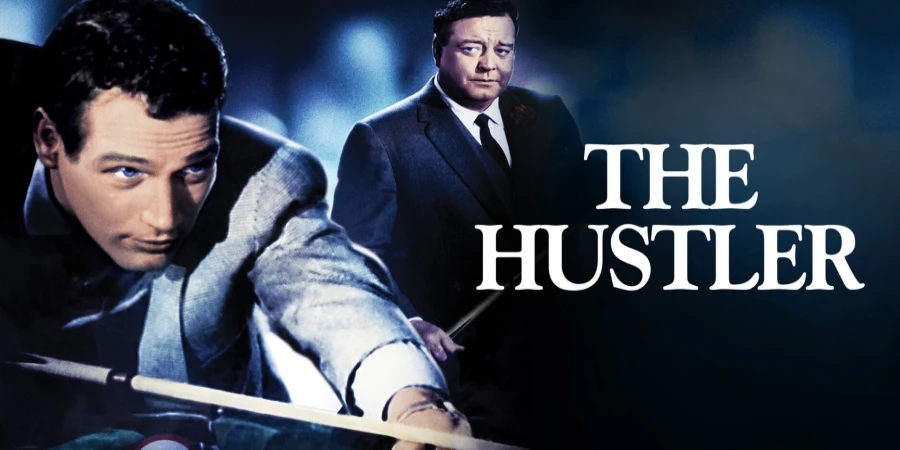

The Hustler is more than a movie about pool. It is a brutal character study about the cost of greatness. We follow a man so desperate to be the best that he sacrifices his soul, only to find redemption in the ashes of tragedy. The film argues that true victory is not about talent, but about character.
Detailed Summary
The Arrival and First Challenge
Cocky, talented pool hustler “Fast Eddie” Felson and his older partner, Charlie Burns, roll into New York City. Their sole purpose is to challenge the legendary player, Minnesota Fats. Eddie is arrogant but undeniably gifted, and he confidently puts up his life savings of several thousand dollars for a high-stakes, straight pool matchup.
The marathon game begins at Ames Pool Hall. For hours, Eddie dominates. He is flashy, quick, and seemingly unbeatable, racking up an impressive lead of over $18,000. However, his arrogance and endurance begin to falter.
A Crushing Defeat
Minnesota Fats, in contrast, remains a stoic and unflappable force. As the game stretches over 25 hours, Eddie begins drinking heavily. His focus shatters. Fats, sensing weakness, turns the tables and methodically claws back every dollar Eddie won, and then some.
A dejected and broke Eddie eventually collapses from exhaustion and alcohol. Charlie takes him back to their hotel, but Eddie, humiliated, abandons him. He is left alone and penniless in the city.
A New Connection and a Dangerous Offer
Aimlessly drifting, Eddie meets Sarah Packard, a lonely, part-time student with a limp and a drinking problem. The two broken souls quickly form a complex, codependent relationship, finding solace in each other’s company. Meanwhile, Eddie encounters the cunning professional gambler Bert Gordon during a poker game.
Bert recognizes Eddie’s raw talent but lectures him on his lack of character, calling him a “born loser.” Nonetheless, he offers to stake Eddie, taking him on the road for a 75% cut of the winnings. Desperate for another shot at Fats, Eddie reluctantly agrees, bringing Sarah along.
On the Road to Ruin
Bert takes Eddie to Louisville, Kentucky, for the Derby. His plan is not to hustle pool but to fleece a wealthy local socialite, Findlay, in a game of billiards. The hustle is a slow burn, designed to make Findlay believe he has a chance.
The plan works perfectly, and Eddie wins a substantial sum. After the game, however, a group of thugs corners Eddie in a public bathroom. As punishment for hustling their friend, they brutally break both of his thumbs. This act renders him unable to play pool for weeks.
Sarah’s Despair
Eddie and Sarah hole up in a hotel room while his hands heal. During this time, Sarah pleads with him to walk away from the life and from Bert’s suffocating influence. Eddie, however, is consumed by his ambition and rejects her pleas.
Later, while Eddie is out celebrating his recovery, a drunken and possessive Bert confronts Sarah. He assaults her, preying on her vulnerability and self-loathing. When Eddie finally returns, he finds that Sarah has taken her own life, having written “perverted, twisted, crippled” on the bathroom mirror in lipstick.
Movie Ending
Devastated and finally clear-eyed, Eddie Felson returns to Ames Pool Hall for his rematch with Minnesota Fats. This time, he is not playing for money or fame; he is playing for Sarah. The game is profoundly different. Eddie is calm, focused, and relentless, playing with a quiet intensity that unnerves Fats.
Eddie systematically dismantles the legend, forcing Fats to quit the game. In that moment, Bert Gordon appears to claim his 75% share of the winnings. Eddie flatly refuses, telling Bert that he will get nothing. When Bert threatens to have his thumbs broken again, Eddie calmly tells him to do it, stating that he can always get new thumbs, but Bert will always be a “perverted, twisted, and crippled” man who is “dead inside.”
Bert realizes he has lost all control over Eddie and lets him go. Shaken, Bert warns Eddie never to set foot in a major pool hall again. Eddie picks up his winnings, acknowledges Fats with a nod of respect, and walks out of Ames, leaving the hustling world behind for good. He finally won, but more importantly, he found the character he lacked.
Are There Post-Credits Scenes?
No, there are no post-credits scenes in The Hustler. The film ends after Eddie walks out of the pool hall, as was standard for films of this era.
Type of Movie
The Hustler is a gritty sports drama with heavy film noir elements. Its tone is cynical, moody, and psychologically intense, focusing on the dark underbelly of professional gambling. The film explores themes of ambition, self-destruction, integrity, and redemption, using the world of high-stakes pool as a backdrop for a profound character study.
Cast
- Paul Newman – ‘Fast Eddie’ Felson
- Jackie Gleason – Minnesota Fats
- Piper Laurie – Sarah Packard
- George C. Scott – Bert Gordon
- Myron McCormick – Charlie Burns
Film Music and Composer
The score for The Hustler was composed by Kenyon Hopkins. His music is a cool, jazz-infused score that perfectly complements the film’s smoky, late-night atmosphere. The moody and melancholic themes underscore the psychological tension and the lonely lives of its characters, becoming as iconic as the film’s visuals.

Filming Locations
Director Robert Rossen shot The Hustler almost entirely on location in New York City. This decision provides the film with a powerful sense of authenticity and grit. Key locations included the now-defunct Ames Billiard Academy and the city’s Greyhound bus terminal, which adds to the realism of Eddie’s transient lifestyle.
Awards and Nominations
The Hustler was a major critical success. Subsequently, it received nine Academy Award nominations and won two.
The film won Oscars for Best Cinematography (Black-and-White) for Eugen Schüfftan and Best Art Direction (Black-and-White). It also earned nominations for Best Picture, Best Director (Robert Rossen), Best Actor (Paul Newman), Best Actress (Piper Laurie), Best Supporting Actor (Jackie Gleason and George C. Scott), and Best Adapted Screenplay.
Behind the Scenes Insights
- Paul Newman, a dedicated actor, performed many of his own trick shots. He received lessons from professional player Willie Mosconi to prepare for the role.
- Jackie Gleason, who was already an accomplished pool player, did not need a double for his scenes. He reportedly claimed he was better than his character, Minnesota Fats.
- During production, there was significant tension between director Robert Rossen and actress Piper Laurie. However, her raw and vulnerable performance ultimately earned her an Oscar nomination.
- The film’s success caused a massive resurgence in the popularity of pool across the United States.
Inspirations and References
The film is a direct adaptation of the 1959 novel of the same name by Walter Tevis. The character of Minnesota Fats was inspired by the real-life pool player Rudolf Wanderone, who legally changed his name to Minnesota Fats after the film’s release to capitalize on the fame.
Alternate Endings and Deleted Scenes
There are no known alternate endings for The Hustler. Director Robert Rossen had a clear vision for the film’s conclusion, and the final cut reflects his intended story of moral redemption over monetary gain. While scenes were inevitably cut during editing, no significant deleted footage has ever been released to the public.
Book Adaptations and Differences
The Hustler is based on the 1959 novel by Walter Tevis. While the film is a faithful adaptation, there are some key differences. For instance, the character of Sarah is less developed in the novel and her tragic storyline does not carry the same weight as in the film.
Furthermore, the movie’s ending puts a stronger emphasis on Eddie’s moral victory and newfound character. The novel is slightly more ambiguous about Eddie’s future. Ultimately, the film broadens the story’s emotional scope and solidifies its thematic focus on integrity.



Memorable Scenes and Quotes
Key Scenes
- The Marathon Match: The initial, epic confrontation between Fast Eddie and Minnesota Fats. It is a masterclass in building tension, showcasing both Eddie’s incredible talent and his fatal flaws over more than 25 hours of continuous play.
- The Thumbs: After successfully hustling a wealthy amateur, Eddie is cornered in a bathroom. Thugs give him a brutal lesson by breaking both of his thumbs, a shocking moment that physically strips him of his one great skill.
- The Final Showdown: Eddie’s return to face Fats after Sarah’s death. No longer cocky, Eddie plays with a cold, devastating precision, a man purified by grief, leading to his ultimate victory.
Iconic Quotes
- Bert Gordon: “Eddie, you’re a loser. You’re a born loser.”
- Eddie Felson: “Fat man, you shoot a great game of pool.”
- Minnesota Fats: “So do you, Fast Eddie.”
- Eddie Felson: “I’m the best you ever seen, Fats. I’m the best there is. And even if you beat me, I’m still the best.”
- Eddie Felson (to Bert): “You’re a perverted, twisted, crippled bastard. I’m goin’, but you’re stayin’. ‘Cause you’re a loser… You’re dead yourself, Bert.”
Easter Eggs and Hidden Details
- Cinematic Foreshadowing: Throughout the film, director Robert Rossen uses mirrors and reflections extensively. These shots often frame characters in distorted or fragmented ways, visually representing their internal conflicts and fractured identities.
- The Meaning of the Limp: Sarah’s physical limp is a metaphor for her emotional and psychological damage. Similarly, Eddie’s broken thumbs become a physical manifestation of his broken character, forcing him to confront who he is without his talent.
- Symbolism of White: Minnesota Fats is consistently dressed in immaculate, formal white attire. This contrasts sharply with Eddie’s grittier appearance and symbolizes Fats’ status as the pure, untouchable king of his domain.
Trivia
- Boxer Jake LaMotta, whose life was depicted in Raging Bull, has a brief, uncredited cameo as a bartender.
- Famous pool champion Willie Mosconi served as the film’s technical advisor and also performed the more complex trick shots that were beyond Paul Newman’s ability.
- Though George C. Scott earned an Oscar nomination for his role as Bert Gordon, he detested the politics of the Academy Awards and actually tried to have his nomination withdrawn.
- Paul Newman reprised his role as ‘Fast Eddie’ Felson 25 years later in Martin Scorsese’s sequel, The Color of Money (1986), for which he finally won the Academy Award for Best Actor.
Why Watch?
This film is a raw and powerful masterpiece. Watch for the electrifying performances from Paul Newman and George C. Scott, the moody cinematography, and a timeless story about ambition, loss, and what it truly means to have character.
Director’s Other Movies
- Body and Soul (1947)
- All the King’s Men (1949)
- Lilith (1964)