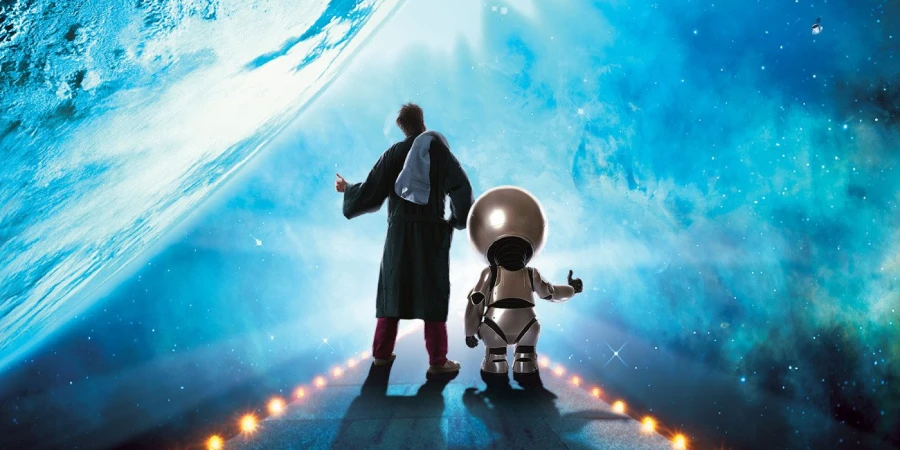

The Hitchhiker’s Guide to the Galaxy (2005) is a sci-fi comedy adaptation of Douglas Adams’ legendary novel, blending absurdist humor, existential philosophy, and British wit. It is a film that boldly asks life’s biggest questions while never taking itself too seriously.
Detailed Summary
Life on Earth and the End of Everything
Arthur Dent is an ordinary man living a painfully ordinary life in England. His worst problem seems to be that his house is about to be demolished to make way for a bypass. That concern quickly becomes irrelevant when Earth itself is scheduled for demolition by the Vogons to make way for a hyperspace express route.
Arthur’s only friend, Ford Prefect, reveals that he is actually an alien researcher for The Hitchhiker’s Guide to the Galaxy, a massive electronic encyclopedia for interstellar travelers. Ford rescues Arthur seconds before Earth is destroyed, and humanity is wiped out without ceremony or drama. The universe, as the film repeatedly reminds us, does not care.
The Vogons and Bureaucratic Horror
Arthur and Ford are captured by the Vogons, one of the most unpleasant species in the galaxy. Their leader, Prostetnic Vogon Jeltz, tortures them by reading his famously awful poetry. When they escape by being thrown into space, they are improbably rescued by the Heart of Gold, a ship powered by the Infinite Improbability Drive.
This introduces the film’s central theme: nothing makes sense, and that is the point.
The Heart of Gold Crew
Aboard the Heart of Gold are:
- Zaphod Beeblebrox, the two-headed, three-armed, narcissistic President of the Galaxy
- Trillian, a human woman Arthur once met on Earth
- Marvin, a clinically depressed robot with a brain the size of a planet
The ship jumps randomly through reality, turning missiles into a bowl of petunias and a whale, both of which immediately question their existence. This scene perfectly encapsulates Douglas Adams’ humor: funny, tragic, and philosophical all at once.
The Quest for the Ultimate Question
Zaphod reveals that he stole the Heart of Gold to reach the legendary planet Magrathea, home of planet-builders. The group hopes to find the Ultimate Question of Life, the Universe, and Everything. The Ultimate Answer, of course, is 42, but the question itself has been lost.
On Magrathea, they meet Slartibartfast, who explains that Earth was actually a supercomputer designed to calculate the Ultimate Question over millions of years, until it was destroyed by the Vogons just before completion.
The Mice and the Meaning of Existence
Arthur learns that hyper-intelligent mice commissioned Earth and now want to extract the Ultimate Question from his brain. This revelation reframes humanity’s role in the universe as a failed experiment, insignificant and mildly amusing.
Arthur ultimately rejects this cosmic exploitation, choosing personal meaning over universal answers.

Movie Ending
In the final act, Arthur is placed inside a recreated version of Earth, designed to help retrieve the Ultimate Question from his subconscious. Instead of delivering cosmic knowledge, Arthur produces a nonsensical phrase about a woman he loved and a bag of groceries.
This moment reinforces one of the film’s core ideas: the universe has no obligation to make sense.
The group escapes the mice, and the story concludes with Arthur, Trillian, Ford, Zaphod, and Marvin traveling together aboard the Heart of Gold. Arthur and Trillian begin a romantic relationship, not because it is cosmically significant, but because it matters to them.
The film ends on an optimistic note, suggesting that while life has no grand answer, companionship, curiosity, and humor are enough.
Are There Post-Credits Scenes?
Yes. There is a brief post-credits scene featuring Marvin, who delivers one final deadpan remark that perfectly matches the film’s tone. It does not set up a sequel but acts as a thematic epilogue.
Type of Movie
The film is a science fiction comedy that leans heavily into satire and absurdist humor, blending space opera elements with existential philosophy and British comedic timing.
Cast
- Martin Freeman as Arthur Dent
- Mos Def as Ford Prefect
- Sam Rockwell as Zaphod Beeblebrox
- Zooey Deschanel as Trillian
- Alan Rickman as the voice of Marvin
- Bill Nighy as Slartibartfast
- Warwick Davis as Prostetnic Vogon Jeltz
Film Music and Composer
The score was composed by Joby Talbot, who created a whimsical and emotional soundtrack that complements the film’s balance of comedy and cosmic melancholy. The music plays a key role in grounding the absurd visuals with genuine feeling.
Filming Locations
The movie was filmed primarily in:
- England (London and surrounding areas)
- Spain (for the Magrathea scenes)
- Studio-based soundstages for spacecraft interiors
The use of practical locations combined with stylized sets helps maintain a tangible, lived-in universe rather than a purely CGI spectacle.
Awards and Nominations
- Nominated for BAFTA Best British Film
- Nominated for Best Visual Effects at several sci-fi and fantasy award ceremonies
- Praised for production design and Alan Rickman’s voice performance as Marvin
Behind the Scenes Insights
- Douglas Adams was actively involved in early drafts before his death in 2001.
- The script went through multiple revisions to adapt the book’s episodic structure into a film narrative.
- Alan Rickman recorded Marvin’s dialogue separately to preserve the character’s detached tone.
- The Vogons were designed to look deliberately uncomfortable and bureaucratic rather than traditionally evil.
Inspirations and References
- Based on the novel The Hitchhiker’s Guide to the Galaxy by Douglas Adams
- Influenced by British radio comedy traditions
- References to existential philosophy, particularly absurdism
- Subtle nods to classic sci-fi such as Doctor Who
Alternate Endings and Deleted Scenes
Several deleted scenes expand Arthur and Trillian’s relationship and further explore Zaphod’s political role. Alternate endings were discussed, but the final version was chosen to preserve Adams’ philosophy that closure is overrated.
Book Adaptation and Differences
The film adapts the first book but:
- Adds a stronger romantic arc between Arthur and Trillian
- Simplifies complex philosophical tangents
- Alters the ending to provide more emotional resolution than the novel
Purists may notice tonal shifts, but the spirit of Douglas Adams remains intact.
Memorable Scenes and Quotes
Key Scenes
- Earth’s destruction treated as a minor inconvenience
- The Infinite Improbability Drive sequence
- Marvin’s introduction and eternal despair
- Slartibartfast explaining fjord design
Iconic Quotes
- “So long, and thanks for all the fish.”
- “I think you ought to know I’m feeling very depressed.”
- “Time is an illusion. Lunchtime doubly so.”
Easter Eggs and Hidden Details
- The number 42 appears repeatedly in background elements
- Book covers from the original series appear briefly on screens
- Marvin’s design subtly evolves to reflect his increasing despair
- The Guide’s interface mimics early internet-era aesthetics
Trivia
- The book was originally a radio series before becoming a novel
- Sam Rockwell improvised many of Zaphod’s gestures
- Marvin’s brain is canonically larger than most planets
- The film’s humor intentionally avoids punchlines in favor of anti-jokes
Why Watch?
Watch this film if you enjoy smart, philosophical comedy disguised as nonsense. It is a rare sci-fi movie that embraces the idea that life has no clear meaning and finds joy in that uncertainty.