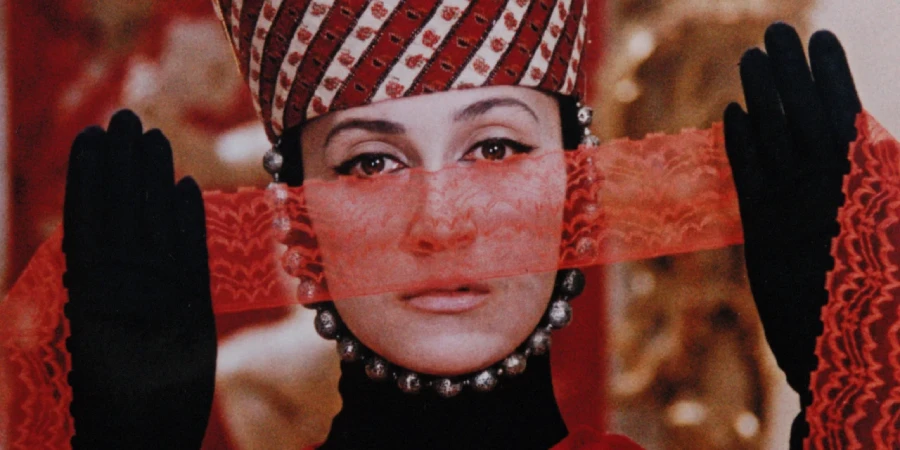

The Color of Pomegranates is not a movie you simply watch; instead, it is an icon you contemplate. Director Sergei Parajanov crafts a cinematic experience that abandons narrative for pure, symbolic poetry. As a result, the film becomes a breathtaking series of living paintings that visualizes the soul of a poet, not the story of his life.
Detailed Summary
The film unfolds as a non-linear sequence of tableaux, representing the inner and outer life of the 18th-century Armenian poet Sayat-Nova. Consequently, each segment is less a plot point and more a visual meditation on a phase of his existence, framed by his own poetry in the intertitles.
Childhood and Learning
The film opens with powerful, symbolic images of the young poet’s world. For instance, we see a dagger dripping pomegranate juice onto a cloth, creating a stain shaped like the borders of ancient Armenia. Books are laid out on a rooftop to dry after a flood, their pages fluttering in the wind. In these early scenes, the boy learns about the world through textures, colors, and sounds. Furthermore, he is shown handling wool, learning to dye fabrics, and observing religious rituals, all of which will deeply inform his later artistic and spiritual life.
The Poet at Court
Next, the film moves to Sayat-Nova’s time as a court musician. Here, he falls in love with a princess named Anna. Their relationship, however, is not shown through conventional romance but through suggestive, highly stylized interactions. For instance, they exchange glances across opulent rooms and share symbolic objects. Actress Sofiko Chiaureli notably plays both the poet’s love and his muse, blurring the lines between the real woman and his artistic ideal. This section is filled with imagery of wealth and courtly life, yet it is all tinged with a sense of emotional distance and unfulfillment.
Life in the Monastery
Following his unrequited love and disillusionment with court life, Sayat-Nova retreats to a monastery. As a result, the film’s visual palette shifts dramatically. The rich colors of the court give way to the austere whites, blacks, and grays of monasticism. Parajanov presents scenes of religious devotion, solitude, and manual labor. Nonetheless, the poet’s inner world remains vibrant. Specifically, memories of his muse continue to haunt him, appearing as an angelic figure amidst the stark reality of his new life as a monk.
The Poet’s Death
The final chapter depicts the poet’s death. As an old man, he is killed during the Persian invasion of his monastery. Parajanov does not portray this as a tragic end but as a final act of sacrifice and transcendence. The poet offers himself up to the invaders, and his blood spills, mirroring the pomegranate juice from the beginning. Ultimately, the film concludes with an “angel of resurrection” and imagery suggesting that the poet’s spirit lives on eternally through his art, having achieved a form of immortality.


Movie Ending
The ending of The Color of Pomegranates is a culmination of its symbolic journey. Sayat-Nova faces his martyrdom calmly, accepting his fate as an invading soldier strikes him down. Immediately after, Parajanov presents a sequence of resurrection. We see the white angel, his muse, and other symbolic figures from his life return. Ultimately, the film asserts that while the man is dead, the poet is eternal. His blood nourishes the earth, and his soul is reborn through his verses, which have become part of Armenia’s cultural fabric. The final shot is not of death but of life continuing, as his artistic legacy endures far beyond his physical existence.
Are There Post-Credits Scenes?
No, there are no post-credits scenes in The Color of Pomegranates. The film concludes definitively with its final symbolic tableau.
Type of Movie
The Color of Pomegranates is an avant-garde biographical art film. It completely defies conventional genre classification. The tone is meditative, surreal, and deeply allegorical. Rather than telling a story, the film functions as a visual poem, focusing on mood and symbolism to evoke the inner world of its subject. It is a work of pure cinema, closer to a painting or a piece of music than a traditional narrative feature.
Cast
- Sofiko Chiaureli – Young Poet / Princess Anna / The Poet’s Muse / The Angel of Resurrection / A Nun
- Melkon Aleksanyan – Sayat-Nova (as a child)
- Vilen Galstyan – Sayat-Nova in the monastery
- Giorgi Gegechkori – Sayat-Nova as an old man
- Spartak Bagashvili – The Poet’s Father
- Medea Japaridze – The Poet’s Mother
Film Music and Composer
The film’s soundscape is as unconventional as its visuals. There is no traditional score written by a single composer. Instead, director Sergei Parajanov curated a rich tapestry of sound. The audio includes authentic Armenian folk songs, liturgical chants from the Armenian Apostolic Church, and the poetry of Sayat-Nova recited or sung. Moreover, natural sounds are amplified, such as the flapping of book pages, the squawking of chickens, and the dripping of water. This approach creates an immersive, historical soundscape that is integral to the film’s symbolic language.

Filming Locations
Parajanov filmed exclusively in historical sites across Armenia, which adds a profound layer of authenticity and meaning. The locations were not mere backdrops; they were characters in themselves. Key sites include: Using these ancient locations connects Sayat-Nova’s internal, spiritual world directly to the tangible history and soul of Armenia.
Awards and Nominations
Due to its heavy censorship by Soviet authorities, The Color of Pomegranates did not have a conventional festival run upon its initial release. However, it has since gained immense critical acclaim and is considered a masterpiece. While it didn’t win major awards at the time, its restored version has been celebrated at numerous retrospectives and classic film festivals worldwide. The film’s true award is its enduring legacy and influence on generations of filmmakers.
Behind the Scenes Insights
- Soviet censors heavily re-edited the film against Parajanov’s wishes. They retitled it from Sayat-Nova to the more abstract The Color of Pomegranates and removed direct references to the poet to make it less nationalistic.
- Director Sergei Parajanov was notoriously defiant of the Soviet regime’s artistic doctrine of socialist realism. His unique style eventually led to his imprisonment on politically motivated charges.
- Parajanov’s “static camera” technique was a deliberate artistic choice. He created compositions like paintings, forcing the audience to scan the frame and discover details, rather than being guided by camera movement.
- Actress Sofiko Chiaureli plays six distinct roles, both male and female. This was Parajanov’s way of illustrating that the Poet, his Love, and his Muse were all facets of a single, unified soul.
Inspirations and References
The primary inspiration for the film is the life and work of Harutyun Sayatyan (1712–1795), best known as Sayat-Nova. He was a celebrated Armenian ashugh, or mystic poet-troubadour, who wrote in Armenian, Azerbaijani, and Georgian. However, the film is not a literal biography. Instead, Parajanov used Sayat-Nova’s own poetic imagery—symbols of wine, pomegranates, daggers, and fish—as the direct source material for the film’s visual language. In addition, the flattened perspectives and intricate compositions are heavily inspired by medieval Armenian illuminated manuscripts and Persian miniatures.
Alternate Endings and Deleted Scenes
The most significant alternate version is the Soviet-censored release from 1971. This version was re-edited by Russian filmmaker Sergei Yutkevich. Yutkevich broke the film into chapters and changed the intertitles to be more abstract, removing Sayat-Nova’s name from them. He also cut several minutes of footage deemed too “formalistic” or religiously provocative. Fortunately, the original director’s cut, known as the “Parajanov cut,” was later restored and is now the widely available version, preserving the director’s true vision.
Book Adaptations and Differences
The Color of Pomegranates is not an adaptation of a book. It is a wholly original cinematic work conceived and written by Sergei Parajanov, though it draws its creative spirit and symbolic vocabulary directly from the collected poems of Sayat-Nova.

Memorable Scenes and Quotes
Key Scenes
- The Bleeding Pomegranate: The opening image where pomegranates spill their juice onto a cloth, forming the shape of Armenia, setting the film’s primary visual motif.
- The Rooftop of Books: Hundreds of illuminated manuscripts are laid out on a monastery roof to dry, their pages catching the wind in a mesmerizing dance of paper and ink.
- The Dyeing of Wool: The poet’s hands are shown working with skeins of wool, dipping them into vats of red, blue, and white dye, symbolizing the creation of art from raw materials.
- The Death of the Catholicos: A stunningly composed scene where a dying church leader is surrounded by mourners, each positioned with painterly precision, creating a living tableau of grief and ritual.
Iconic Quotes
The film contains almost no spoken dialogue. Its “quotes” are the intertitles, which are excerpts from Sayat-Nova’s poems.
- “I am the man whose life and soul are torment.”
- “The book of my heart can only be read by a man like me.”
- “My soul is in the heavens, my body in the grave.”
Easter Eggs and Hidden Details
- Parajanov deliberately composed each shot with a flat, two-dimensional perspective. This technique is a direct visual reference to the style of medieval Armenian miniatures and frescoes.
- Animals frequently appear and carry symbolic weight. For example, sheep can represent the flock (the faithful), while chickens might symbolize domestic or earthly life.
- Many of the ornate costumes, rugs, and artifacts seen in the film were authentic antiques borrowed from museums in Armenia, lending incredible texture and historical accuracy to the visuals.
- The film uses very specific gestures derived from Armenian religious rituals and folk traditions, which would be immediately recognizable to a culturally fluent audience.
Trivia
- The film’s original title was simply Sayat-Nova. Soviet authorities forced the change to the more poetic but less specific The Color of Pomegranates.
- Parajanov storyboarded every single shot with the precision of a master painter, creating highly detailed sketches for each tableau before filming.
- Famed international directors like Michelangelo Antonioni, Federico Fellini, and Jean-Luc Godard were huge admirers of the film and advocated for Parajanov’s creative freedom.
- Musician and artist Lady Gaga paid homage to the film’s aesthetic in her music video for “911,” recreating several of its most iconic scenes.
Why Watch?
Watch this film to witness cinema at its most poetic and visually radical. It is a feast for the eyes and a challenge for the mind. Abandon expectations of a story; instead, allow its rich, symbolic imagery to wash over you.
Director’s Other Movies
- Shadows of Forgotten Ancestors (1965)
- The Legend of Suram Fortress (1985)
- Ashik Kerib (1988)
Recommended Films for Fans
- Andrei Rublev (1966)
- The Holy Mountain (1973)
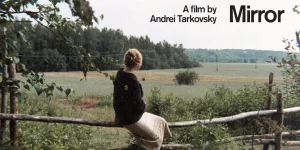
- Mirror (1975)
- Nostalghia (1983)