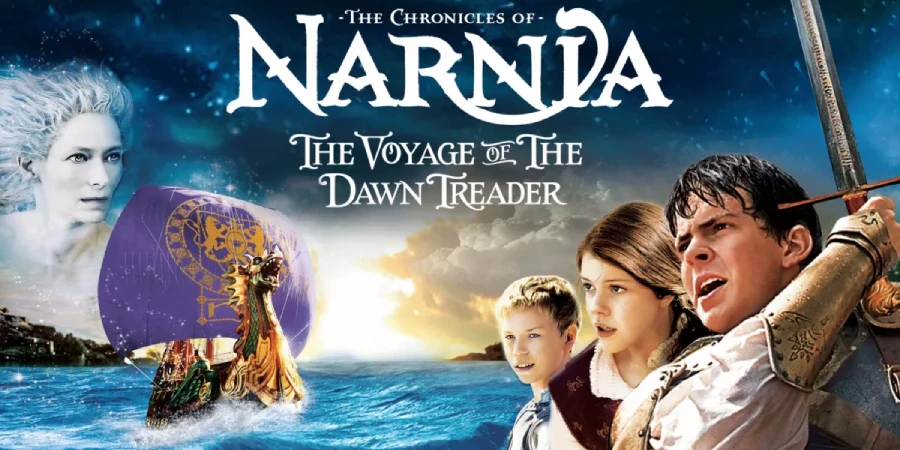

The Chronicles of Narnia: The Voyage of the Dawn Treader is the third film adaptation of C.S. Lewis’s beloved fantasy series. Released in 2010, the movie shifts the tone from large-scale war to a more introspective, spiritual, and exploratory journey, focusing on temptation, faith, and personal growth. While often considered the most divisive entry in the trilogy, it holds a special place for fans of classic fantasy storytelling.
Detailed Summary
Returning to Narnia: A New Call
The story begins in wartime England, where siblings Lucy and Edmund Pevensie are staying with their irritating cousin Eustace Scrubb. Unlike the previous films, Narnia does not call them through destiny or prophecy at first. Instead, they are suddenly pulled into a painting of a ship at sea, dramatically re-entering the magical world.
They find themselves aboard the Dawn Treader, a Narnian vessel led by King Caspian, who is now on a quest to find the seven lost lords of Narnia—noblemen banished during his uncle Miraz’s tyrannical reign.
The Purpose of the Voyage
Caspian reveals that the voyage is not about conquest, but restoration and justice. Each stop along the eastern seas brings them closer to Aslan’s Country and further into dangerous, unknown territories where magic behaves differently.
This structure gives the film an episodic, almost mythic feel, with each island representing a different moral or psychological trial.
Eustace’s Transformation
One of the most critical arcs belongs to Eustace, who starts as selfish, cynical, and dismissive of Narnia. On a dragon-infested island, his greed leads him to steal treasure—an act that magically transforms him into a dragon.
This is not just a physical curse, but a symbolic punishment for his inner flaws. His eventual redemption, aided by Aslan, becomes one of the most emotionally resonant moments in the film.
Temptation and the Green Mist
As the Dawn Treader sails east, the crew encounters the Green Mist, a dark force that manifests people’s fears, regrets, and desires. This antagonist is less a villain with a face and more an embodiment of inner darkness.
Lucy faces the temptation of vanity and jealousy, Edmund confronts lingering guilt and ambition, and Caspian wrestles with insecurity as a ruler. These moments reinforce the film’s central theme: evil often comes from within.
Reepicheep’s Final Quest
The noble mouse Reepicheep serves as the moral compass of the story. His lifelong dream is to reach Aslan’s Country, and his unwavering faith and courage push the crew forward when fear threatens to overwhelm them.
His arc emphasizes honor, belief, and self-sacrifice without irony or cynicism.
Movie Ending
The Dawn Treader finally reaches the edge of the world, where the sea turns into a wall of water cascading downward. Here, the crew learns that only those from Narnia may proceed further.
Lucy and Edmund are told they can never return to Narnia, as they are now too old and must learn to know Aslan in their own world under a different name. This moment is deeply emotional, signaling the end of their journey not just geographically, but spiritually.
Reepicheep fulfills his destiny by sailing alone into Aslan’s Country in a small coracle, disappearing into the light—a quiet but powerful farewell.
Aslan appears one final time, reassuring the children that Narnia was meant to prepare them for life beyond it. Lucy and Edmund return to England with Eustace, forever changed, carrying the lessons of courage, humility, and faith with them.
The ending deliberately avoids spectacle, choosing closure and reflection over grand action, which has remained a point of debate among fans.
Are There Post-Credits Scenes?
No. The Voyage of the Dawn Treader does not include a post-credits or mid-credits scene. The story ends definitively with the children’s return to England and Aslan’s farewell.
Type of Movie
This film is a fantasy adventure with strong elements of family storytelling and spiritual allegory, leaning more toward character development and moral exploration than epic warfare.
Cast
- Ben Barnes as King Caspian
- Skandar Keynes as Edmund Pevensie
- Georgie Henley as Lucy Pevensie
- Will Poulter as Eustace Scrubb
- Simon Pegg as the voice of Reepicheep
- Liam Neeson as the voice of Aslan
- Tilda Swinton (archival appearance as the White Witch)
Film Music and Composer
The score was composed by David Arnold, known for his work on the James Bond series. His music blends nautical adventure themes with emotional, almost sacred undertones, reinforcing the film’s reflective nature rather than bombastic action.



Filming Locations
- Queensland, Australia – primary filming location for ocean scenes
- Gold Coast Studios – interior ship sets
- Extensive CGI was used to create fantastical islands and sea creatures
Australia’s coastal landscapes provided vast horizons that visually reinforced the theme of journeying toward the unknown and the divine.
Awards and Nominations
- Nominated for Best Visual Effects at several technical awards
- Won Best Family Film at smaller international festivals
- Praised for production design, despite mixed critical reception overall
Behind the Scenes Insights
- This was the first Narnia film not directed by Andrew Adamson
- Michael Apted focused heavily on character arcs rather than large battles
- Will Poulter’s performance as Eustace was widely praised, even by critics of the film
- The film shifted studios from Disney to Fox, affecting tone and marketing
Inspirations and References
- Based primarily on “The Voyage of the Dawn Treader” (1952) by C.S. Lewis
- Heavy Christian allegory, especially in Aslan’s role and Eustace’s transformation
- Mythological sea-journey stories such as The Odyssey influenced the structure
Alternate Endings and Deleted Scenes
- Deleted scenes included extended island explorations and additional dialogue with Caspian
- No known alternate ending was filmed; the farewell was always intended to be final
- Some darker Green Mist sequences were cut to maintain a family-friendly rating
Book Adaptations and Differences
- The film adds the Green Mist as a unifying antagonist, which does not exist in the book
- The book is more episodic; the film creates a central threat for cinematic cohesion
- Lucy’s vanity subplot is expanded significantly compared to the novel


Memorable Scenes and Quotes
Key Scenes
- Eustace’s transformation into a dragon
- Lucy reading the spell book and seeing her reflection change
- Reepicheep sailing into Aslan’s Country
Iconic Quotes
- Aslan: “In your world, I have another name.”
- Reepicheep: “My soul is bound to the Eastern Sea.”
- Lucy: “We came here to find ourselves.”
Easter Eggs and Hidden Details
- The spell book contains references to other Narnia novels
- Aslan’s Country visually mirrors descriptions of Heaven from Lewis’s writings
- The number seven repeatedly appears, symbolizing completeness
Trivia
- This is the shortest Narnia film in runtime
- Will Poulter later said this role defined his early career
- The Dawn Treader ship was built as a partial full-scale set
Why Watch?
If you value character-driven fantasy, meaningful themes, and a sense of wonder over constant action, this film offers a thoughtful and emotionally grounded experience. It’s especially rewarding for viewers who appreciate fantasy with moral depth.
Director’s Other Works (Movies)
- Coal Miner’s Daughter (1980)
- Gorillas in the Mist (1988)
- Nell (1994)
- The World Is Not Enough (1999)