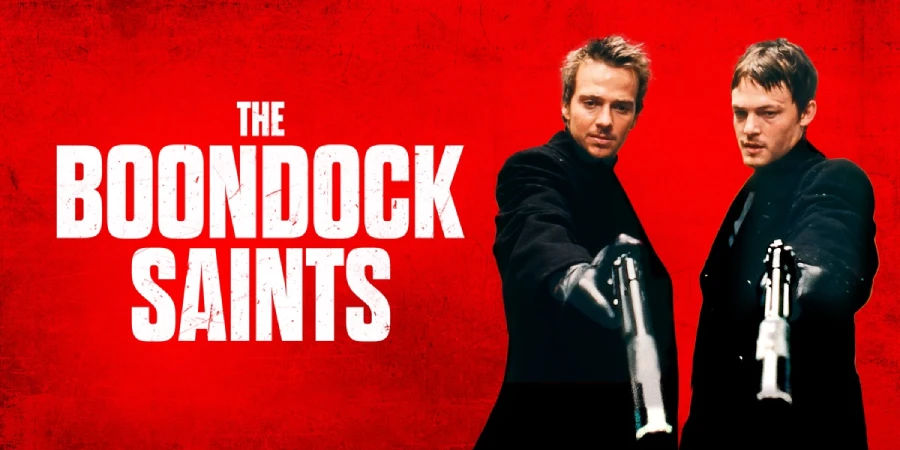

Few films have inspired such a passionate cult following from a box office grave as The Boondock Saints. The film presents a brutal, stylish fantasy of vigilante justice wrapped in religious iconography. Its journey from a hot script to a direct-to-video release is nearly as dramatic as its plot. Here we break down every prayer, every bullet, and every f-bomb.
Detailed Summary
The Tipping Point: A Saint Patrick’s Day Brawl
Irish brothers Connor and Murphy MacManus work in a Boston meatpacking plant. On Saint Patrick’s Day, they get into a bar fight with members of the Russian mafia who want to shut the place down. Although they are initially arrested, public support and self-defense claims lead to their release.
Consequently, the media nicknames them “the Saints” of South Boston. This event plants the seed for their future crusade.
A Divine Calling and the First Hit
That night, the brothers experience what they interpret as a divine calling. They believe God has chosen them to eradicate evil from their city. Their mission begins immediately.
As their first act, they hunt down and execute the Russian mobsters who attacked them. They recite a family prayer before killing the final boss, setting a precedent for their ritualistic vigilantism.
Enter Paul Smecker
Brilliant but eccentric FBI Special Agent Paul Smecker (Willem Dafoe) arrives to investigate the bizarre execution. Smecker has a unique method, listening to opera on his Walkman while reconstructing the crime scene in his mind. He quickly deduces the killings were not a professional hit but something else entirely.
Despite his duty to catch them, Smecker develops a grudging admiration for the vigilantes’ efficiency. On the other hand, the local police detectives, Duffy, Greenly, and Dolly, are comically inept and mostly get in his way.
Rocco and the Frenchy Connection
The Saints’ path crosses with Rocco (David Della Rocco), a bumbling but loyal friend and a low-level errand boy for the local Italian crime family, the Yakavettas. Don “Papa Joe” Yakavetta sets Rocco up to be killed in a hit on a man named “Frenchy.”
However, the Saints were already targeting Frenchy and his crew. They save Rocco’s life during the chaotic shootout. Rocco, realizing his own boss betrayed him, enthusiastically joins the brothers as their “funny man.” He provides them with invaluable inside information on the Italian mob.
The Catholic Church Confrontation
Seeking spiritual guidance, the MacManus brothers attend confession. In a powerful scene, Connor confesses their actions, detailing their belief that they are on a mission from God. Instead of absolution, he asks the priest for his blessing.
The priest is understandably horrified and conflicted by their righteous slaughter. Notably, this scene underscores the central moral question of the film. Are the Saints’ actions divine will or sinful murder?
Il Duce’s Return
Terrified by the Saints’ effectiveness, Papa Joe Yakavetta calls in a legendary hitman: Il Duce. Locked away for decades, Il Duce is a ruthless killer with an old-school style. He is Papa Joe’s last hope.
Il Duce ambushes the Saints at a mobster’s home, culminating in a fierce gunfight. He captures Rocco and wounds the brothers, but is ultimately forced to play a game of Russian roulette. He survives, but the Saints escape, though Rocco dies from his wounds. In a key twist, Smecker discovers Il Duce is actually Noah MacManus, the brothers’ long-lost father.
The Final Showdown at the Courthouse
For their final act, the Saints decide to execute Don Yakavetta publicly during his murder trial. They infiltrate the courthouse with help from a disguised Agent Smecker. He assists them by disabling the guards and creating a diversion.
With their father Il Duce fighting alongside them, the brothers crash the trial. They deliver a speech about good and evil before executing Papa Joe in front of the horrified court and media. They then recite their family prayer as they stand over his body.
Movie Ending
The film’s ending is its most talked-about sequence. After executing Don Yakavetta, Connor, Murphy, and their father Noah are hailed by some and condemned by others. The movie freezes on their triumphant, armed pose in the courtroom.
It then cuts to a series of man-on-the-street interviews playing over the credits. These interviews show a public deeply divided over the Saints’ actions. Some people call them heroes for doing what the law cannot, while others label them as murderers no different from the criminals they hunt. Agent Smecker, who has gone into hiding, is also heard speaking in an interview, implicitly supporting the Saints’ cause and questioning the true nature of justice.
Are There Post-Credits Scenes?
No, there are no scenes after the credits finish. The montage of public opinion interviews serves as the film’s final statement.
Type of Movie
The Boondock Saints is a vigilante action-thriller with strong elements of dark comedy and crime procedural. Its tone is highly stylized, blending brutal violence with religious overtones and sardonic humor.
The film is not meant to be a realistic portrayal of crime. It operates as a modern-day morality play, albeit one drenched in profanity and gunfire.
Cast
- Sean Patrick Flanery – Connor MacManus
- Norman Reedus – Murphy MacManus
- Willem Dafoe – Agent Paul Smecker
- David Della Rocco – David “The Funny Man” Della Rocco
- Billy Connolly – Noah “Il Duce” MacManus
- Bob Marley – Detective Greenly
- David Ferry – Detective Dolly
- Brian Mahoney – Detective Duffy
- Carlo Rota – Don “Papa Joe” Yakavetta
Film Music and Composer
The score for The Boondock Saints was composed by Jeff Danna. His work effectively blends traditional Irish folk music, orchestral pieces, and religious hymns. This juxtaposition highlights the Saints’ cultural heritage and their self-perceived holy mission.
One of the most memorable uses of music is Agent Smecker’s habit of listening to opera, specifically “The Blood of Cuchulainn,” while analyzing crime scenes. Furthermore, the soundtrack features two songs by director Troy Duffy’s own band, The Brood.
Filming Locations
Despite being set in Boston, Massachusetts, the majority of the film was shot in Toronto, Canada. This decision was primarily driven by budget constraints. Several Toronto landmarks, like the old Don Jail, are visible throughout the movie.
Some exterior shots and establishing footage were captured in Boston to maintain authenticity. The choice of Boston is crucial to the story, however, emphasizing the city’s strong Irish-Catholic identity which is central to the MacManus brothers’ background.
Awards and Nominations
Due to its troubled production and limited theatrical release, The Boondock Saints did not receive any major awards or nominations. Its success was almost entirely built on home video sales and word-of-mouth popularity, making it a true cult phenomenon without industry accolades.
Behind the Scenes Insights
- Director Troy Duffy was the subject of a documentary called Overnight (2003). It chronicled his aggressive behavior and conflicts with producers, including Harvey Weinstein, which ultimately led to the film’s disastrous distribution deal.
- The character David Della Rocco was named after and played by a friend of Troy Duffy’s, who also worked as a production assistant. Many of Rocco’s mannerisms and lines were based on his real-life personality.
- Initially, Jake Busey was cast as Rocco, but he dropped out due to scheduling conflicts. This allowed the real David Della Rocco to step into the role.
- Willem Dafoe reportedly took a pay cut to play Agent Smecker because he was so fascinated by the character. He was also instrumental in shaping Smecker’s eccentricities.
Inspirations and References
Troy Duffy has stated the primary inspiration came from a personal experience. He witnessed a drug dealer stealing money from a corpse across the hall from his apartment. This event sparked the idea of two brothers taking justice into their own hands.
The film’s vigilante theme draws clear parallels to movies like Death Wish and comic books like The Punisher. Stylistically, its non-linear narrative and witty, profane dialogue recall the works of Quentin Tarantino, particularly Pulp Fiction.
Alternate Endings and Deleted Scenes
An early draft of the script featured a much darker ending where the brothers are killed in the courtroom shootout. This was changed to the more ambiguous ending that made it into the final film, leaving the door open for a sequel.
Several scenes were trimmed for pacing. For instance, a notable deleted scene involved a more extensive conversation between Rocco and his girlfriend, providing more depth to his character before his tragic death.
Book Adaptations and Differences
The Boondock Saints is an original screenplay written by Troy Duffy. It is not based on a pre-existing book, comic, or any other source material.
Memorable Scenes and Quotes
Key Scenes
- The Rope Scene: The brothers’ attempt to drop down from a vent on a rope to assassinate mobsters goes comically wrong. One brother drops his gun, and the other drops the rope, leaving them dangling helplessly before the situation devolves into a chaotic gunfight.
- The Cat: In a moment of slapstick action, the brothers accidentally kill a cat belonging to one of their targets. Their immediate, over-the-top grief in the middle of a shootout is a perfect example of the film’s dark humor.
- Smecker’s Recreations: Agent Smecker’s mental reconstructions of the shootings are a stylistic highlight. He visualizes the events in slow motion, often placing himself in the action, providing a dynamic way to deliver exposition.
Iconic Quotes
- “And shepherds we shall be. For thee, my Lord, for thee. Power hath descended forth from thy hand that our feet may swiftly carry out thy command. So we shall flow a river forth to thee and teeming with souls shall it ever be. In nomine Patris et Filii et Spiritus Sancti.” – The MacManus Family Prayer
- “There was a firefight!” – Agent Paul Smecker
- “Right, so, we’re sort of like 7-Eleven. We’re not always doing business, but we’re always open.” – Murphy MacManus
- “Is it dead?” – Rocco (referring to the cat)
Easter Eggs and Hidden Details
- Veritas and Aequitas: The brothers have tattoos on their hands: “Veritas” (Latin for “Truth”) on Connor’s right hand and “Aequitas” (Latin for “Justice” or “Equity”) on Murphy’s left hand.
- Rocco’s Hit List: The piece of paper Rocco brings to the brothers with mobster names on it is actually a list of producers and crew members who worked on the film.
- Director’s Cameo: Troy Duffy has a very brief, uncredited cameo as one of the patrons in the bar during the Saint Patrick’s Day brawl.
- Real News Footage: The news footage used during the opening and closing scenes of the movie is authentic footage from actual news broadcasts, adding a layer of realism to the public’s reaction.
Trivia
- Before Sean Patrick Flanery and Norman Reedus were cast, actors like Stephen Dorff, Ewan McGregor, Brendan Fraser, and even Patrick Swayze were considered for the roles of the MacManus brothers.
- The F-word is used approximately 246 times throughout the film.
- Billy Connolly, who plays the father, is only eight years older than Sean Patrick Flanery, who plays his son Connor.
- The film was shelved for a period following the Columbine High School massacre due to studio concerns about its violent content. This delay contributed to its extremely limited theatrical release in the United States.
Why Watch?
This film is essential viewing for fans of stylized action and morally grey stories. Its blend of dark humor, religious overtones, and over-the-top violence created a cult classic that continues to fuel debate. It’s a raw, unapologetic, and unforgettable cinematic experience.
Director’s Other Movies
- The Boondock Saints II: All Saints Day (2009)