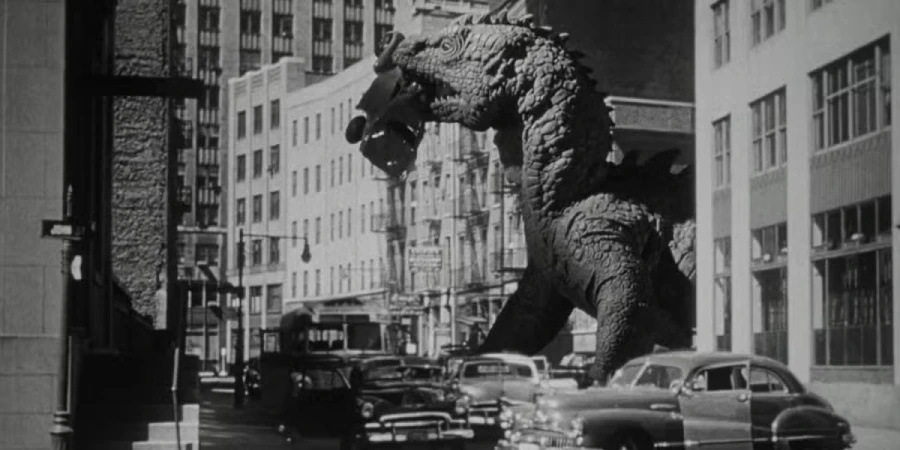

The Beast from 20,000 Fathoms is one of the most influential monster movies ever made and a cornerstone of 1950s science-fiction cinema. Directed by Eugène Lourié and featuring groundbreaking stop-motion animation by Ray Harryhausen, the film helped define the “giant monster awakened by nuclear testing” trope that would dominate the genre for decades.
Detailed Summary
Arctic Nuclear Test and the Awakening
The film opens in the Arctic Circle, where the U.S. military conducts an atomic bomb test. Shortly after the explosion, seismic disturbances are detected beneath the ice. A massive prehistoric creature, frozen for millions of years, is awakened by the nuclear blast.
This moment reflects one of the movie’s central fears: human technological arrogance triggering uncontrollable consequences.
Scientist Tom Nesbitt witnesses the creature during the test but suffers shock, leaving him unable to convince authorities of what he saw.
Scientific Doubt and the First Evidence
Back in civilization, Tom struggles to explain his encounter. Paleontologist Professor Thurgood Elson eventually listens and proposes a terrifying theory: the creature is a Rhedosaurus, a dinosaur-like predator believed extinct for over 100 million years.
At first, the military dismisses the idea as fantasy.
That changes when ships begin disappearing in the Atlantic.
The Monster Reaches Civilization
The Rhedosaurus attacks a lighthouse off the coast, providing physical proof of its existence. The sequence is famous for its atmosphere and remains one of Ray Harryhausen’s most iconic scenes.
The creature heads south toward major population centers, feeding on whales and leaving destruction in its wake.
A New Kind of Threat: The Disease
After being wounded by military fire, the beast bleeds into the ocean. Scientists discover something even more dangerous than the monster itself: its blood carries an ancient pathogen unknown to modern medicine.
If the creature dies naturally, the disease could spread globally.
This transforms the monster from a physical danger into a biological apocalypse.
Race Against Time
As panic spreads, the Rhedosaurus reaches New York City. The military evacuates parts of Manhattan while scientists work desperately to find a way to destroy the creature without allowing its contaminated blood to spread.
Their solution is risky and untested: a radioactive isotope missile designed to completely cauterize the wound.
Movie Ending
The climax takes place in Coney Island, one of the most memorable settings in classic monster cinema.
The Rhedosaurus rampages through the amusement park, smashing roller coasters, tearing through buildings, and causing mass destruction. The location is significant because it represents innocent joy and modern civilization colliding with prehistoric terror.
As the military launches its final attack, the isotope missile strikes the creature directly in the neck wound created earlier in the film.
The radiation burns from the inside out, killing the monster instantly and preventing its infected blood from spreading.
The beast collapses among the ruins of the amusement park, finally lifeless.
There is no celebration.
The ending is deliberately somber. The monster is gone, but the message is clear: humanity created this disaster itself, and nuclear power cannot be undone once unleashed.
The final tone suggests caution rather than victory.
Are There Post-Credits Scenes?
No. The film ends definitively with no post-credits scene, teaser, or sequel setup. This was standard for 1950s cinema, long before post-credit traditions existed.
Type of Movie
The film is a science-fiction monster movie rooted in Cold War paranoia, blending horror elements with speculative science and disaster-film structure.
Cast
- Paul Christian as Tom Nesbitt
- Paula Raymond as Lee Hunter
- Cecil Kellaway as Professor Thurgood Elson
- Kenneth Tobey as Colonel Evans
- Ross Elliott as Dr. Morton
Film Music and Composer
The score was composed by David Buttolph, whose dramatic orchestral themes emphasize tension, military urgency, and looming dread. The music plays a crucial role in making the monster feel massive even before it appears on screen.
Filming Locations
Most of the film was shot in Los Angeles studios, with location footage used for:
- New York City street scenes
- Coney Island amusement park
- Manhattan skyline backgrounds
The use of real New York locations helped ground the fantasy in reality, making the monster’s destruction feel disturbingly plausible to 1950s audiences.
Awards and Nominations
The film did not receive major awards at the time of release. However, it has since earned retroactive recognition as:
- A landmark achievement in visual effects
- One of the most influential monster films in cinema history
- A foundational inspiration for later kaiju films
Behind the Scenes Insights
- Ray Harryhausen created the creature using stop-motion animation, working frame by frame for months.
- The monster’s design was intentionally non-specific, avoiding resemblance to known dinosaurs to increase realism.
- The film’s modest budget forced creative editing tricks to make the creature appear larger and more destructive.
- Harryhausen later stated this film launched his entire career.
- The Rhedosaurus model was reused and modified for later productions.
Inspirations and References
The movie was loosely inspired by Ray Bradbury’s short story “The Fog Horn”, which also features a prehistoric creature awakened by modern technology.
The atomic-age theme reflects real Cold War fears surrounding:
- Nuclear testing
- Radiation mutations
- Scientific overconfidence
The film directly influenced Japanese filmmakers during the creation of Godzilla (1954).
Alternate Endings and Deleted Scenes
No alternate ending was filmed.
Several shorter destruction scenes were removed due to budget limitations and censorship concerns, especially regarding civilian casualties. Some storyboards reveal plans for a longer New York rampage that was never completed.
Book Adaptations and Differences
The film is not a direct adaptation of a novel.
While inspired by Bradbury’s short story, the movie significantly expands the concept by introducing:
- Military involvement
- Global biological threat
- Nuclear responsibility themes
Bradbury later distanced himself from the film’s final script, though he acknowledged its influence.
Memorable Scenes and Quotes
Key Scenes
- The atomic bomb test awakening the creature
- The lighthouse attack sequence
- Discovery of the monster’s infectious blood
- Evacuation of New York City
- The Coney Island destruction finale
Iconic Quotes
- “There are forces mankind was never meant to unleash.”
- “You can’t bomb nature into submission.”
- “This creature is older than civilization itself.”
Easter Eggs and Hidden Details
- The monster’s roar was created by combining animal sounds played at altered speeds.
- Several military stock footage shots were reused from World War II films.
- The Rhedosaurus’s posture directly inspired early Godzilla concept art.
- Newspaper headlines visible on screen reference real Cold War tensions of the era.
Trivia
- The film was released only eight years after Hiroshima and Nagasaki.
- It was one of the first movies to link nuclear testing with monstrous consequences.
- Ray Harryhausen animated every creature scene himself.
- The movie popularized the idea of monsters attacking modern cities.
- Steven Spielberg has cited it as an early inspiration.
Why Watch?
You should watch The Beast from 20,000 Fathoms if you appreciate:
- Classic practical effects
- Cold War–era science fiction themes
- The origins of modern monster cinema
- Ray Harryhausen’s legendary animation
It may look dated, but its influence is everywhere—from Godzilla to Jurassic Park.
Director’s Other Works
Eugène Lourié:
- The Giant Behemoth (1959)
- Gorgo (1961)
- The Colossus of New York (1958)
Recommended Films for Fans
- Godzilla (1954)
- Them! (1954)
- The Giant Behemoth (1959)
- King Kong Lives (1986)
- It Came from Beneath the Sea (1955)
- King Kong (1933)