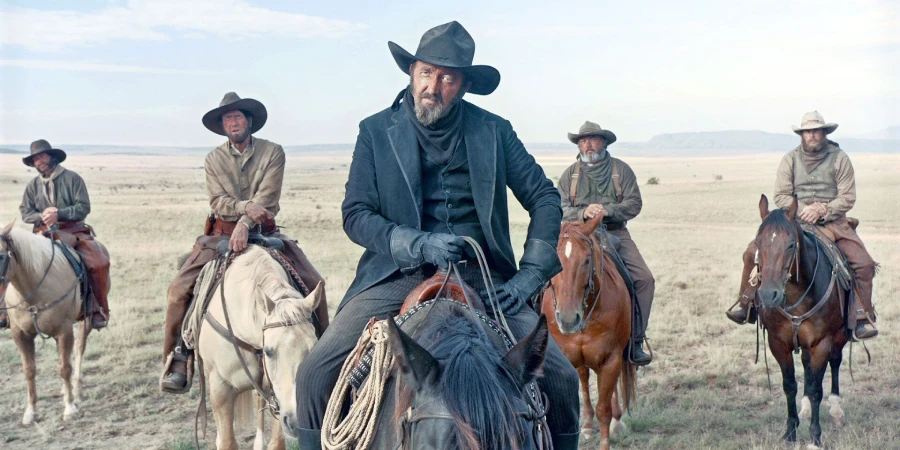

Directed by Joel Coen and Ethan Coen, The Ballad of Buster Scruggs is a six-part Western anthology that blends absurd humor, brutal violence, melancholy, and existential dread. Released in 2018, the film is both a loving tribute to and a subversion of classic American Western mythology. It’s poetic, ironic, and often devastating.
Detailed Summary
The Ballad of Buster Scruggs
We meet Buster Scruggs (Tim Blake Nelson), a cheerful, impeccably dressed singing cowboy who rides through the desert like he’s stepped out of a 1930s musical. He talks directly to the audience, sings witty songs, and casually outguns anyone who challenges him.
His charm is matched only by his deadliness. In saloons and dusty towns, he kills with absurd ease and comic timing. Eventually, he meets a younger, faster gunslinger (played by Willy Watson) who shoots him dead mid-song. Buster ascends to heaven strumming his guitar.
Key idea: Even legends get replaced. The West consumes its own myths.
Near Algodones
A nameless cowboy (James Franco) attempts to rob a bank. The banker survives thanks to ridiculous armor and pots strapped under his clothes. The robber is caught and sentenced to hang. Just before execution, a Comanche attack disrupts the event. He survives, only to be arrested again later for a crime he didn’t commit.
He is hanged anyway. His final line — admiring a pretty girl in the crowd — is both absurd and tragic.
Theme: Fate in the West is arbitrary and merciless.
Meal Ticket
This is perhaps the darkest segment. A traveling impresario (played by Liam Neeson) manages a limbless orator (Harry Melling), who recites Shakespeare, Lincoln, and Shelley in small towns. As attendance dwindles, the impresario discovers a performing chicken that can do math.
The implication is devastating: the impresario disposes of the orator — likely drowning him — and replaces him with the more profitable chicken.
Brutal truth: Art has little value in a world driven by survival and profit.
All Gold Canyon
A lone prospector (Tom Waits) searches for gold in a pristine valley. He talks to nature affectionately while digging methodically. After finally striking gold, he’s shot by a young thief. However, the prospector survives, kills the thief, and leaves with his fortune.
This is the rare segment with a comparatively hopeful ending. The valley endures.
Nature is indifferent but resilient. Humans are not.
The Gal Who Got Rattled
Alice Longabaugh (Zoe Kazan) travels west with her brother, who suddenly dies. She joins a wagon train led by Billy Knapp (Bill Heck). Vulnerable and alone, she agrees to marry Billy for security.
When a Native American attack occurs, Billy leaves her with a gun and instructions to shoot herself if he fails to return. Believing him dead, she does exactly that — moments before he reappears alive.
This story is heartbreakingly ironic. Alice dies due to fear and misunderstanding.
Perhaps the film’s cruelest meditation on isolation and miscommunication.
The Mortal Remains
Five strangers share a stagecoach: a Frenchman, an Englishman, a lady, a trapper, and two bounty hunters (Brendan Gleeson and Jonjo O’Neill). As the journey continues, it becomes clear something is off.
The bounty hunters speak philosophically about capturing souls. The passengers gradually realize they may already be dead or en route to death. The hotel at the end feels like a purgatorial space. The film ends ambiguously but heavily implies the stagecoach is carrying souls to the afterlife.
The West becomes a metaphor for mortality itself.
Movie Ending
The final segment, The Mortal Remains, concludes the anthology on a metaphysical note. The bounty hunters — who never sleep — suggest they transport people who don’t always realize they’ve been “caught.” The passengers grow increasingly uneasy as night falls.
When they arrive at a dark hotel, the bounty hunters carry a body upstairs. The remaining passengers hesitate at the threshold. The staircase feels symbolic — like crossing into the afterlife. The final shot lingers in silence.
The implication is powerful: every story in the film leads here. Death is the only certainty in the West — and in life.
The Coen Brothers offer no comfort, no heroic sendoff. Instead, they close on existential inevitability. The frontier wasn’t just about expansion. It was about extinction.
Are There Post-Credits Scenes?
No. The Ballad of Buster Scruggs does not include any mid-credits or post-credits scenes. Once the final frame fades, the storybook closes for good.
Type of Movie
This is a Western anthology film blending dark comedy, existential drama, and revisionist Western themes. It simultaneously celebrates and dismantles classic cowboy mythology.
Cast
- Tim Blake Nelson as Buster Scruggs
- James Franco as the Near Algodones Cowboy
- Liam Neeson as the Impresario
- Harry Melling as the Artist
- Tom Waits as the Prospector
- Zoe Kazan as Alice Longabaugh
- Brendan Gleeson as Irish Bounty Hunter
- Jonjo O’Neill as English Bounty Hunter
Film Music and Composer
The score was composed by Carter Burwell, a longtime Coen collaborator. The music shifts between playful Western ballads and somber orchestral arrangements, reinforcing each segment’s tone. The opening song performed by Buster Scruggs perfectly sets the ironic tone.
Filming Locations and Their Importance
Filming took place primarily in:
- New Mexico
- Colorado
- Nebraska
The vast landscapes are crucial. The open plains emphasize isolation and fate. The untouched valley in All Gold Canyon symbolizes purity before human greed intrudes. The harsh deserts reflect the unforgiving moral universe of the film.
Awards and Nominations
The film received three Academy Award nominations at the Academy Awards:
- Best Adapted Screenplay
- Best Costume Design
- Best Original Song
It also won Best Screenplay at the Venice Film Festival.
Behind the Scenes Insights
- Originally conceived as a Netflix miniseries before becoming a feature film
- Each segment was shot almost like a standalone short film
- Tom Waits performed many of his own physical stunts
- The Coens intentionally styled Buster like a Gene Autry parody
- Practical effects were heavily used in outdoor sequences
Inspirations and References
The film draws from classic Western dime novels and pulp stories. It also references:
- The works of Bret Harte
- American frontier folklore
- Traditional singing cowboy films of the 1930s
- Existential literature themes common in Coen films
Alternate Endings and Deleted Scenes
No major alternate ending was filmed. However, several extended dialogue scenes — particularly in The Mortal Remains — were trimmed for pacing. Early drafts reportedly made the afterlife metaphor more explicit, but the Coens chose ambiguity instead.
Book Adaptations and Differences
The film is not based on a single novel but is inspired by Western short story traditions. The screenplay was published as an illustrated book after release, expanding on dialogue and visual notes.
Memorable Scenes and Quotes
Key Scenes
- Buster shooting a man through a poker table while finishing a song
- The banker emerging in full “pan armor”
- The silent implication of the impresario’s betrayal
- The prospector whispering “Mr. Pocket” when he finds gold
- Alice’s tragic misunderstanding before the gunshot
- The eerie stillness inside the stagecoach at night
Iconic Quotes
- “You can’t be top dog forever.”
- “First time?”
- “I don’t hate my fellow man… even when he’s tiresome and surly and tries to cheat at poker.”
- “We’re all heading for the same destination.”
Easter Eggs and Hidden Details
- The film is structured like a literal old Western storybook, complete with page turns
- Buster directly addressing the camera mirrors early cinema techniques
- The number of passengers in the final story reflects symbolic “five stages” interpretations of grief
- Musical motifs subtly repeat across segments
- The final hotel lighting mimics classic depictions of limbo
Trivia
- The Coens’ first Western since True Grit
- Shot digitally despite its classic Western aesthetic
- Tim Blake Nelson performed most of his singing live
- The film runs 133 minutes but feels episodic by design
- It was one of Netflix’s early prestige film projects
Why Watch The Ballad of Buster Scruggs?
Watch it for the sharp writing, the stunning cinematography, and the uniquely Coen balance of absurd humor and philosophical weight. If you enjoy Westerns that question their own mythology, this one lingers long after the credits.
It’s funny. It’s cruel. It’s oddly beautiful. And beneath it all, it quietly reminds us that every frontier has an ending.
Directors’ Other Works
Other notable films by Joel and Ethan Coen include:
- Blood Simple (1984)
- Fargo (1996)
- The Big Lebowski (1998)
- No Country for Old Men (2007)
- True Grit (2010)
Recommended Films for Fans
If you enjoyed this film, consider: