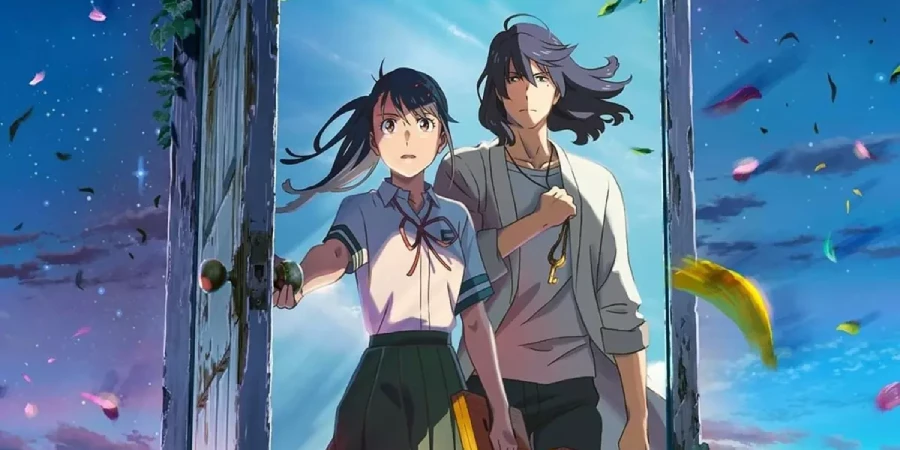

Suzume is a visually poetic road movie wrapped inside a supernatural disaster tale, directed by Makoto Shinkai. Following the emotional lineage of his previous works, the film blends romance, grief, memory, and national trauma into a story that travels across Japan—both geographically and spiritually.
At its core, this is not just a fantasy adventure. It is a story about learning how to live with loss, how to close doors to the past, and how to choose to keep living anyway.
Detailed Summary
The Girl, the Stranger, and the First Door
Suzume Iwato, a 17-year-old high school girl living in Kyushu, meets a mysterious young man named Souta Munakata on her way to school. He is searching for “doors.” Curious, Suzume follows him into an abandoned ruin in the mountains where she finds a freestanding, ancient door standing alone amid wreckage.
When she opens it, she glimpses a surreal, star-filled dimension beyond. She unknowingly releases a powerful entity called the “Keystone,” a cat-like spirit named Daijin. This act sets off a chain reaction across Japan.
Souta reveals that he is a “Closer,” someone tasked with sealing these doors before giant worm-like entities escape from the other side and cause earthquakes.
Souta Becomes a Chair
Daijin turns Souta into a three-legged childhood chair belonging to Suzume. This bizarre transformation becomes one of the film’s most emotionally clever devices. Suzume now has to travel across Japan carrying and chasing a talking chair that is actually the boy she just met.
Their journey becomes a literal road trip through regions affected by past disasters. At each location, they must find doors hidden in abandoned places—schools, ferris wheels, ruins—and perform a ritual to close them before disaster strikes.
The Journey Across a Wounded Japan
As Suzume travels from Kyushu to Shikoku, Kobe, Tokyo, and finally Tohoku, she meets kind strangers who help her: a young mother, a bar owner, high school girls, and Souta’s grandfather.
Each stop subtly references real abandoned spaces left behind after earthquakes and the 2011 Tōhoku disaster. These are not random ruins. They are memories of real loss.
Suzume begins to realize the emotional weight of what these doors represent: places where people once lived, loved, and were forced to leave behind.
The Truth About Suzume’s Past
We learn that Suzume lost her mother during the 2011 earthquake and tsunami. As a child, she wandered into ruins and found that same mysterious door. On the other side, she saw a future version of herself, who comforted her.
That memory, long repressed, is tied to the origin of her connection to these doors.


Movie Ending
In Tokyo, Daijin abandons Suzume after feeling rejected and returns to being a Keystone. Meanwhile, Souta is taken into the Ever-After (the starry realm beyond the doors) and becomes the new Keystone himself to prevent a catastrophic worm from destroying Tokyo.
Suzume refuses to accept this. She travels to Tohoku, to the exact ruins where she lost her mother. There lies the original door she encountered as a child.
She enters the Ever-After to save Souta.
Inside this realm, time overlaps. Suzume realizes the person who comforted her as a child after her mother’s death… was her present self. She was always the one who gave herself the strength to keep living.
She rescues Souta from his Keystone fate and closes the final door properly, accepting her grief instead of running from it.
Back in the real world, Souta returns to human form. Daijin and the second Keystone, Sadaijin, resume their roles in maintaining balance.
The film ends with Suzume returning to her normal life, no longer haunted by the past, having emotionally “closed the door” she kept open for years.
She reunites with Souta, and while the film avoids a dramatic romantic confession, the emotional connection is clear and hopeful.
The ending is about healing, not romance. About choosing life after tragedy.
Are There Post-Credits Scenes?
No. There are no post-credits or mid-credits scenes in Suzume. The story concludes fully before the credits roll.
Type of Movie
Suzume is a supernatural road adventure blended with emotional drama and disaster fantasy. It uses magical realism to explore grief, memory, and healing in post-disaster Japan.
Cast (Japanese Voice Actors)
- Nanoka Hara as Suzume Iwato
- Hokuto Matsumura as Souta Munakata
- Eri Fukatsu as Tamaki (Suzume’s aunt)
- Shota Sometani as Minoru Okabe
Film Music and Composer
The score was composed by RADWIMPS with composer Kazuma Jinnouchi. Their music elevates the emotional weight of the journey, especially the ending theme “Suzume.”

Filming Locations and Their Importance
Although animated, the film meticulously recreates real Japanese locations:
- Kyushu coastal towns
- Kobe urban districts
- Tokyo’s abandoned amusement areas
- Tohoku ruins referencing 2011 disaster zones
These are not stylistic choices. They are emotional landmarks tied to real history.
Awards and Nominations
Suzume was nominated for the Golden Bear at the Berlin International Film Festival and won multiple Japanese animation awards, praised for animation, music, and emotional storytelling.
Behind the Scenes Insights
- Shinkai deliberately traveled across Japan to sketch real abandoned locations.
- The chair design was based on a childhood object from Shinkai’s life.
- The 2011 disaster theme was something Shinkai had avoided for years before feeling ready to address it.
- Over 2,000 background art pieces were created to capture realistic towns.
Inspirations and References
The film draws thematic inspiration from the 2011 Tōhoku earthquake and tsunami, Japanese folklore about spirit gates, and Shinkai’s own recurring themes of distance and connection.
Alternate Endings and Deleted Scenes
Early drafts had a darker ending where Souta remained a Keystone permanently. Shinkai chose a hopeful resolution instead.
Several travel interactions were shortened to keep pacing tight.
Book Adaptations and Differences
A novelization written by Makoto Shinkai was released alongside the film, expanding internal thoughts of Suzume and Tamaki, giving more emotional depth to their relationship.



Memorable Scenes and Quotes
Key Scenes
- Suzume running with the three-legged chair across towns
- The first time the worm emerges from a door in the sky
- Suzume meeting her younger self in the Ever-After
Iconic Quotes
- “I’ll be okay.”
- “We close doors so tomorrow can come.”
Easter Eggs and Hidden Details
- Posters of previous Shinkai films appear subtly in backgrounds.
- The starry Ever-After resembles visual motifs from Your Name.
- The chair always faces forward during emotional growth moments.
Trivia
- The film took nearly three years to animate.
- Real disaster photography influenced background art.
- Daijin’s design is based on traditional Japanese lucky cat statues.
Why Watch?
Because Suzume is not just a fantasy film. It is therapy in animated form. It gently asks how we carry grief, and whether we are ready to set it down.
Director’s Other Works (Movies)
- Your Name. (2016)
- Weathering with You (2019)
- The Garden of Words (2013)
Recommended Films for Fans
- Spirited Away (2001)
- A Silent Voice (2016)
- Wolf Children (2012)
- The Girl Who Leapt Through Time (2006)