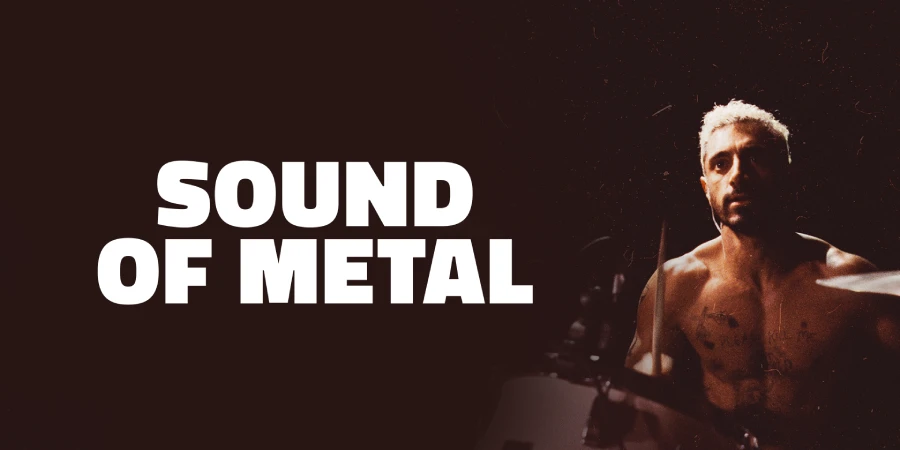

Sound of Metal shatters the illusion that silence is empty. Instead, it weaponizes quiet, forcing both its protagonist and the audience to confront what remains when everything is gone. The film is an immersive, visceral journey into a world redefined not by loss, but by a new way of being. Therefore, it is more than just a movie; it is an experience.
Detailed Summary
The Sound Fades
Ruben Stone is a heavy-metal drummer. He and his girlfriend, the band’s singer Lou, live a nomadic life in their RV, touring from gig to gig. Their life is a loud, chaotic, and deeply codependent routine. However, this delicate balance is thrown into chaos when Ruben suddenly experiences severe, rapid hearing loss. During a show, the sound distorts into a muffled, incomprehensible rumble. Consequently, his world shrinks to a panicked, ringing silence.
Diagnosis and Desperation
A doctor confirms Ruben’s fears. He has lost most of his hearing, and it will only get worse. Furthermore, the doctor warns that any further exposure to loud noise could destroy his remaining hearing permanently. Ruben, a recovering heroin addict, immediately fixates on the possibility of cochlear implant surgery. This expensive procedure, however, is not a cure. Panicked for his sobriety, Lou contacts Ruben’s sponsor, who finds a rural sober house specifically for Deaf individuals.
Arrival at the Deaf Community
Ruben reluctantly agrees to go. He arrives at a serene, isolated community run by a man named Joe, a Vietnam veteran who lost his hearing in the war. Joe insists that Ruben commit fully to the program. This means he must stay alone, without Lou and without his phone. After a tearful and gut-wrenching goodbye, Lou leaves, promising to wait for him. Ruben, as a result, feels completely abandoned and terrified.
Learning to Be Deaf
Initially, Ruben is sullen and resistant. He cannot communicate and feels like an outsider. Joe, however, patiently guides him, giving him simple tasks and encouraging him to learn to “be Deaf.” Ruben slowly begins to learn American Sign Language (ASL). He also starts to connect with the other members of the community, especially the children at a Deaf school where he volunteers. For instance, he teaches a young boy to drum. For the first time, he finds moments of peace and belonging in this new, silent world.
Chasing a Cure
Despite his progress, Ruben can’t let go of his old life. He secretly obsesses over getting the cochlear implants. In a desperate move, he sells his beloved RV and all of his music equipment to fund the surgery. When Joe discovers this, he is heartbroken. He explains that the community’s philosophy is rooted in accepting deafness as a culture, not a handicap to be fixed. Because of this, Ruben’s actions are a betrayal. Joe asks him to leave the community, as his heart is now in a different place.
The Broken Promise of Sound
Ruben undergoes the cochlear implant surgery. After a period of healing, the implants are activated. The sound, however, is not what he expected. It is a distorted, metallic, and jarring caricature of hearing. Nonetheless, he flies to Paris to reunite with Lou, who is now living with her wealthy father, Richard. He finds that Lou has also changed. She is thriving in a new, stable life and her own self-harm scars are healing. Ultimately, Ruben realizes the life they shared on the road is gone forever.


Movie Ending
The ending of Sound of Metal is a moment of profound and quiet acceptance. The morning after his reunion with Lou, Ruben sits with her father, Richard. The implants process the sounds of the morning—a ringing church bell, distant traffic, Richard making a smoothie—as a distorted, grating symphony of noise. Ruben clearly struggles with this artificial soundscape. He sees that Lou is happy and has found a new, healthier life without him.
Later, he sits alone on a park bench, the city alive around him. The sounds through his implants remain harsh and unpleasant. After a moment of contemplation, he reaches up and removes the external processors for his implants. The chaotic digital noise abruptly ceases, plunging him back into total silence.
In contrast to his earlier panic, he now appears calm. Quietly, he observes the world around him—kids playing, leaves rustling—in stillness. At last, the silence he once feared becomes something he accepts, discovering the peace Joe spoke of. The struggle is over; he has stopped fighting.
Are There Post-Credits Scenes?
No, Sound of Metal does not have any post-credits or mid-credits scenes. The film concludes with Ruben’s final moment of acceptance on the bench.
Type of Movie
Sound of Metal is a powerful character-driven drama. While it involves music, it is not a “music movie” in the traditional sense. Instead, the film focuses on themes of addiction, identity, loss, and acceptance. Its tone is raw, immersive, and deeply empathetic. The director uses a groundbreaking sound design to place the audience directly into Ruben’s auditory experience, making it a uniquely visceral and emotional journey.
Cast
- Riz Ahmed – Ruben Stone
- Olivia Cooke – Lou Berger
- Paul Raci – Joe
- Lauren Ridloff – Diane
- Mathieu Amalric – Richard Berger
Film Music and Composer
The film’s score is one of its most innovative elements, masterfully handled by sound designer Nicolas Becker. Interestingly, there is very little traditional “music” in the film. Instead, the “score” is a complex soundscape composed of distorted audio, muffled vibrations, high-frequency ringing, and oppressive silence. Becker’s goal was to authentically replicate Ruben’s subjective auditory experience.
Abraham Marder, the director’s brother and co-writer, also contributed to the score and wrote the song “Green,” which Olivia Cooke performs. The film’s sound is ultimately its main character. It’s a sonic journey from overwhelming noise to the profound texture of silence. As a result of this work, the film won the Academy Award for Best Sound.

Filming Locations
The majority of Sound of Metal was filmed in Massachusetts. Locations like Rowley, Ipswich, Danvers, and Topsfield provided the backdrop for Ruben and Lou’s tour life and, more importantly, the isolated setting for Joe’s Deaf community. This rural environment effectively contrasts with the loud, transient life Ruben lived before. In addition, the final act of the film was shot on location in Paris, France, highlighting Lou’s new, sophisticated world and Ruben’s ultimate displacement from it.
Awards and Nominations
Sound of Metal was a critical darling and a major awards contender. It received six Academy Award nominations, including Best Picture. Notably, it won two Oscars:
- Best Sound
- Best Film Editing
In addition, the film earned nominations for Best Picture, Best Actor for Riz Ahmed, Best Supporting Actor for Paul Raci, and Best Original Screenplay. Ahmed also made history as the first Muslim to be nominated for the Best Actor Oscar.
Behind the Scenes Insights
- Director Darius Marder insisted on an immersive experience for his lead. Consequently, Riz Ahmed wore custom-made audio blockers deep in his ear canals that emitted white noise, preventing him from hearing his own voice and the voices of other actors.
- Riz Ahmed dedicated seven months to preparing for the role. This preparation included learning to play the drums and becoming fluent in American Sign Language.
- The film was shot chronologically. This allowed Ahmed to experience Ruben’s journey of hearing loss and gradual integration into the Deaf community in real-time.
- Paul Raci, who plays Joe, is a CODA (Child of Deaf Adults). He is fluent in ASL and a prominent member of the Deaf community, which brought a deep layer of authenticity to his character and the film.
- The film was in development for over a decade. It originated as a project by director Derek Cianfrance called Metalhead before he passed it to Darius Marder.
Inspirations and References
The film grew from an unfinished docu-fiction project by director Derek Cianfrance titled Metalhead. That project followed the real-life metal band Jucifer, whose drummer, Edgar Livengood, suddenly went deaf. Cianfrance co-wrote the story for Sound of Metal with Darius Marder, who had previously co-written Cianfrance’s The Place Beyond the Pines. Marder then took the core concept of a drummer losing his hearing and developed it into the fictional narrative we see in the final film, focusing more on the internal journey and themes of identity.
Alternate Endings and Deleted Scenes
Director Darius Marder has been firm that the film’s ending is the only one that was ever seriously considered. No official alternate endings or significant deleted scenes have been released. The narrative was designed to build toward that specific moment of quiet acceptance. Therefore, the team filmed a story with a singular, powerful conclusion in mind. Any other outcome would have undermined the central theme of the film: finding peace in stillness rather than chasing a broken past.
Book Adaptations and Differences
Sound of Metal is not based on a book. It is an original work with a screenplay written by Darius Marder and his brother, Abraham Marder. The story credit is shared with Derek Cianfrance, who conceived the initial idea.

Memorable Scenes and Quotes
Key Scenes
- The Opening Gig: The film opens with a blistering, loud performance by Ruben and Lou. This scene powerfully establishes their world of sound before it is violently taken away.
- The Pharmacy: Ruben’s hearing cuts out almost entirely while he waits for a prescription. The sound design plunges the audience into his muffled, terrifying perspective for the first time.
- Joe’s Office: Joe explains the goal of the community is not to fix deafness but to learn how to live with it. This is where he teaches Ruben about the “kingdom of God” found in stillness.
- The Classroom Slide: After weeks of isolation, Ruben connects with Deaf children at a school, sharing a moment of pure joy on a slide. It’s the first time he truly embraces his new reality.
- The Final Silence: Ruben sits on a bench in Paris. He removes his cochlear implant processors and finally accepts the quiet, observing the world with a look of peace.
Iconic Quotes
- “The world does not stop for you. Your sobriety is on you.” – Joe
- “Right now, you’re a motherf—ing addict. So for me, those moments of stillness, that place, that’s the kingdom of God. And that place will never abandon you.” – Joe
- “You should understand that this is a Deaf community. We are looking for a solution to this… not this.” – Joe, gesturing from his mind and heart to his ears.
- “It’s okay, Lou. It’s okay.” – Ruben
Easter Eggs and Hidden Details
- Ruben’s Tattoos: On Ruben’s chest is a tattoo of a dog with the words “PLEASE KILL ME.” After Lou leaves him at the community, a new tattoo appears below it, covering the words and symbolizing a shift in his desire to live.
- The Cochlea Slide: The metal slide at the Deaf school where Ruben plays with the children is shaped like a spiral, subtly resembling the cochlea of the inner ear.
- Immersive Captions: The film’s open captions describe all sounds, not just dialogue (e.g., [WIND BLOWING], [MUFFLED SPEECH]). This was a deliberate choice to include hearing audiences in an experience more akin to how Deaf and hard-of-hearing individuals watch films.
- The Band Name: Ruben and Lou’s band is called “Blackgammon,” a subtle nod to their codependent, black-and-white view of the world and their intertwined journey.
Trivia
- Olivia Cooke actually learned to scream-sing for the role of Lou. She worked with a vocal coach to produce the harsh metal vocals without damaging her voice.
- The majority of the supporting cast in the Deaf community are, in fact, Deaf or hard-of-hearing actors, adding to the film’s authenticity.
- Darius Marder’s own grandmother was Deaf after a medical mistreatment, which gave him a personal window into Deaf culture and inspired his approach to the story.
- The sound mix was incredibly complex. The team spent 20 weeks on sound design alone, creating specific audio textures to represent every stage of Ruben’s hearing loss.
Why Watch?
This film is a technical and emotional masterpiece. Riz Ahmed’s monumental performance combined with groundbreaking sound design creates a rare, visceral experience. Ultimately, it’s a profound story about acceptance that will change how you listen to the world around you.
Director’s Other Movies
- Loot (2008)
Recommended Films for Fans
- The Rider (2017)
- CODA (2021)
- The Place Beyond the Pines (2012)
- A Star Is Born (2018)
- Whiplash (2014)