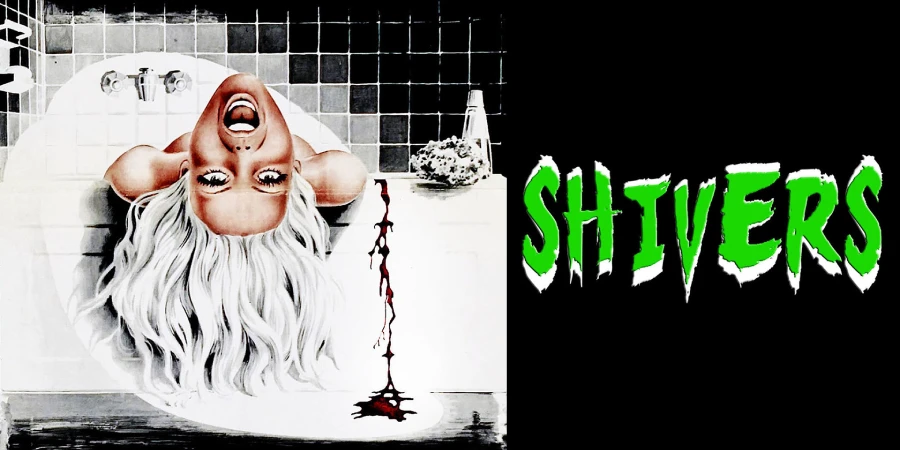

Shivers (also known as The Parasite Murders or They Came from Within) is one of David Cronenberg’s earliest and most controversial films. A chilling fusion of science fiction and body horror, it introduced the director’s long-term obsessions with disease, sexuality, and transformation.
Detailed Summary
The Starliner Apartments: A Modern Utopia with Dark Secrets
The story takes place in Starliner Island, a luxurious high-tech apartment complex marketed as a peaceful, self-sustaining mini-society. Its residents are wealthy, isolated, and seemingly safe from the chaos of the outside world. This perfect setting makes the horror all the more shocking.
A Scientist’s Experiment Gone Wrong
Dr. Emil Hobbes, a medical researcher, has created a parasite intended to replace human organs. However, the parasite also has a disturbing side effect: it turns hosts into sexually aggressive, uncontrollable beings. Realizing the catastrophic implications, Hobbes kills his teenage test subject and himself in the film’s brutal opening sequence.
The Parasite Spreads
Medical officer Roger St. Luc begins investigating the mysterious deaths with the help of nurse Forsythe. Soon, parasite-infected residents begin attacking others, spreading the infection like a sexually transmitted epidemic. The film transforms the luxurious apartment into a claustrophobic battleground.
Breakdown of Society Inside Starliner
As more residents become infected, normal social rules collapse. The parasite-driven desire becomes more violent and widespread. Instead of fleeing, people embrace their new impulses. The horror grows not from gore alone, but from the loss of identity and control.


Movie Ending
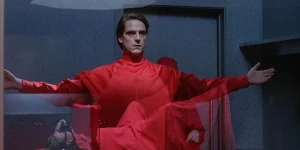
As chaos peaks, St. Luc tries to escape the building, confronting infected residents who now act like a collective hive of violent desire. Forsythe is infected and seduces him, marking his final moment of resistance.
Despite fighting desperately, St. Luc loses and becomes infected as well. The film ends with a chilling sequence: the residents, now fully transformed, calmly leave the Starliner complex in their cars. They prepare to spread the parasite to the rest of the world, with the last words implying the infection’s expansion:
They’re going to downtown Montreal.
The ending offers no cure, no hero, and no hope—suggesting that society will willingly embrace its own destruction.
Are There Post-Credits Scenes?
No, Shivers does not include any post-credits scene. The unsettling final note occurs just before the credits roll, leaving the viewer with lingering dread rather than closure.
Type of Movie
Shivers is a sexually charged science fiction horror film that uses infection as a metaphor for the breakdown of modern society. Its horror lies not only in parasites but in the fear that human desire can destroy civilization from within.
Cast
- Paul Hampton as Dr. Roger St. Luc
- Joe Silver as Rollo Linsky
- Lynn Lowry as Nurse Forsythe
- Barbara Steele as Betts
- Allan Kolman as Dr. Hobbes
Film Music and Composer
The film features a minimalist, eerie soundtrack composed by Ivan Reitman. Its sparse and disorienting music complements the emotionless brutality of the narrative, enhancing tension without overwhelming the visuals.



Filming Locations and Importance
The movie was shot in real apartment complexes in Montreal, Canada. The modern, upscale buildings serve as ironic symbols: what was meant to be ideal living becomes a containment zone. The architecture emphasizes isolation, reinforcing Cronenberg’s message that societal collapse doesn’t come from outside threats but from within privileged spaces.
Awards and Nominations
Shivers did not win mainstream awards; instead, it became infamous. It sparked public debates in Canada, leading to political discussions about whether public funds should support extreme filmmaking. This controversy ultimately helped cement Cronenberg as a provocative auteur, launching his long career.
Behind the Scenes Insights
- The film was partly funded by the Canadian government, which caused political outrage once the explicit content was revealed.
- Barbara Steele, an icon of Gothic horror cinema, agreed to join because she admired Cronenberg’s unique approach to terror.
- Production was extremely low budget; many extras were unpaid Montreal residents.
- Cronenberg insisted on realistic parasite designs, rejecting more stylized monster options in favor of biological plausibility.
Inspirations and References
Cronenberg was influenced by medical research, particularly concerns about sexually transmitted diseases and organ transplant ethics in the 1970s. Rather than classic monster movies, Shivers draws from clinical realism, questioning whether evolution might produce humans who value pleasure over morality.
Alternate Endings and Deleted Scenes
There are no widely documented alternate endings, but certain graphic scenes were shortened in different international releases. Some cuts removed explicit sexual violence scenes to avoid censorship bans, though these are restored in full versions today.
Book Adaptations and Differences
Shivers is not based on a novel; however, it inspired future literature and academic studies about contagion horror. Interestingly, its themes parallel J.G. Ballard’s writing, and Cronenberg later adapted Ballard’s Crash—showing shared obsessions with body and desire.



Memorable Scenes and Quotes
Key Scenes
- Dr. Hobbes killing his test subject, establishing the film’s shocking tone.
- The grotesque medical discovery of wriggling parasites inside a victim’s stomach.
- The swimming pool attack sequence, symbolizing infection as infectious pleasure.
- The final transformation of the entire apartment community.
Iconic Quotes
- “Man is an animal that thinks too much.”
- “Even dying is an act of eroticism.”
- “Everything is erotic. Everything!”
Easter Eggs and Hidden Details
- Nurse Forsythe’s detached acting style mirrors the parasite’s emotionless influence, foreshadowing her transformation.
- Cronenberg intentionally avoided heroic framing for St. Luc to challenge expectations of a savior figure.
- Some residents are seen smiling while being infected, suggesting consent through ecstasy.
Trivia
- The film caused a Canadian MP to publicly denounce government arts funding.
- Cronenberg stored fake parasites in his refrigerator at home during production.
- Shivers helped invent the modern subgenre of body horror.
Why Watch?
Because it’s the beginning of Cronenberg’s career-long exploration of biology, sex, and psychology. The film remains unsettling because its horror is not only physical but philosophical: what if humanity’s downfall comes from wanting too much pleasure?
Director’s Other Works
- Rabid (1977)
- The Brood (1979)
- Videodrome (1983)
- The Fly (1986)
- Crash (1996)
- A History of Violence (2005)
Recommended Films for Fans
- Society (1989)
- Rabid (1977)
- The Brood (1979)
- Slither (2006)
- Possession (1981)
- Videodrome (1983)