Shin Godzilla (also known as Godzilla Resurgence) is one of the most politically charged and intellectually ambitious entries in the long-running Godzilla franchise. Directed by Hideaki Anno and Shinji Higuchi, the film reimagines Godzilla not as a simple monster, but as a national-scale catastrophe reflecting Japan’s modern fears.
Detailed Summary
A Strange Disaster in Tokyo Bay
The film begins with an abandoned yacht drifting in Tokyo Bay. Shortly after, mysterious underwater activity triggers explosions beneath the surface. Government officials initially assume it is a volcanic or tectonic incident.
When a massive creature briefly emerges from the water and retreats again, panic spreads. Still, bureaucracy slows everything down. Committees are formed. Meetings are held. No one wants to make a decisive call.
This slow response becomes one of the film’s core criticisms of modern governance.
The First Form of Godzilla
Godzilla appears in a grotesque, unfinished-looking form, crawling awkwardly through canals and city streets. Unlike previous versions, this Godzilla is not majestic. It is terrifying because it looks wrong.
As the creature evolves rapidly, its biology shocks scientists. It appears capable of:
- Self-directed evolution
- Nuclear fission within its body
- Extreme regeneration
Military attempts fail badly. Conventional weapons barely slow it down.
Political Chaos and Power Vacuum
As Godzilla’s threat escalates, Japan’s leadership collapses when the Prime Minister and cabinet members are killed during an evacuation failure.
Deputy Chief Cabinet Secretary Rando Yaguchi emerges as the central figure. Unlike traditional politicians, he favors fast action over protocol. He assembles a small task force of scientists, engineers, and outsiders.
Their goal is not to kill Godzilla, but to understand it.
Godzilla’s Fourth Evolution
Godzilla undergoes its most terrifying transformation yet. Standing upright, massive and godlike, it unleashes an unprecedented attack:
- Atomic breath capable of cutting through skyscrapers
- Precision laser beams fired from its back and tail
- Complete destruction of Tokyo’s center
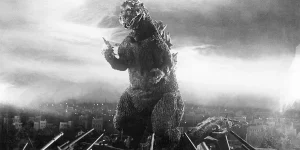
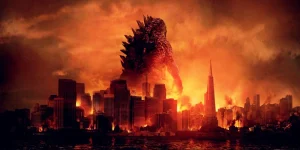
The scene is one of the most chilling sequences in franchise history. The city burns. The creature stands unmoved, emitting nuclear heat.
This Godzilla is not evil. It is simply a walking nuclear disaster.
International Pressure
The United States and United Nations intervene, proposing a thermonuclear strike on Tokyo to eliminate the monster. Japan is given limited time to stop Godzilla on its own.
Failure will mean sacrificing the capital city.
With the clock ticking, Yaguchi’s team devises a radical plan: coagulate Godzilla’s blood using a chemical coolant, freezing it from the inside.

Movie Ending
The final act focuses on the execution of the “Yashiori Strategy.”
Using unmanned drones, trains, and automated systems, the team lures Godzilla into central Tokyo. Explosives knock it off balance, forcing it to collapse.
Tankers filled with coolant are pumped directly into its bloodstream.
Godzilla begins to freeze.
At the climax, just as the creature appears immobilized, its tail splits open revealing humanoid creatures forming from its body, seemingly the next stage of its evolution.
Before they can fully emerge, Godzilla completely solidifies.
Tokyo is saved seconds before the nuclear strike deadline.
The film ends on an unsettling note. Godzilla is not dead. It is merely frozen.
The humanoid forms imply that if reactivated, Godzilla may evolve beyond anything humanity can control.
The final message is clear: the disaster is paused, not ended.
Are There Post-Credits Scenes?
No. There are no post-credits or mid-credits scenes in Shin Godzilla. However, the final shot of Godzilla’s tail functions as a silent epilogue and is intentionally disturbing.
Type of Movie
Shin Godzilla is a science fiction disaster film blended with political satire and kaiju horror. It emphasizes realism, crisis management, and institutional failure rather than traditional monster action.
Cast
- Hiroki Hasegawa as Rando Yaguchi
- Yutaka Takenouchi as Hideki Akasaka
- Satomi Ishihara as Kayoko Ann Patterson
- Ren Osugi as Prime Minister Seiji Okochi
- Akira Emoto as Prime Minister Kanji Hazama
The film features an unusually large ensemble cast, mirroring real governmental structures.
Film Music and Composer
The score was composed by Shiro Sagisu, best known for Neon Genesis Evangelion.
Music highlights include:
- Rearranged Evangelion themes
- Heavy choral pieces
- Military-style orchestration
The soundtrack reinforces the sense of escalating crisis and emotional paralysis.

Filming Locations
- Tokyo metropolitan areas
- Yokohama port facilities
- Chiba industrial zones
- Toho Studios
Real government buildings and urban infrastructure were digitally recreated to increase realism. The goal was to make the disaster feel plausible, not fantastical.
Awards and Nominations
- Winner: Best Picture – Japan Academy Prize
- Winner: Best Director – Japan Academy Prize
- Winner: Best Visual Effects
- Over 80 domestic awards and nominations
It is one of the most critically acclaimed Godzilla films ever made in Japan.
Behind the Scenes Insights
- Hideaki Anno wrote the script while recovering from severe depression after Evangelion
- Over half the dialogue consists of real Japanese bureaucratic terminology
- Godzilla’s design went through dozens of anatomical studies
- The creature’s movement was partially inspired by medical deformities
- Motion capture was used but heavily altered to appear unnatural
- The film intentionally avoids emotional melodrama
Inspirations and References
- Original Godzilla (1954)
- The Fukushima nuclear disaster
- 2011 Tōhoku earthquake and tsunami
- Japanese disaster-response bureaucracy
- Neon Genesis Evangelion themes of evolution and existential fear
Godzilla here symbolizes unchecked systems, not a villain.
Alternate Endings and Deleted Scenes
- Early drafts featured Godzilla evolving into a fully humanoid species
- Another concept involved Godzilla splitting into multiple entities
- These ideas were abandoned to preserve realism
- The humanoid tail forms remain as a visual implication instead
Book Adaptations and Differences
The film is not based on a novel but inspired by the original Toho character.
Major differences from classic Godzilla films include:
- Godzilla evolves during the movie
- No traditional human antagonist
- Focus on systems rather than heroes
- No monster battles
- Godzilla behaves like a biological phenomenon
Memorable Scenes and Quotes
Key Scenes
- Godzilla’s first emergence through the canal
- The atomic breath destruction of Tokyo
- Endless government emergency meetings
- The unmanned train bombing sequence
- The final reveal of humanoid forms on Godzilla’s tail
Iconic Quotes
- “This is not a monster. This is a disaster.”
- “If we follow protocol, the country will collapse.”
- “Godzilla is evolving faster than we can think.”
Easter Eggs and Hidden Details
- Evangelion sound cues appear during military briefings
- Camera angles mirror Evangelion command center scenes
- Godzilla’s roar contains distorted human screams
- The creature’s blood resembles radioactive coolant
- The name “Yashiori” references a myth used to defeat Orochi
- Some meeting dialogue is lifted from real government transcripts
Trivia
- Godzilla has eight officially confirmed evolutionary forms
- The film contains over 300 speaking roles
- Godzilla’s eyes never blink
- Its atomic breath temperature exceeds 1 million degrees
- The creature is fully CG with no practical suit used
Why Watch?
You should watch Shin Godzilla if you want:
- A serious, intelligent monster film
- Political realism rarely seen in sci-fi
- A return to Godzilla’s nuclear horror roots
- One of the most unique reboots ever made
- A film that treats catastrophe as process, not spectacle
This is not popcorn entertainment.
It is a cold, unsettling reflection of modern vulnerability.
Director’s Other Works
Hideaki Anno
- Love & Pop (1998)
- Ritual (2000)
- Evangelion: 1.0 You Are (Not) Alone (2007)
- Evangelion: 2.0 You Can (Not) Advance (2009)
- Evangelion: 3.0 You Can (Not) Redo (2012)
- Evangelion: 3.0+1.0 Thrice Upon a Time (2021)
Shinji Higuchi
- Attack on Titan (2015)
- Attack on Titan: End of the World (2015)
- Shin Ultraman (2022)
Recommended Films for Fans
- Godzilla (1954)
- Godzilla Minus One (2023)
- Shin Ultraman (2022)
- Shin Kamen Rider (2023)
- Cloverfield (2008)
- The Host (2006)
- Arrival (2016)
- Contagion (2011)