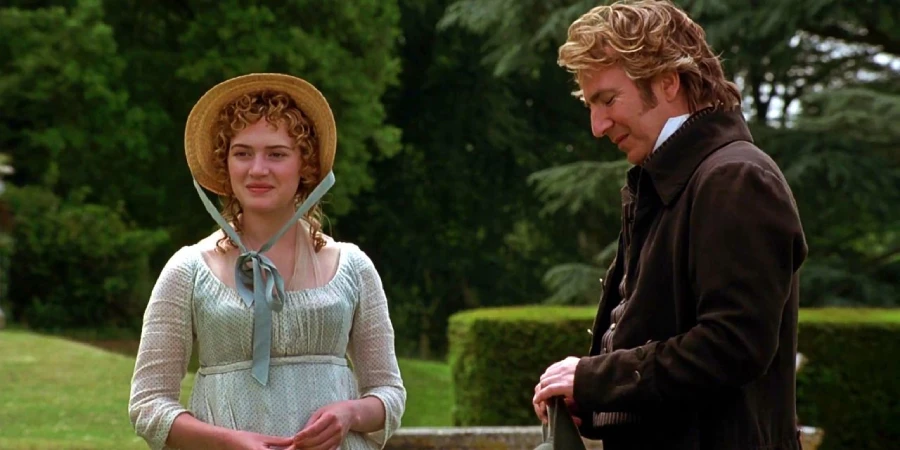

Ang Lee’s Sense and Sensibility (1995) is a refined, emotionally rich adaptation of Jane Austen’s classic novel. Written for the screen by Emma Thompson, who also stars in the film, it balances restrained English decorum with deeply felt romantic longing. Think drawing rooms, meaningful glances, and emotional devastation politely hidden behind tea cups.
Detailed Summary
The Dashwood Family’s Sudden Fall
After the death of Mr. Dashwood, his estate passes to his son from a previous marriage. As a result, Elinor, Marianne, Margaret, and their mother are forced into financial insecurity, moving from their comfortable home to the more modest Barton Cottage. This shift sets up the central conflict: love versus practicality in a society where marriage determines a woman’s future.
Elinor Dashwood and Quiet Restraint
Elinor Dashwood embodies sense: emotional self-control, rationality, and social awareness. She forms a strong attachment to Edward Ferrars, a gentle but awkward man. However, Edward’s family disapproves of Elinor’s lack of wealth, and unsettling rumors begin to circulate about Edward’s past commitments.
Elinor suffers silently, carrying emotional burdens without complaint, becoming the emotional backbone of the family.
Marianne Dashwood and Romantic Idealism
Marianne represents sensibility: passion, spontaneity, and emotional honesty. She falls intensely for John Willoughby, whose charm and shared romantic ideals sweep her off her feet. Their public closeness scandalizes society, but Marianne doesn’t care. Love, to her, should be dramatic and all-consuming.
When Willoughby suddenly abandons her and later appears engaged to another woman, Marianne is emotionally shattered.
Colonel Brandon and the Power of Constancy
Colonel Brandon, older, reserved, and deeply honorable, quietly loves Marianne. Though initially overlooked by her due to his lack of flamboyance, Brandon consistently proves his integrity through loyalty, kindness, and self-sacrifice, especially during Marianne’s illness.
Illness, Reflection, and Growth
Marianne’s emotional devastation leads to a dangerous illness. This near-death experience forces her to reevaluate her worldview. She begins to see the value of restraint, emotional maturity, and the kind of love built on respect rather than passion alone.


Movie Ending
Edward Ferrars, having been secretly engaged years earlier to Lucy Steele, honors his commitment even after being disowned by his family. However, Lucy reveals her own opportunism by breaking off the engagement once Edward loses his inheritance and quickly marrying his brother instead.
This twist frees Edward to finally confess his love to Elinor. In one of the film’s most emotionally powerful moments, Elinor breaks down in tears, releasing emotions she has suppressed throughout the entire film. Edward proposes, and their marriage represents a union of mutual respect, affection, and emotional equality.
Meanwhile, Marianne fully recovers from her illness and reflects on her past behavior. She comes to recognize Colonel Brandon’s quiet devotion, understanding that real love does not need grand gestures to be profound. Over time, she grows to love him deeply, and they marry, forming a partnership based on stability, admiration, and emotional growth.
The film ends with both sisters happily married, having matured without losing their core identities. Sense and sensibility are no longer opposites, but complementary virtues.
Are There Post-Credits Scenes?
No. Sense and Sensibility does not include post-credits or mid-credits scenes. The story concludes fully within the film’s final moments.
Type of Movie
Sense and Sensibility is a period romantic drama that blends literary adaptation with character-driven storytelling, focusing on emotional development, social constraints, and romantic fulfillment.
Cast
- Emma Thompson as Elinor Dashwood
- Kate Winslet as Marianne Dashwood
- Hugh Grant as Edward Ferrars
- Alan Rickman as Colonel Brandon
- Imelda Staunton as Charlotte Palmer
- Gemma Jones as Mrs. Dashwood
Film Music and Composer
The score was composed by Patrick Doyle, whose elegant and emotionally restrained music perfectly mirrors the film’s themes. The soundtrack subtly underscores longing, heartbreak, and quiet joy without overpowering the performances.



Filming Locations
The film was shot primarily in England, using authentic countryside estates and historic homes.
- Saltram House (Devon) served as Norland Park, emphasizing lost wealth and inherited privilege.
- Barton Cottage locations reflect the Dashwoods’ reduced circumstances.
These locations reinforce the film’s social themes: where you live reflects who you are allowed to be in Austen’s world.
Awards and Nominations
- Academy Awards (1996)
- Won: Best Adapted Screenplay (Emma Thompson)
- Nominated: Best Picture, Best Actress, Best Supporting Actress, Best Costume Design, Best Original Score
- Golden Globes
- Won: Best Motion Picture – Drama
- Won: Best Actress – Drama (Emma Thompson)
Behind the Scenes Insights
- Emma Thompson wrote the screenplay over several years while also preparing to act in the lead role.
- Director Ang Lee, a Taiwanese filmmaker, was initially considered an unconventional choice for a Jane Austen adaptation.
- Hugh Grant was cast against type; his awkward charm became a defining feature of Edward Ferrars.
- Alan Rickman’s Colonel Brandon was made more romantically appealing than in the novel to suit modern audiences.
Inspirations and References
- Based on Jane Austen’s 1811 novel Sense and Sensibility.
- Influenced by classic British period dramas and Merchant Ivory productions.
- Ang Lee approached the story as a universal emotional drama rather than a purely English literary piece.
Alternate Endings and Deleted Scenes
- Some extended family interactions were cut to improve pacing.
- Early drafts included more explicit social satire, later toned down for emotional clarity.
- No known alternate ending was filmed; the final version closely follows Austen’s resolution.
Book Adaptations and Differences
- The film softens some of the novel’s sharper social satire.
- Colonel Brandon is portrayed as more overtly romantic.
- Elinor’s emotional restraint is heightened, making her breakdown more impactful.
- The movie emphasizes emotional intimacy more than societal critique.


Memorable Scenes and Quotes
Key Scenes
- Elinor’s silent heartbreak upon learning of Edward’s engagement
- Marianne collapsing in the rain after Willoughby’s rejection
- Marianne’s near-fatal illness and emotional reckoning
- Edward’s unexpected proposal and Elinor’s emotional release
Iconic Quotes
- “I will be calm. I will be mistress of myself.” – Elinor Dashwood
- “My feelings shall be entirely hidden.” – Elinor Dashwood
- “I cannot determine what to do about my feelings.” – Marianne Dashwood
Easter Eggs and Hidden Details
- Emma Thompson subtly mirrors Elinor’s emotional state through posture rather than dialogue.
- Marianne’s wardrobe colors become progressively muted after Willoughby’s betrayal.
- Rain frequently accompanies moments of emotional overflow.
- Edward’s hesitations are visually emphasized through framing and silence rather than dialogue.
Trivia
- Emma Thompson became the only person to win an Oscar for acting and screenwriting for the same film.
- Kate Winslet was only 19 years old during filming.
- Ang Lee spoke limited English at the time and relied heavily on emotional interpretation.
- The film revived global interest in Jane Austen adaptations.
Why Watch?
Because Sense and Sensibility proves that emotional intelligence is as cinematic as passion. It’s a masterclass in subtle acting, intelligent writing, and romantic storytelling that respects both the heart and the mind.
Director’s Other Works (Movies)
- The Wedding Banquet (1993)
- Eat Drink Man Woman (1994)
- Crouching Tiger, Hidden Dragon (2000)
- Brokeback Mountain (2005)
- Life of Pi (2012)